All the charts and data we refer to can be found on the Yacht Club page.
Hey everyone,
We left off last weekend with something of an incomplete thought. We had insisted that it was "a good time to own some deep OTM puts." We thought that there was a broad range of "known unknowns" that could arise. VIX at 14 was "too low."
This was all we talked about, but it was still nothing more than a vague notion. We weren't able to justify it, and we didn't try very hard, because we don't know where to begin when it comes to ascribing probabilities to unknowns and unknowables.
What we will try to do today instead is to provide some very non-mathy justification for our hand-wavey concerns. And perhaps we can begin with where we left off
last time:
We think of a Trump victory, and the attendant circumstances, as something similar to [dealer disintermediation in the market]. A "disintermediation." And now we feel like there will be some "gaps," and "vol-of-vol" occurring in the world. Because there's an opening for it, and whenever there's an opening for it, crazy stuff has to happen, as if by some natural law.
Crazy stuff. Let's try to expand on that. But first...
- crazy stuff (look-at-that-chart)
- crazy stuff (jim-bear)
- crazy stuff (disinter-media-tion)
crazy stuff (look at that chart)
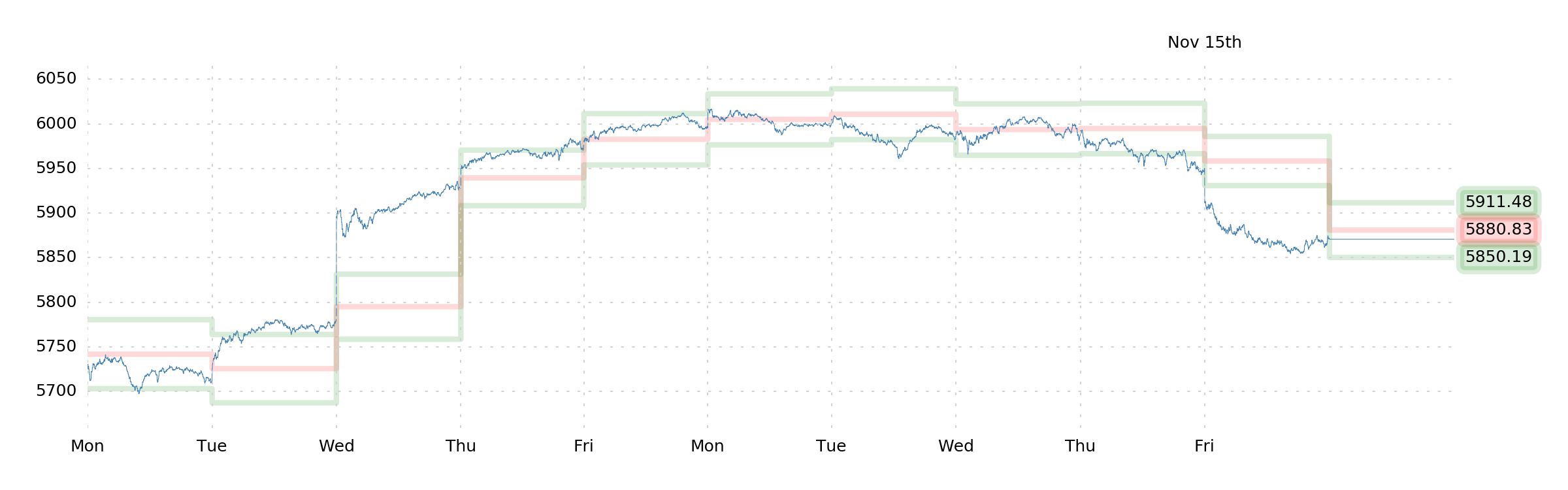
The week was remarkably consistent. Every day we said the same thing: It looks bullish on a 1-week timeframe, but today's 0DTE positioning looks pretty lousy. Maybe tomorrow?
Added up, again and again, that resulted in decidedly bearish action. Down 2.00% by Friday.
Day-to-day, the index was barely able to spend time above the Mid band. That's some tremendously weak price-action. If it weren't for the 0DTE positioning data, we'd have never expected this weakness, but every morning, the data told us there'd be selling on the way up. (Largely a function of near-term sold puts, from customers expecting stability. Irony always wins.)
Since this is a fascinating juncture with a fascinating chart, we're very much looking forward to the coming week. On
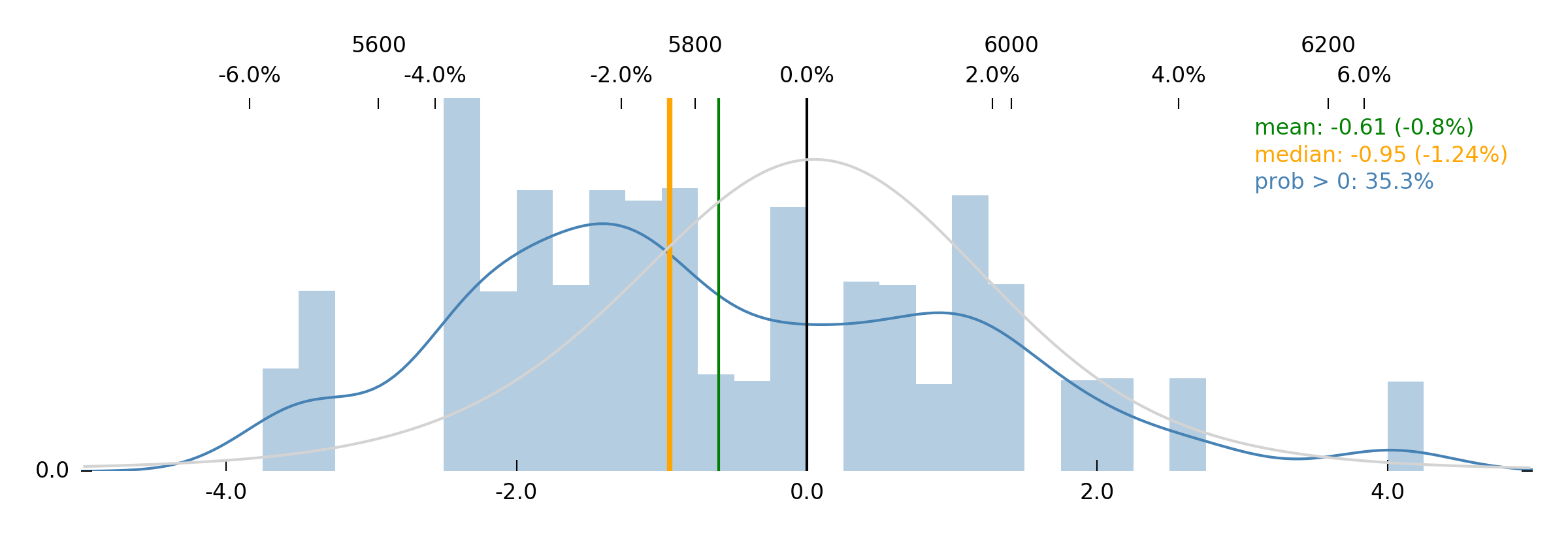
Friday morning, we thought that poor price-action on Friday would probably carry through to the following week (based on Robot Jim's step-forward plot), so we're currently feeling a bit bearish (and reasonably happy to be holding those OTM puts that we've been yapping about).
So what's in store for the coming week? Are we right to lean bear-y?
crazy stuff (jim-bear)
Wow.
This is an unusual stance from Robot Jim. A median of –0.95 MAD (–1.24%) is insane. A probability of upside of just 35.3% is crazy. Jim is bearish.
Like, sure, we thought he'd be bearish, but this is a rare treat.
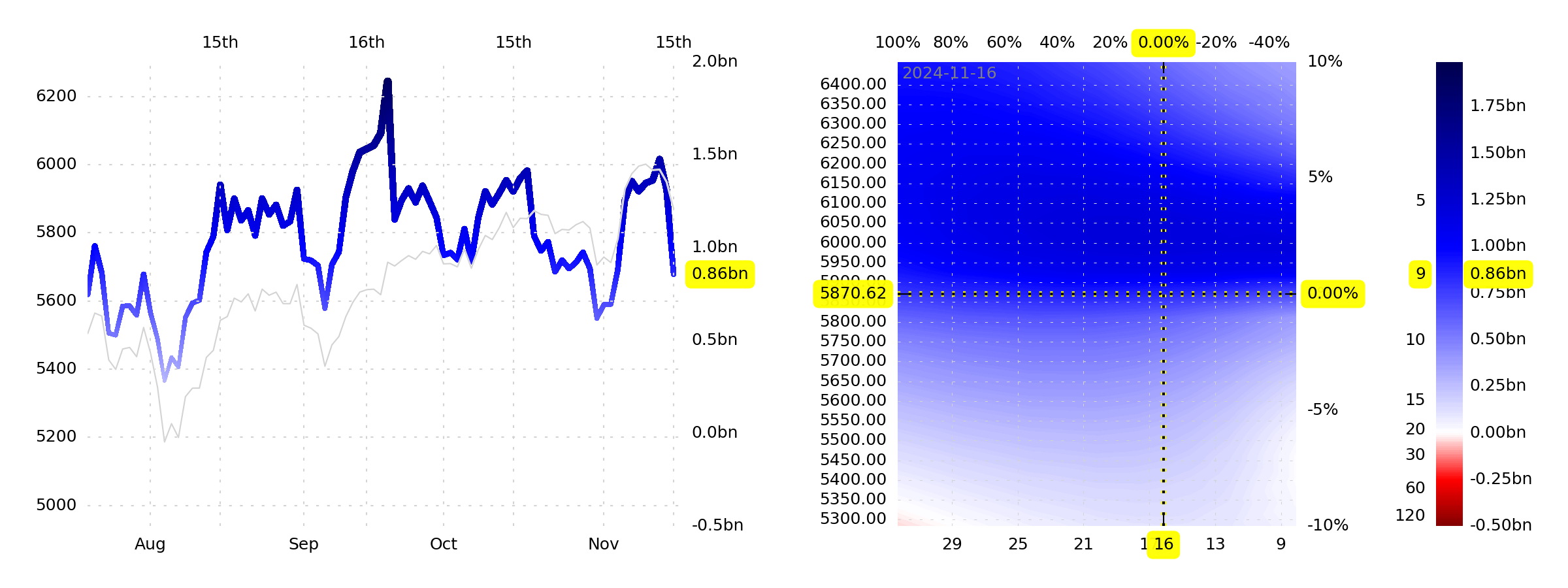
GEX+ fell considerably on Friday. Bigger moves can easily continue to occur now.
There's no need to belabor the point. It's a bearish outlook. We have no reason to disagree.
Now let's talk more about those OTM puts we bought, and why.
crazy stuff (disinter-media-tion)
Isn't it obvious that when the most orderly market participant becomes less active, that's when the market becomes more disorderly?
This is the concept of dealer disintermediation in a nutshell. It's like a teacher stepping out of a classroom, a traffic light malfunctioning at a busy intersection, or a spacecraft losing its gyroscope. You don't have to believe that the dealer is "good" or well-intentioned, or even that the NBBO is an accurate representation of the truth about the security. That doesn't matter. It is simply by quoting a price and providing that anchor that the dealer provides immense value. The market is truly "made" thereby.
When this anchor comes loose for any reason, that's when the market moves in strange ways, subject to all sorts of customer whims and emotions. The children are soon standing on the desks; the cars are colliding; the spaceship is veering off course. Maybe it was a lousy teacher; a badly timed traffic light; or an unreliable, heat-damaged gyroscope—but everything is still much more chaotic now that it's gone. We shout and crash and tumble. "Crazy stuff."
Being that this is what we've found to be true in the market—and that we find ready metaphors elsewhere—perhaps you will be receptive to a more plebeian example: The media.
The media is a lot like a market-maker. It is a medium (it's literally the plural of medium). It is an anchor. It is meant to represent some truth to its clientele, and it thereby provides an immensely valuable service. You can, cynically, argue that the media is stupid, or crass, or that it's corporate and evil, or that it merely "manufactures consent"—but you must admit that it nevertheless provides some baseline, however inaccurate, for public awareness and discourse. It quotes an NBBO for the market of "things that happened." And thus, we can imagine that a "disintermediation of the media" would make things a bit more chaotic, unhinged.
Here's the point: We are proposing that (weirdly) the 2024 election of the television star and former host of The Apprentice is perhaps best understood as a "media disintermediation." The Donald said the fact-checkers were wrong. The Donald said they're trying to trick you. The Donald set up his own media company and called it TRUTH. The Donald called all the stuff you see in the media "fake news." The Donald, ultimately, induced some kind of autophagy—activated some kind of kill-switch—whereby the media got into a yelling match with a foghorn. Played chess with a pigeon. Wrestled a pig. Tilted at windmills. And so on. (And lost, of course.)
And what we're left with, now, is a sort of "common knowledge" that people distrust the media, and that the media has delegitimized itself to such an extent that people get their news from the weirdest and most disparate places, and can't even agree on "things that happened," because the bid-ask on the market for "things that happened" is so wide you could drive a global pandemic and a few wars through it.
It's an awful lot like when customers are taking opposite positions to one another. When the dealer is no longer involved. And the result of that anchor coming loose is that we're adrift in a sea of disparate opinions. Buyers meet sellers one-on-one, without an intermediary. They yell, but they can't possibly understand each other. The market gets gappy, illiquid. There's "vol-of-vol," whereby even volatility itself is unpredictable. A meta-confusion reigns.
It's at this point where you could sensibly argue that this isn't our first rodeo. Trump already directed and produced a season of this insanity, so what's different about this time? And one response to that could to be that people consciously voted for a second season, affirming that the media (and those interests that it seems to represent) was the enemy, and now there's a consensus around this. That's worth something, certainly. But we're more interested in something else: AI.
Up until now, the whole Artificial Intelligence thing has left people split on whether this is revolutionary or not. Some people think the AI chatbots are gimmicks; some people think they're a glimpse of the future. Like other exciting new technologies, we think it'll probably end up being "the future—but not in the way you were thinking," but in the meantime, what AI is definitely good at doing is creating very convincing false content. Fake images that look real. Fake letters that seem official. Fake narratives that seem believable. "Fake news."
Of course "fake news" isn't new. Some journalists (like Hunter S. Thompson) would tell you that fake news is actually
better news, since strict adherence to "the facts" really doesn't get to the heart of the matter anyway, and narrative embellishment is important to convey the story. A million philosophers would agree, especially those post-war post-structuralists and critical theorists who would challenge just about any objective metaphysics that could be used as a basis for objective truth (we've talked about these folks
before). They'd tell you that "news" is all about crafting narratives to benefit those in power. And then, a bit more cleverly, there are the likes of
Baudrillard, who posited that the symbols that the media uses to tell stories are just as real, if not
more real, than the reality on the ground—which, more often than not, is inextricably tied up with the media representation of it.
We won't argue with any of this. All we want to do is point out that the YouTubers and podcasters that folks seem to get their news from were already very keen to delegitimize the rump of traditional news media for their own benefit—but now a Trump victory has consecrated and enshrined the idea that the media is not trusted anymore. And now, in pursuit of straying eyeballs, desperate for narratives to anchor their disintermediated knowledge of "things that happened," AI is the ultimate tool. Content must be generated, and AI can do that. Compelling images must be created and shared, and AI can do that. Truth is all subjective anyway.
Do the children have to misbehave when the teacher leaves the room? No—but they almost always do. Do the cars have to crash into each other when the traffic light is out? No—but they almost always do. Does the spacecraft have to spiral out of control when the gyro is out? No—but it almost always does. Does the market have to go haywire when the dealer isn't taking the other side of the bulk of flows and managing a large inventory? No—but it almost always does. And that's why we said that we expect "crazy stuff" to happen when there's a media disintermediation, "as if by some natural law." Because it really does seem like it's a necessity, however crazy that sounds.
Long deep OTM puts. They're cheap.
Enjoy the week!
The SqueezeMetrics Team