All the charts and data we refer to can be found on the Yacht Club page.
Hey everyone,
We left off with these conclusions from last weekend's research:
Whenever the dealer can say, "I don't have to delta-hedge," that's bearish. It could be because customers are taking both sides of the trade, or it could be because dealers are able to use correlations to neglect hedging, but the result is the same.
So, two ratios seem to matter a lot:
- net-to-gross option delta ("are dealers actively holding risk, or is it just customers?")
- gross-option-delta-to-stock-volume ("is delta-hedging occurring?")
Right now, we'd like to refresh the stats for more validation, and then try to think through what it all means for the broader market.
But first...
- Being long gamma
- Being long volga
- Being right occasionally
Being long gamma
We spent two weeks hedging a long call, scalping gammas.
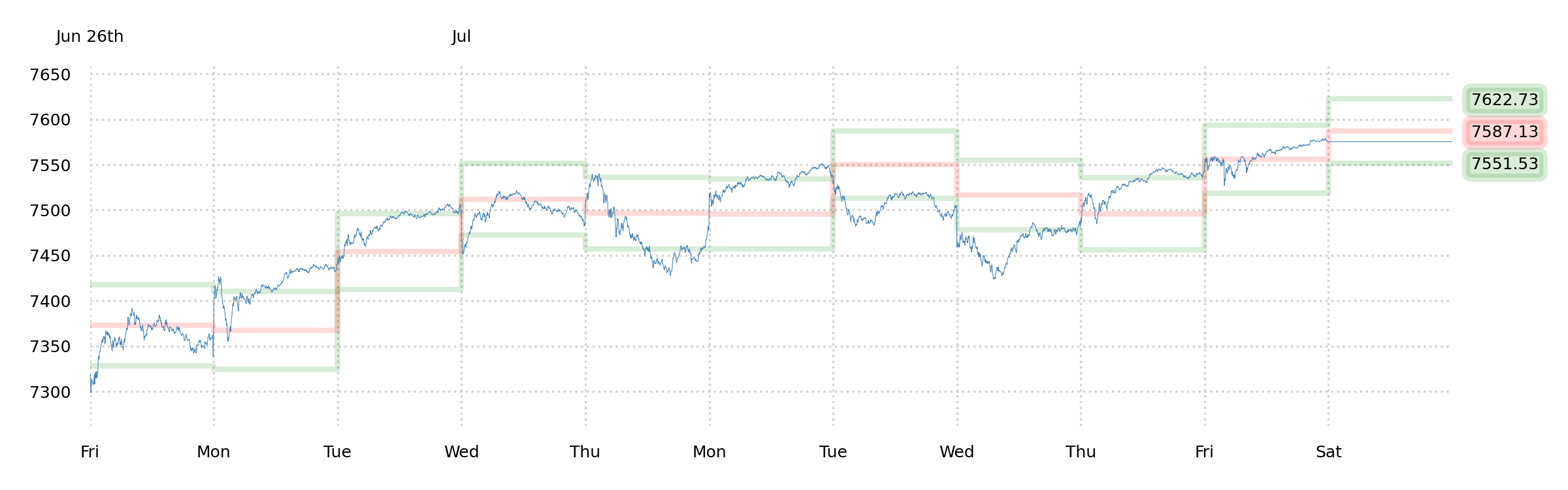
The only day in that period where SPX didn't move outside of the daily SuMo bands was this past Friday (when the call had a 1 delta anyway). This is suggestive of the fact that we were able to scalp our way into a green PnL—but it was actually better than that: The 0DTE dealer hedging maps were extremely helpful at finding the right levels for flattening deltas intraday, and it all worked out phenomenally well.
The thesis for being long gamma was that there was a "disagreement" between the poor sentiment of DIX and the more eager suggestions of RISC and volatility, more broadly. A recipe for chop. Meanwhile, Robo-Jim saw the opportunity for some wiggles, though nothing particularly dramatic. The long-gamma approach seemed appropriate with vols suitably low, and we're pleased with the outcome.
But the forecast definitely looks a bit more dramatic again.
Being long volga
We already noted this on
Friday morning, and our thoughts haven't changed a bit since then:
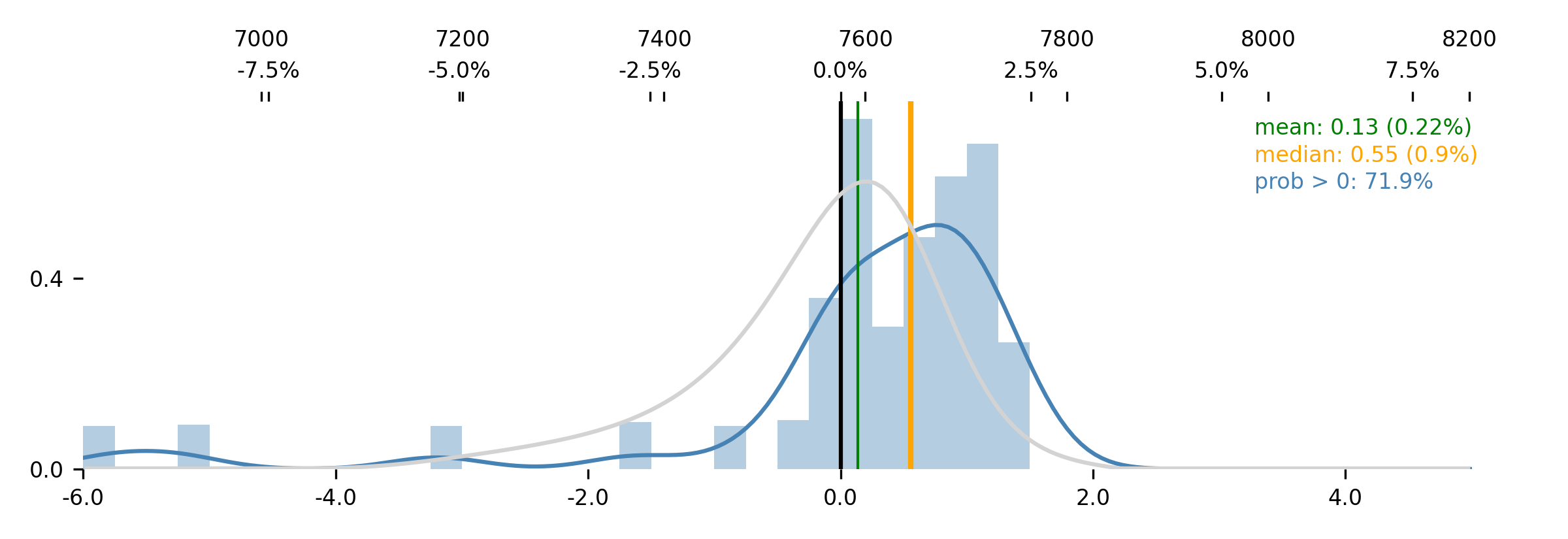
Fat left tail.
And since we're always suckers for a fat left tail, we're inclined to get back into some volga. E.g., a 7000-strike put for next month. With VIX at a 15 handle and extant macro risks and bubbly trading, this isn't a big ask—owning vol feels fairly easy. Jim gives us permission to do so.
Well, the forecast for this weekend looks a lot like it did on Friday morning.
And our conclusion is the same: We cannot possibly not own an OTM put when there's a couple percent chance of some seriously crashy action. We're already filled in the 7000-strike across a couple tenors (centered on 1-month). Tangentially, part of the idea of buying at a very round-number strike is that if things do fall apart, you're much more likely to find a real, two-sided market at the round numbers. Even when the quoting machines are turned off, some folks will be trading that strike by hand. Slow, small-batch, artisanal trading.
So, just a consideration. For future conditional liquidity.
Meanwhile, let's keep watching the 0DTE maps this week, as they've been very instructive.
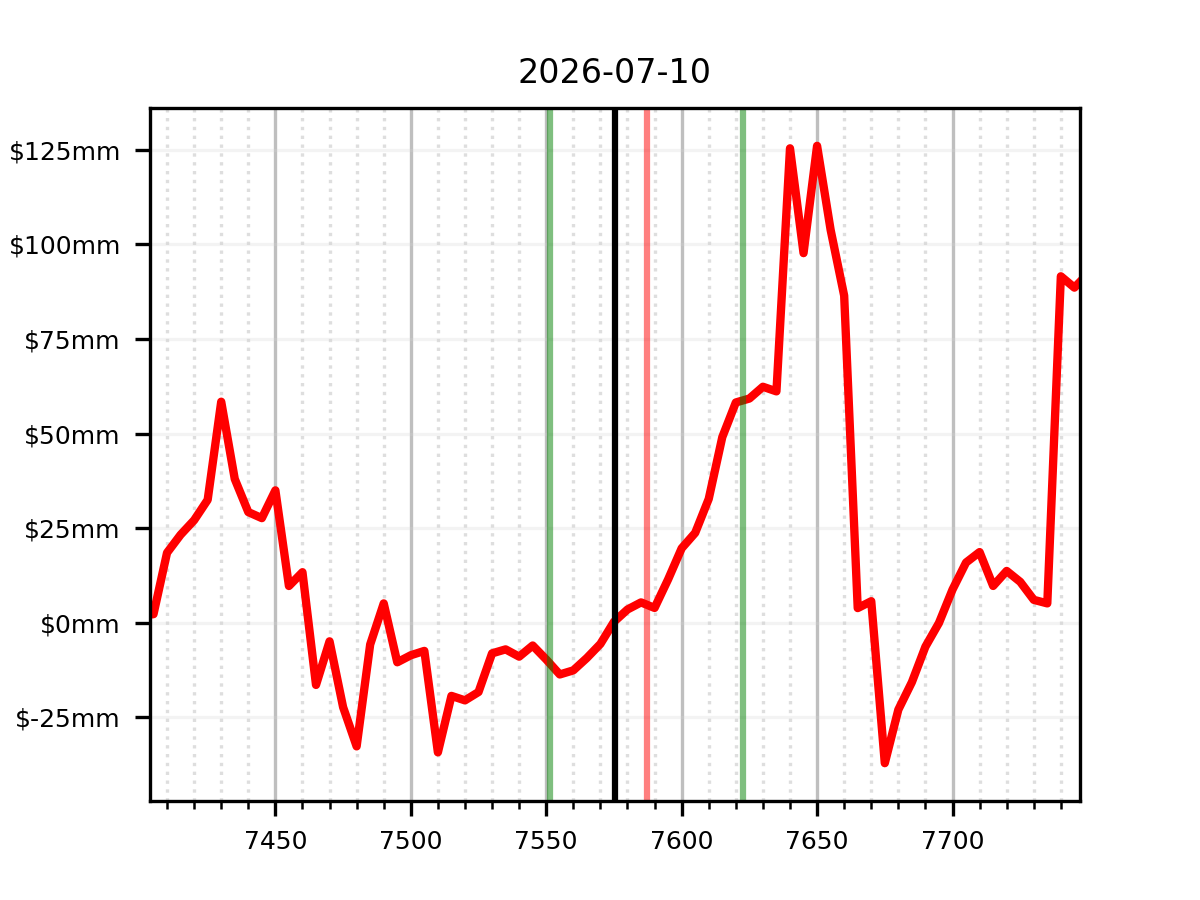
Monday, for instance, has a pretty broad swath of dealer short gamma from below spot all the way up to 7640. How that impacts intraday wiggles is going to depend on where we open, but the idea would be to ride it up and ride it down, if possible.
That said—by golly it's hard to want to even buy an E-mini for a scalp right now. Really feels like this market needs to roll over.
But let's just be happy with our puts. It'll be an interesting week.
Being right occasionally
Quick recap: We felt like dealers, market-wide, were using the correlations between the S&P 500 index (SPX) and component stock options to neglect hedging some SPX options. E.g., if an option dealer is long an SPX call (likely!), they can use a smattering of TSLA, MSFT, and NVDA calls, which they are short, to lay off some of that risk. We called this "delta-fudging." The more customers are interested in buying calls in these pendulous mega-caps, the more fudging occurs.
We
found three bits of evidence suggesting that this is, in fact, happening.
- GEX+ losing some ability to predict SPX vol
- SPY-QQQ correlations becoming gradually more stable
- correlation stabilization happening only in high-GEX+ markets
And then we started collecting all of this data on who's buying what in every single optionable NMS stock and ETF. A month of data now.
So far, our analysis has considered call and put imbalances, net delta flows, net-to-gross delta flows, and the ratio of gross option flows to stock volume; and how each of these can impact next-day returns across the whole 5,000+ ticker universe.
If call and put imbalances and net delta flows are the "customer" side of things, telling us about who wants to buy what delta and gamma; then the net-to-gross and gross-to-stock ratios are the "dealer" side of things, telling us about whether delta-hedging needs to occur, and whether it appears to be occurring at all.
The "dealer" side of things is overwhelmingly more useful data, by the numbers, and the message is clear, as we stated above: Whenever the dealer can say, "I don't have to delta-hedge," that's bearish.
This is classic "disintermediation." If you go to the Yacht Club page, scroll to the bottom, click on the drop-down in the Weekly Notes section, and select "disintermediation," you'll see all the times this concept showed up (it's a lot). Dealer-intermediaries are the only reason markets "work" like we expect them to. Disintermediation is necessarily destabilizing.
We now have 22 days of data. That's not a lot of data, but maybe it's enough that we can start asking a slightly bigger question, and one that we've been wondering about ever since we started digging into delta-fudging:
What happens when this whole universe of tickers is "one-sided" with a high net-to-gross flow? Will that be bullish for the broader market (SPX)? Because in theory, a higher net ($) across the whole dataset means that more money is being managed by dealers, and that should be stabilizing, and thereby bullish.
This would be the "simple" interpretation.
The alternative interpretation is that a whole bunch of dealer-induced delta-hedging "stability" in single-names doesn't translate into index-level stable-bullishness at all because of index-level delta-fudging. I.e., one-directional trading might be good for any given ticker because it suggests that dealers will be "managing" that ticker, but one-directional trading across the whole basket might just be an opportunity to write the flows off against SPX flows themselves (including 0DTE and 1DTE stuff). In other words, stabilizing delta-hedging and dealer management in single-names actually takes stabilizing delta-hedging and dealer management away from the index.
And if that were the case, we'd expect aggregate one-sidedness in stock and ETF option trading to be paradoxically bearish. This would be the "complex" explanation.
The reason we're kinda rooting for the "complex" explanation is that we think this matches the footprint of delta-fudging exactly—and since we've already seen a good amount of evidence for it, we think we're going to see it here, too.
Run it!
Yes! Complex.
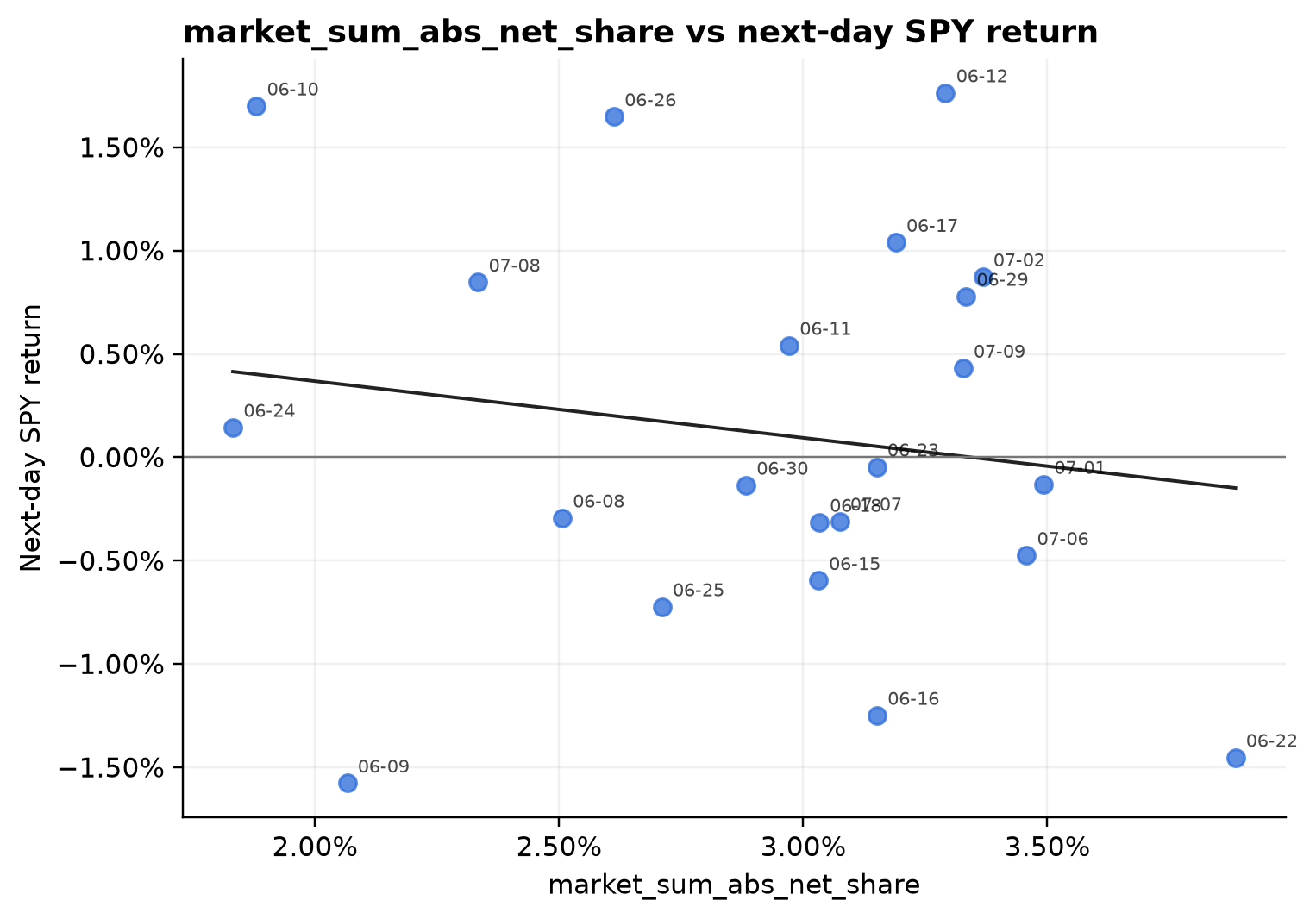
More absolute netted out one-directional flows, across every stock and ETF with options, has tended toward worse next-day S&P returns in the last 22 trading days.
Whenever the dealer can say, "I don't have to delta-hedge," that's bearish.
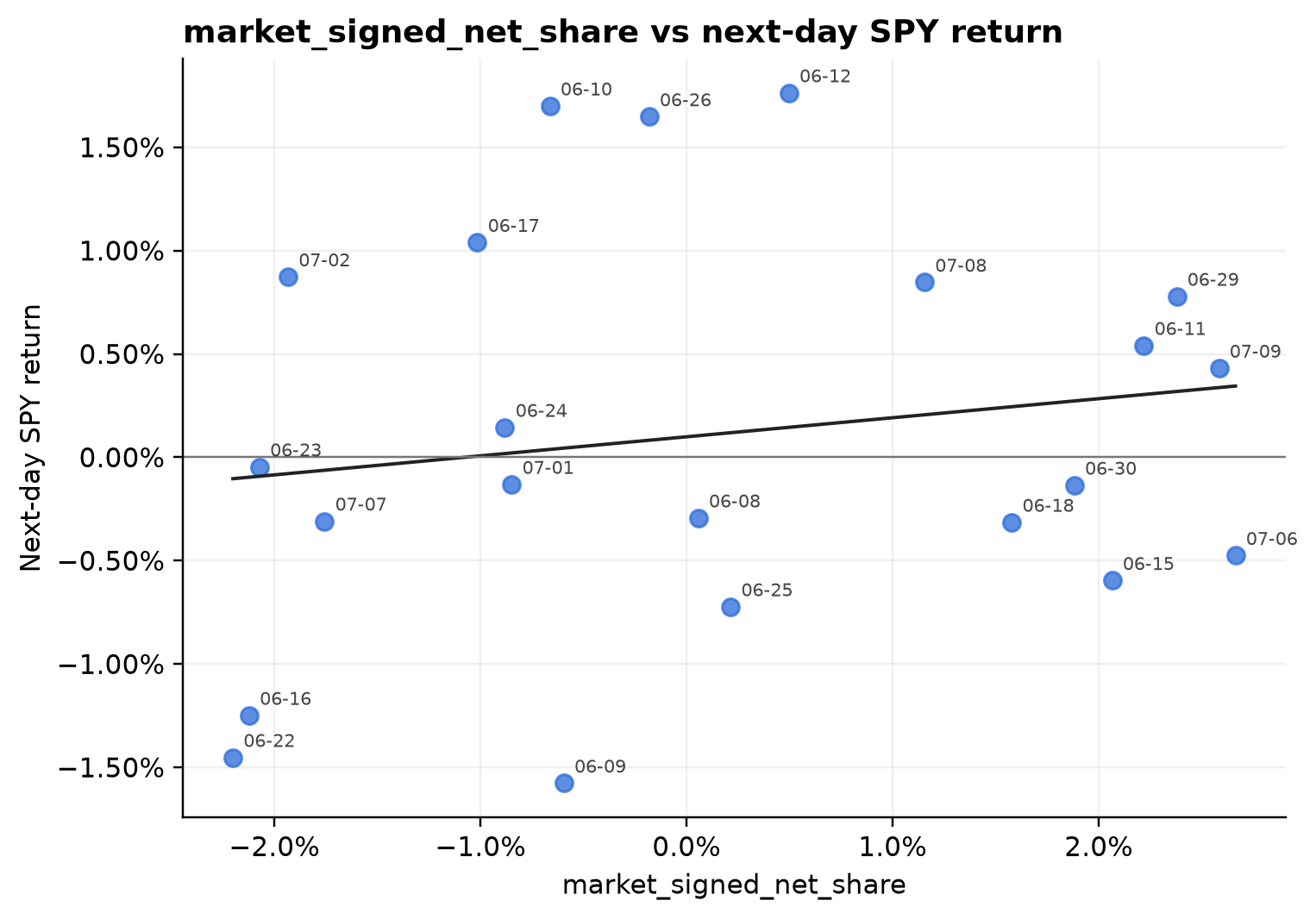
Now maybe this is a bridge too far... but we can't help ourselves: We know that the absolute (non-signed, ignorant of delta) net flows are meaningful, to some extent, and that whether those flows are positive or negative actually doesn't carry too much signal in individual tickers. But maybe, just maybe, there will be signal in there for the broader market. So what we'd like to do now is incorporate the direction of those net deltas (+/-) and scatterplot that out, too.
Thesis: In the same exact way that +delta tends to predict [some] poor next-day returns at the stock level, and -delta tends to predict [some] better returns, we expect that the index will reverse this tendency, for the exact same reason (delta-fudging) that it got reversed in the scatterplot above. So, e.g., more positive deltas, more net buying via options, across the whole universe of stocks, should be bullish for SPX next-day.
So let's just un-abs() that variable on the x axis and see what happens...
Yes! The same "paradoxical" effect. Customers net buying deltas in single-names (long call, short put) actually gets transmuted into index buying through the agency of dealers (who refrain from hedging their SPX exposure going forward in some fraction of the dollar amount of the value of the single-name option delta), whereas the net effect of bought deltas in single-names is bearish for the ticker itself going forward.
Is this enough data (22 days) to establish definitively that this is the nature of the correlation between index and single-name options? No. No way.
But it's compelling that this data is, so far, the same "shape" as what we were expecting.
Enjoy the week!
The SqueezeMetrics Team