All the charts and data we refer to can be found on the Yacht Club page.
Hey everyone,
A few weeks ago, we bought puts on the S&P 500. That didn't make money. Most people would agree that it's hard to make money buying puts on the S&P 500. Partly, that's because the "game is rigged," and partly, that's because there are a lot of smart people playing the game, and it's hard to get an edge in the most competitive spaces.
Not impossible, of course. But definitely hard.
The wisdom of the gambler, however, is that you ought to be playing at the smallest, stupidest table that will allow you. In the market, that means finding little, lower-liquidity opportunities, and it means trying to reverse-engineer the [often irrational] fears of your fellow traders and investors so that you can either provide the liquidity that they need or predate on them (which are, really, just different sides of the same coin).
To that end, we've been having a lot of fun looking at the market through the lens of the P-scope (which we properly introduced last weekend), since by showing us what tickers are predictively associated with others, we glean a lot of information about our fellow traders and investors, and the way things work.
One whimsical example of this below. But first...
- Feeling
- Strangling
- BDC (Buy Da Calls)
Feeling
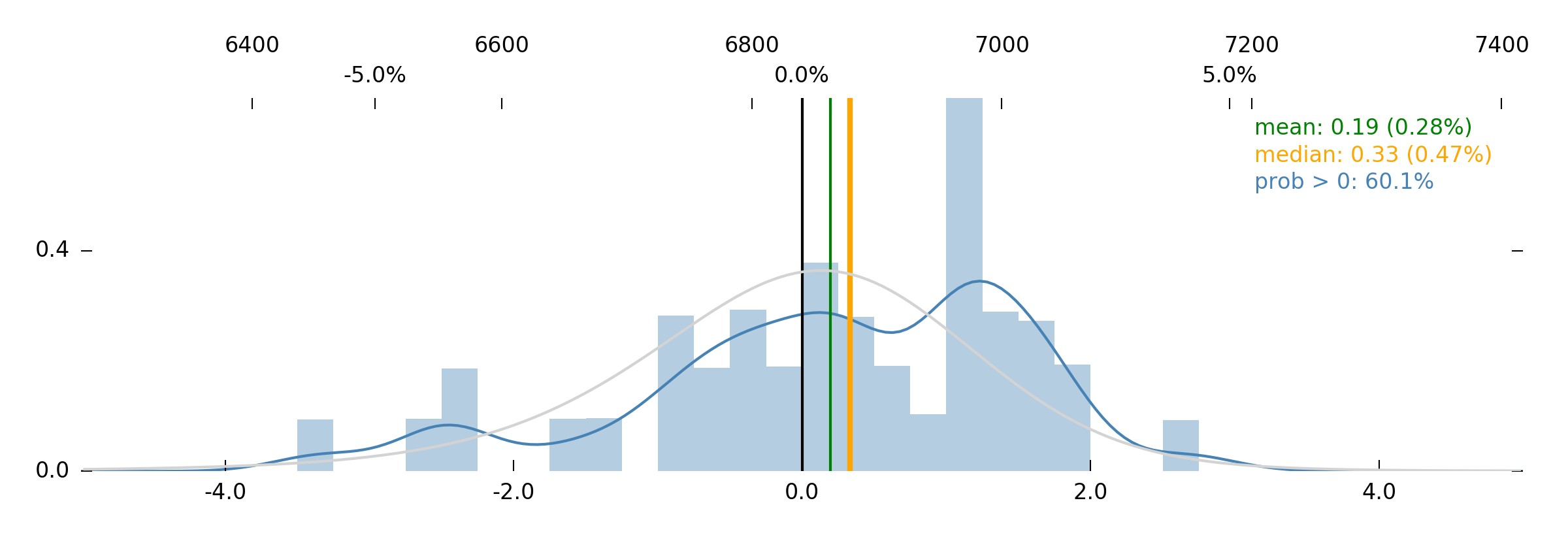
Last weekend, we cited Robot Jim's 63% chance of upside for the index, and we shrugged. Certainly, we could argue that there's an air of instability (echoing from a couple weeks prior), but there appeared to be no appropriate bearish bet to take against the market. Besides, our long-dollar, long-bond "feelings" aren't necessarily bad for stocks.
Unsurprisingly, it went up.
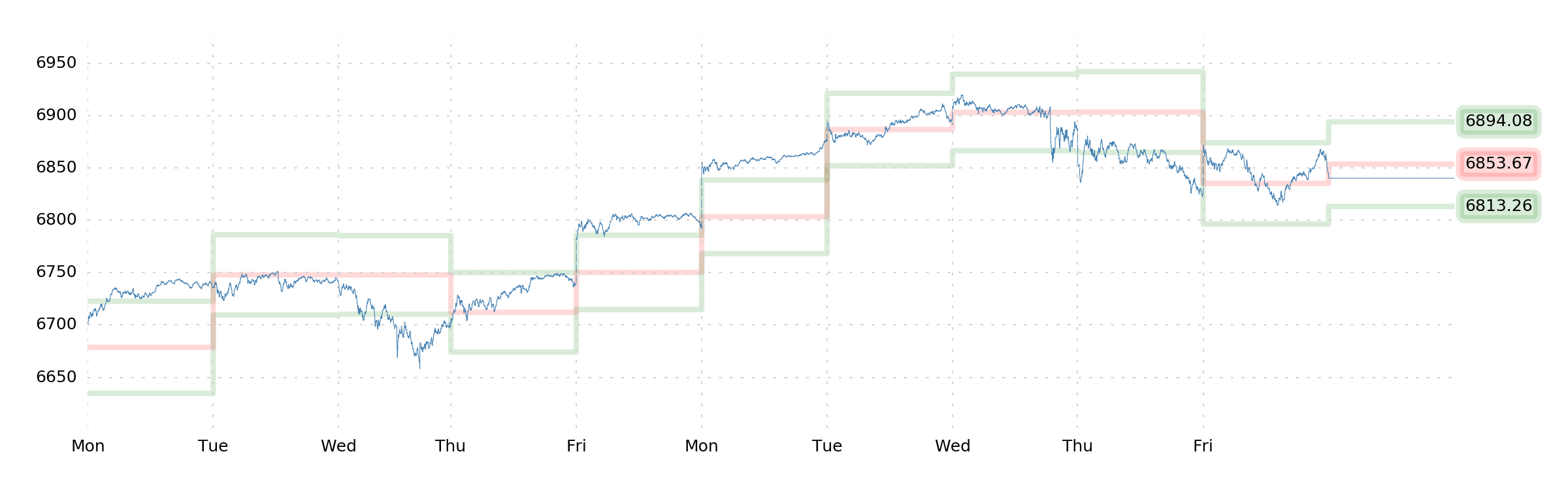
In terms our of intraday trading, Tuesday was flat (actually, recall that we lost money because we chose to buy a 0DTE put instead of just shorting E-minis at the prescribed limit—but ideally, if you were being smart, you would have been flat), Wednesday was a nice big win, Thursday had no trade, and Friday ("short at Momentum") was also a big win, since the index opened right above SPX 6875, then fell.
So, no complaints there.
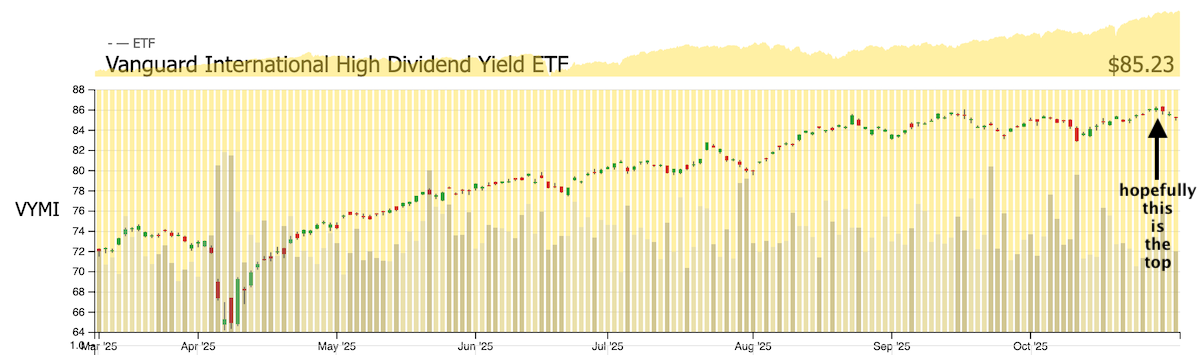
The only other bet from the week was against the "international high-dividend," with respect to which, on
Tuesday morning, we finally took the plunge:
One more thing: We finally want to try shorting FID (international high-dividend) to express our belief that dollar-strength is much more likely than implied by the market, and this could trend hard down when people come around to that idea. Cheap way to do it is probably VYMI puts. Will be poking at that this morning.
Indeed, we eased into a smattering of VYMI puts, which, despite this being the most liquid instrument for "international high dividend yields," still aren't exactly "liquid" options.
But maybe that's a good thing, re: that gambling wisdom about playing at smaller tables. You wouldn't be able to place tens of millions of dollars on a convex short VYMI bet, even if you wanted to. At least not without making yourself extremely visible on the chart.
And if we may inject a bit of extra "wisdom" into the mix—there's a tendency for investors to prefer an instrument with a "yield" to one without. Indeed, the Internal Revenue Code (which strongly encourages buy-and-hold, and punishes most profit-taking) may be the only reason that Growth (which habitually buys back shares instead of distributing profits) performs as well as it does. So when you see investors fearfully "reaching" for a measly 4.00% non-dollar yield (VYMI and other int'l dividend ETFs) as protection against dollar debasement, there's an unusually good probability that something a bit stupid is happening. Yield makes people do stupid things. Yield covers over a multitude of sins. For a while.
Let's talk more about that in a minute.
Strangling
What's in store?
Jim maintains a bullish lean, but there's a left tail reappearing. The underpriced outcomes here are a 4.00% loss and a 2.00% gain. The suggestion is that we be leaning "long volatility" in some fashion.
Some people get very fussy about the exact structure to put on for a "long volatility" bet. We used to think about this stuff a lot, too; but the fact of the matter is that it's all very similar in the long run. Long a strangle will hit less often and frustrate you much more, but structurally, it's probably the best (you always have to pay a steep psychological premium to get the best PnL).
Since we're already "long volatility" most of the time by leaning long options across a number of tickers (like VYMI), we're not too keen on adding a low-probability long-vol bet. If we didn't have that positioning already, though, we'd be happy to add a small long-gamma position of some kind.
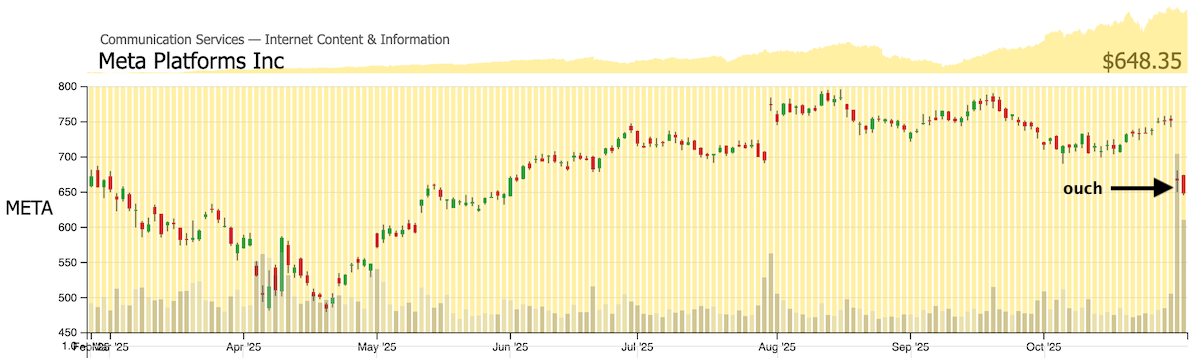
Speaking of gamma, you've been watching the impact of dealer long gamma during this earnings season, whether you've fully appreciated it or not. Megacaps, rather than moving together, jockey for position and move opposite one another. For instance, Amazon's excellent (+10%) performance on Friday came at a cost for Apple, Meta, Google, Microsoft, and Nvidia, all of which were flat to down. This is what tends to happen when index concentration is high and SPX dealer gamma is also high. You may recall 2017 being a particularly notable example of this, since volatility was so low that the effect was accentuated.
Although there's no edge inherent in this state of affairs, we'd argue that a selective mean-reversion strategy makes some sense. At the moment, then, you might be compelled to take a [quick] mean-reversion swing bet on META, which likely had a few points "unfairly" shaved off by Amazon's ascendance.
Maybe pair a META call with an AAPL put, betting that Friday's price-action in Apple reflects the realization that we're all paying too much for a low-growth stock with some recent execution trouble.
An intra-index strangle?
Too cute, maybe.
Ok, moving on.
BDC (Buy Da Calls)
A minute ago, we made fun of people who "reach for yield" by default. People who like the feeling of "income." Certainly, there's a place for income-seeking behavior (e.g., you are an octogenarian), but from a growth-optimal business perspective, distributing high dividends is a sub-optimal game, and a dangerous one when the investor expects the dividend to be regular.
So you can imagine that the Business Development Company (BDC), which fills this role, is particularly sensitive to small disturbances in the world of private credit. Particularly since the underlying assets are fundamentally illiquid, and danger can come from both the poor performance of the middle-market debtor as well as the fear of the end-user who owns the fund and suddenly wants to redeem.
In the meantime, the structure of the BDC is inherently lousy (like a REIT) since its raison d'être is to blast 90%+ of its income back into the greedy gob of the smarmy small-time investor who likes the idea of having access to "private markets," and less-than-optimal investment practices are practically encouraged thereby.
*ahem*
Seems like a good place to look for trading opportunities!
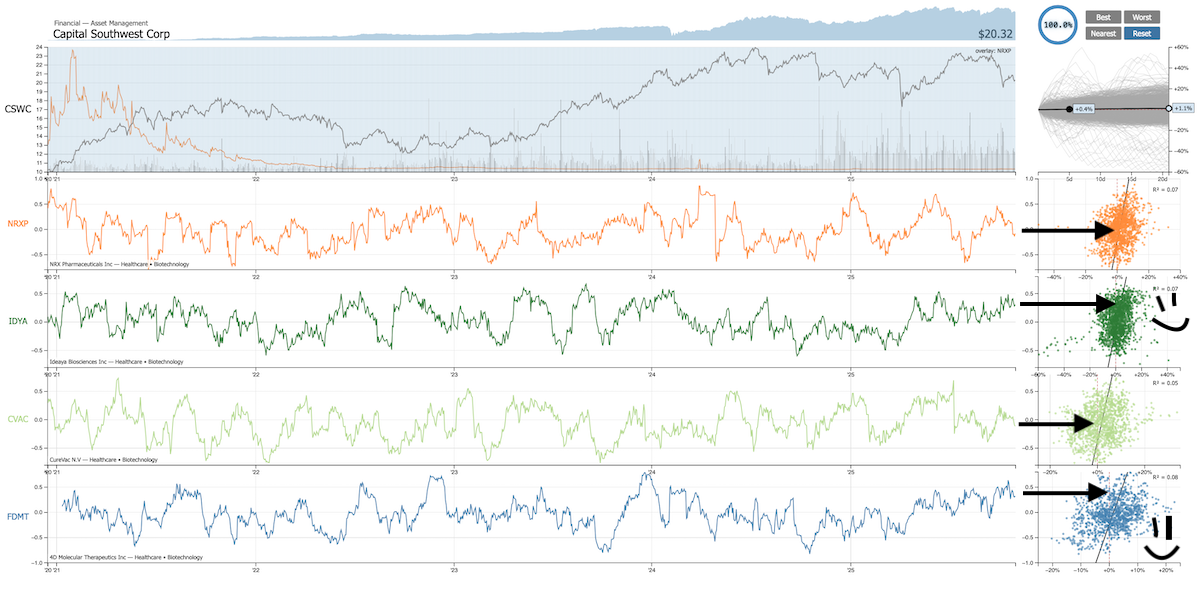
At least that's what we thought when we saw Crescent Capital (CCAP), Main Street Capital (MAIN), Capital Southwest (CSWC), and Sixth Street Specialty Lending (TSLX) all toward the top of the Ideas page—bullish opportunities. We don't really know what any of these companies do, but since we liked the idea of getting long one of them with a call option (a trade that assumes that some of the recent private market fears blow over and greedy dip-buyers show up, thirsting for more yield), we pulled up their P-scopes to see what moves them.
So, what are the predictive correlates for these companies?
- Crescent Capital BDC Inc: Three Chilean tickers and two retail stocks.
- Main Street Capital Corp: Bitcoin.
- Capital Southwest Corp: Biotech, biotech, biotech.
- Sixth Street Specialty Lending: Telcom, retail REIT, timber REIT, specialty chemicals, biotech... quite a mix.
Right off the bat, without knowing anything about these, we like Sixth Street as an investment, since it's harder to pin down, and we'd guess it's not overexposed to garbage or a particular theme or industry. Meanwhile, the other three look like they're probably leaning heavily into some particular type of "trade," whether that's Bitcoin or biotechs or... Chile.
Of course, the better-
investment BDC isn't necessarily the one that we want to take a punt on, since sometimes the best bet is that a steaming pile of garbage (or a ticker with a concentrated risk) is going to go up for some reason. So when we actually look through the correlated tickers and where they're at, we recognize that
Capital Southwest is probably the best positioned to rally here (with Sixth Street in second place). For Main Street to outperform, you'd really want Bitcoin to rally; and for Crescent to win, well, you need Chile (copper) to go down. And Chile is doing
great right now, so that's a no-go.
Weird, right?
Being long Capital Southwest (CSWC) gives you exposure to a strange, but reasonably strong, lagged correlation relationship between some biotechs and a little $1bn BDC. Does CSWC tell investors that they're particularly exposed to biotechs? No. It's certainly not in the marketing (it wouldn't look good in marketing materials), but the proof of the pudding is in the eating.
In fact, it gets even more fun (if you want it to), because if you pull up the IBB ETF (biotech sector) while you're looking at CSWC, there's no perceptible causal relationship there, even though there are a bunch of biotech tickers that seem to predict CSWC's price. So, what are the commonalities between the ones that seem to actually be associated? They're all small molecule, mRNA, or gene-therapy related, and they're all clinical-stage.
We can guess that CSWC has some substantial risks tied to this sub-market, even if nobody would want to talk about the details.
Kinda cool, right?
There's a lot going on here.
So while last weekend, we talked about fairly boring, portfolio-level associations (Verizon and its relationship with risky growth beta), this weekend we have an example of a tiny little segment of the market with novel and diverse interrelationships—and hints at really fun trade ideas (like being long a particular BDC when Bitcoin has rallied, and short another when Chile has rallied).
We think this is downright whimsical. So let's try to tell one more correlation-story next weekend before we start thinking about other things.
Enjoy the week!
The SqueezeMetrics Team