All the charts and data we refer to can be found on the Yacht Club page.
Hey everyone,
In direct contrast to the brevity and limited scope of the last two Sunday notes, there are a number of things we'd like to address this weekend, so let's ramble.
Firstly,
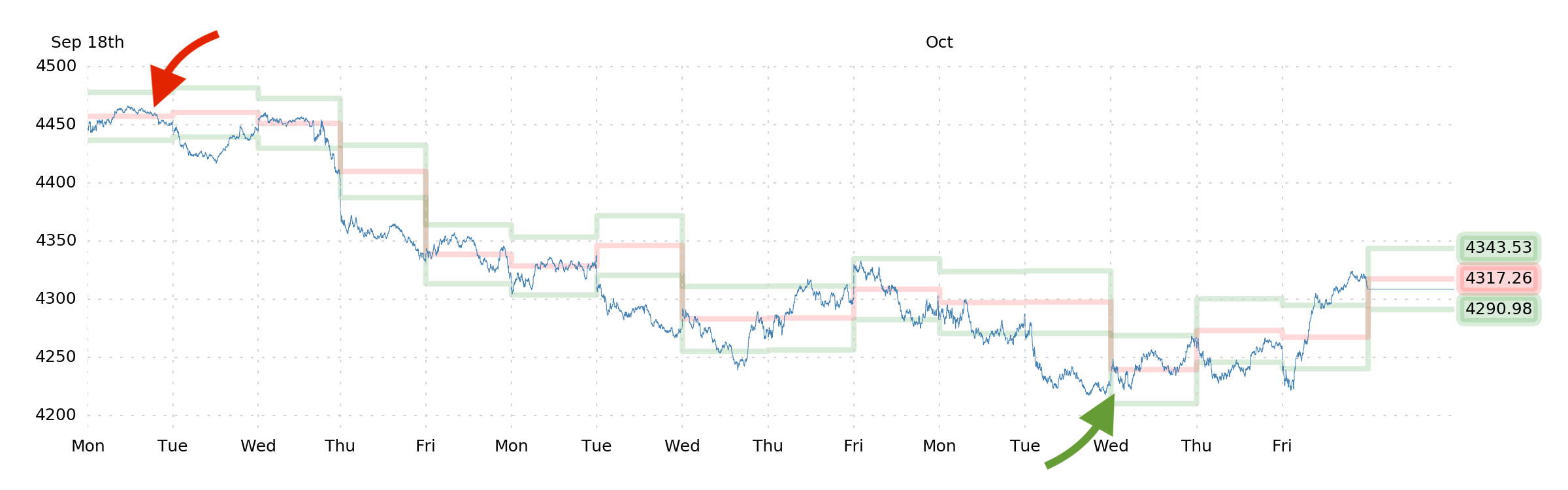
Our short position, which we closed on Wednesday morning, was meaningful in size and turned out to be quite productive, netting 220 points of SPX downside. That's enough to make a difference to our year.
Cool.
Secondly,
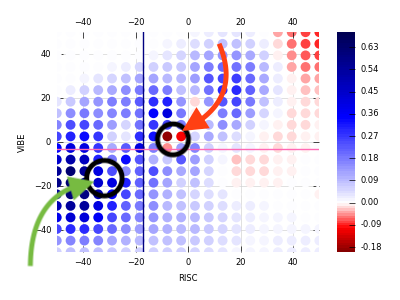
RISC-VIBE was a really big part of our decision both to short, and to cover our short.
This is exciting, because the whole reason that we were interested in exploring RISC and VIBE as a heatmappable, pair-wise dataset was that SPX put flows (NPD) have been weird and muted lately (it's a bear market, you know), and aren't telling us as much as we'd like in the NPD-VGR heatmap (VGR is still telling us things, of course, and contributed a lot to our recent decisions). And so far, it's helping us.
Cool.
Thirdly,
But the reason we entertained the idea of getting linear short SPX in the first place was not RISC, or VIBE, or VGR, or any other tangible data point. Rather, it was something "muddy, shaky, and out-of-focus." I.e., our Gigabrain Macro Thesis of 2023, which is all about the correlation of stocks and bonds, and the reasoning behind it. This led us to believe that TLT would be taking a "quick jog lower," and that stocks would be compelled to follow.
Cool...
But now that it happened, and we're out of our short—what happens next?
Fourthly,
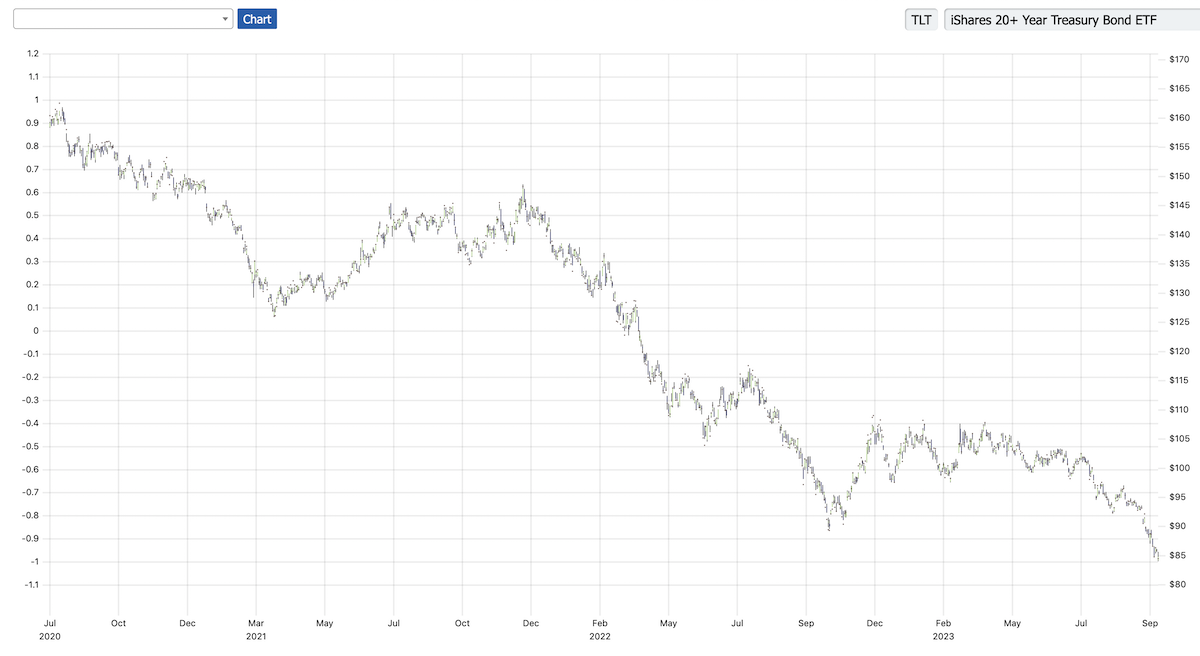
A really big part of the Gigabrain Macro Thesis is that people, after many moons of low rates, were eager to justify buying Treasury bonds yielding anything above 3.00%, regardless of the embedded "real rate," or inflation. "Inflation is transitory" was thus mostly an argument put forward in bad faith from people who really wanted to justify grabbing yield. And that's what they did. And because people jumped the gun (pulled forward demand), bonds languished in 2023.
But now that the 30-year is touching 5.00%, we expect some new dynamics to be in play. Why? Because our lizard-brains are looking at TLT right now and wanting to buy the dip like degenerates. To bet that we can catch a falling knife. To bet that this is going to be The Trade. We haven't seriously considered this until now, but now we have an itch to participate.
And we can't be the only ones.
So while one group is obsessively watching a bond chart like the above and muttering, "I didn't lose money, I'm holding to maturity," the other group is either squealing about betting on duration, convexity, deflation, and recession, and furiously buying TLT calls; or squealing about ridiculously high yields, and furiously selling TLT puts.
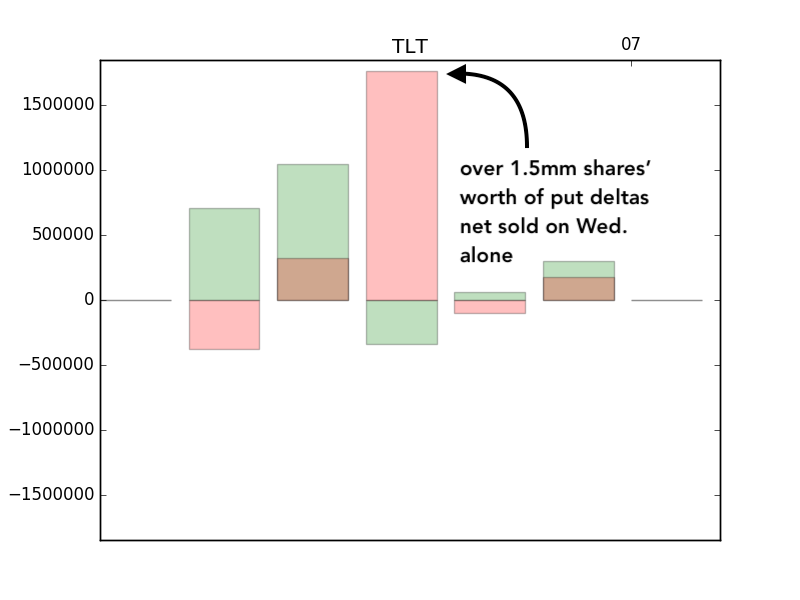
Out of morbid curiosity, we actually dug into the past week of TLT option flow and segmented flows into net deltas. Unsurprisingly, they were net positive, with both calls and puts (green and red) generally contributing +delta (calls bought, puts sold) from customers.
For context, Wednesday's net put delta was well over +1.5mm shares' worth. For TLT, that's a lot, and one-sided, and we'd suggest that it illustrates the situation well.
We would also suggest, as we always have, that positive delta flows in options are dead weight for prices; in the same way that negative delta flows in options are buoyant for prices. This is because, as time passes, dealers generally need to re-hedge customer long calls and short puts by selling the underlying; and dealers generally need to re-hedge customer short calls and long puts by buying the underlying. And so—ceteris paribus—this last week's flow's are illustrative of a not-bullish immediate future. Again, in econ-speak, demand has already been "pulled forward" by these option trades.
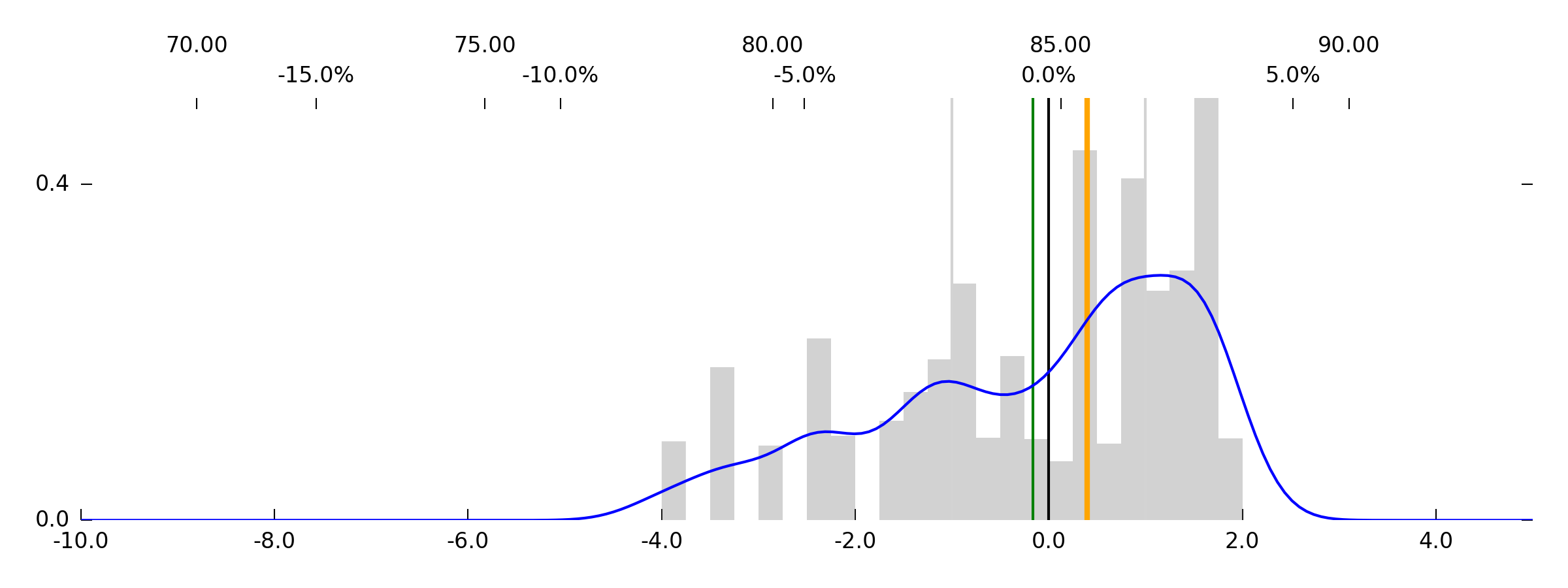
Some support for this view can be found in Robot Jim's assessment of the TLT situation. His 1-week forecast has a negative mean, despite a modestly positive median.
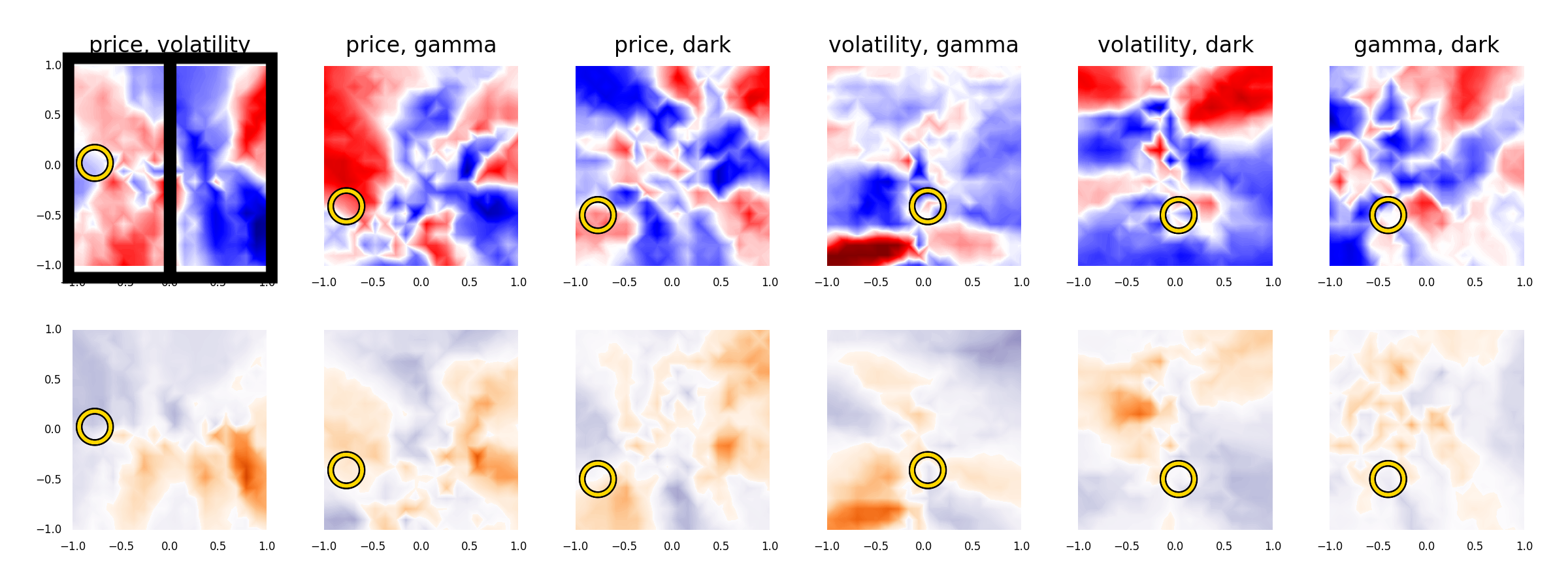
A big part of what Jim sees appears to be the autocorrelation, or "trend," that dominates near-term bond returns. Note in the TLT weathermap, that if you divide along the 'price' (x) axis in the 'price, volatility' weathermap, the left side is mostly red and the right side is mostly blue.
This tells us something we may already know: That bonds tend to keep going down if they're already going down—and vice-versa. (Which makes the exercise of catching a falling bond knife even more precarious.)
All told, our impression of sentiment, our data on option flows, and our analysis of price-action all add up the same thing: Don't buy TLT yet. But you see, we're itching to make this trade, so we kept looking for an excuse—and we maybe finally found one in CBOT Ultras!
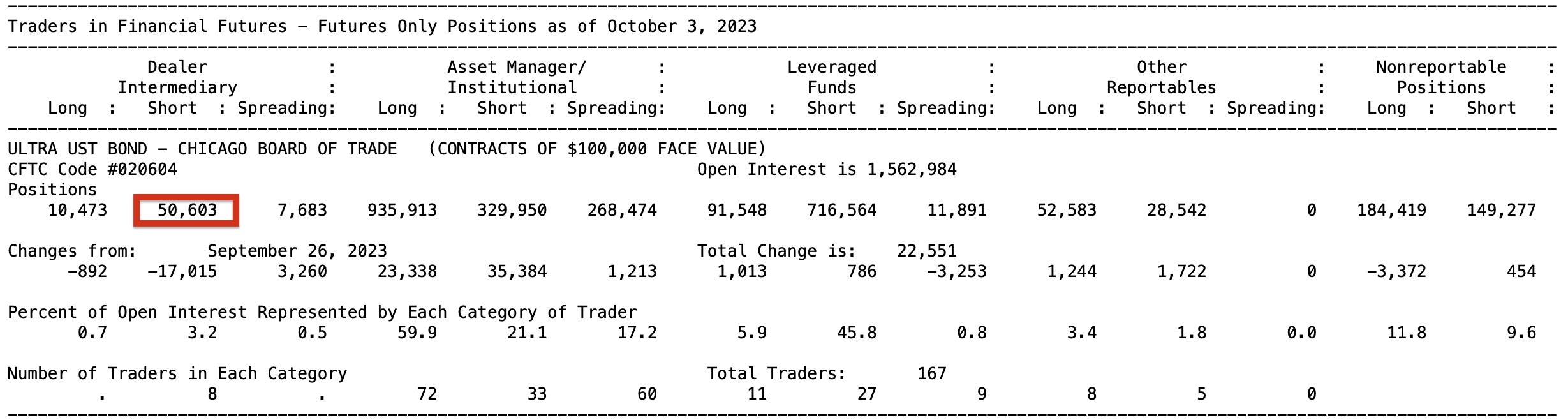
See that "50,603" in the Dealer Intermediary Short category of the CFTC
CoT report? That's how many ultras dealers are short. That's not a lot, historically! That's on the low end! Could that be bullish?!
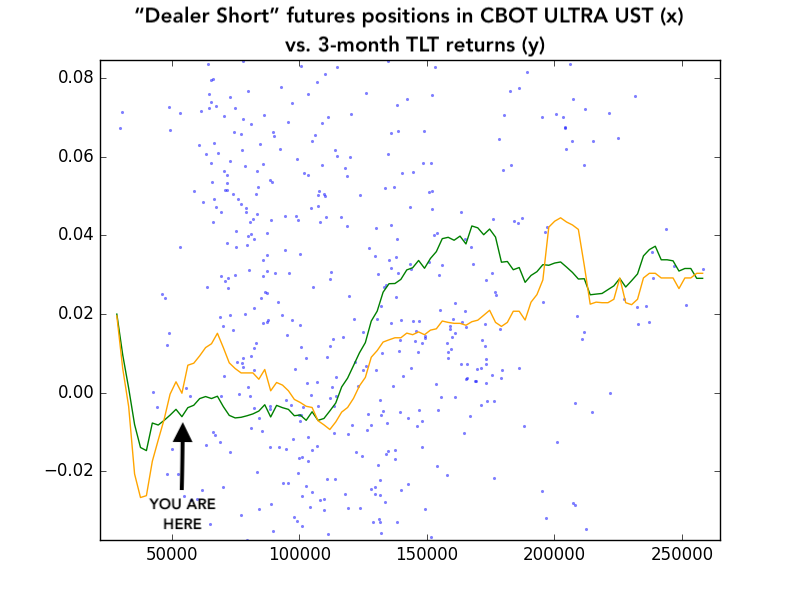
So we plotted out the historical association between CoT "Dealer Short" data and TLT returns.
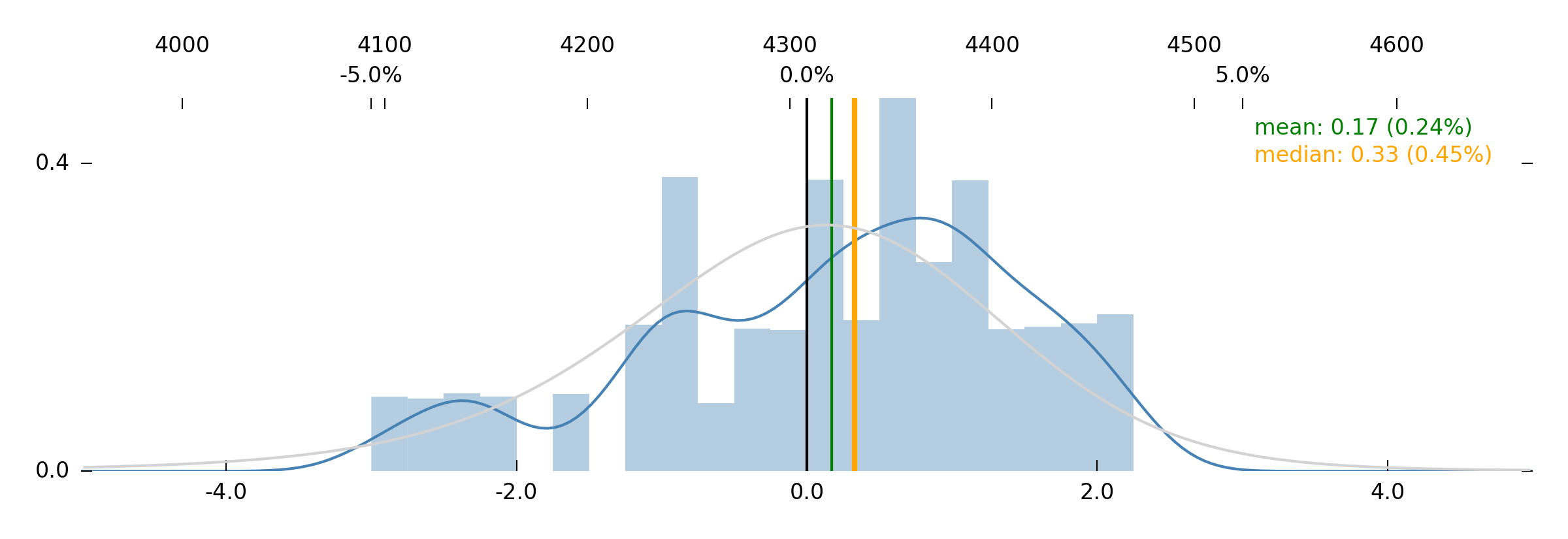
And here they are (green is mean, orange is median):
Ah.
No, that's not bullish. Not at all. Around 150,000 ultras held short by dealers is where you start getting some good returns (+4.00% mean over 3 months). Everything lower is lousy. (And you can do this test with a 2-week instead of 3-month timeframe, which arguably makes more sense for this data, and the result is the same.)
(Nerds: Based on this information, it seems like dealers in bond futures are probably mostly short futures to delta-hedge things with put-option-like return profiles, because all other things being equal, the more they're short, the better that is for forward bond returns, and that probably means that they're buying back those short positions as time passes and "delta" falls. Maybe some true bond geeks can tell us if that makes sense or not.)
So, anyway, it seems like there's a bit of an interesting irony at work here. Bond prices went down, and triggered some pretty strong betting impulses. Impulses that may even be described as a Fear Of Missing Out. But in the case of declining bond prices, the FOMO impulse looks like it will just keep bond prices down.
In order to take that long bond bet we're itching to take, what we probably really want to do is wait until everyone else has gotten sick of punting on that long bond bet (perhaps visible in IVs or in transaction-level data), or has started getting worried and ringing up their dealer to buy some protection (perhaps visible in dealer intermediary CFTC CoT data on Ultras).
So yes, we are quite keen to take a bet on bonds, and we feel like we've been very patient in waiting for an opportunity—but for now, we're going to keep waiting, because no matter how hard we try, we cannot justify that long.
Fifthly,
Now what about stocks? (Y'know, what we usually talk about.) Well, we mentioned a couple weeks ago that stocks really want bonds to go gently up. They want to see a non-recessionary, non-scared bid for bonds. Could that happen this week?
Sure. Or, at least, it could appear that way for a few days. And if we were to take a binary bet on Up/Down, we'd probably take the Up in stocks this week.
Jim agrees, though not too forcefully. The upside bet appears to be the better bet, with underpriced probabilities in landing at SPX 4350 and above.
We're not too keen on any directional bet, though. Not yet, anyway.
Reminder: There's a holiday for the cash bond market on Monday, but not for other stuff. In the current scenario, where the SPY:TLT correlation is much-watched, that's kind of fun, but we don't see anything breaking as a result.
Sixthly,
Let's not forget, amidst all of our silly prognostications, that there are two things we need to start addressing soon:
- RISC and VIBE data should be added to our usual spreadsheets and materials.
- We need to do a bit of research into VIX options before the year is over.
Lastly,
It was a pleasant couple weeks for our egos, so let's temper that self-congratulation: We forgot, last weekend, to talk about the Q3 results from our 2023 "Degenerate Science" project, where we buy tons of OTM calls and puts on random stuff in hopes that just one or two really knock it out of the park.
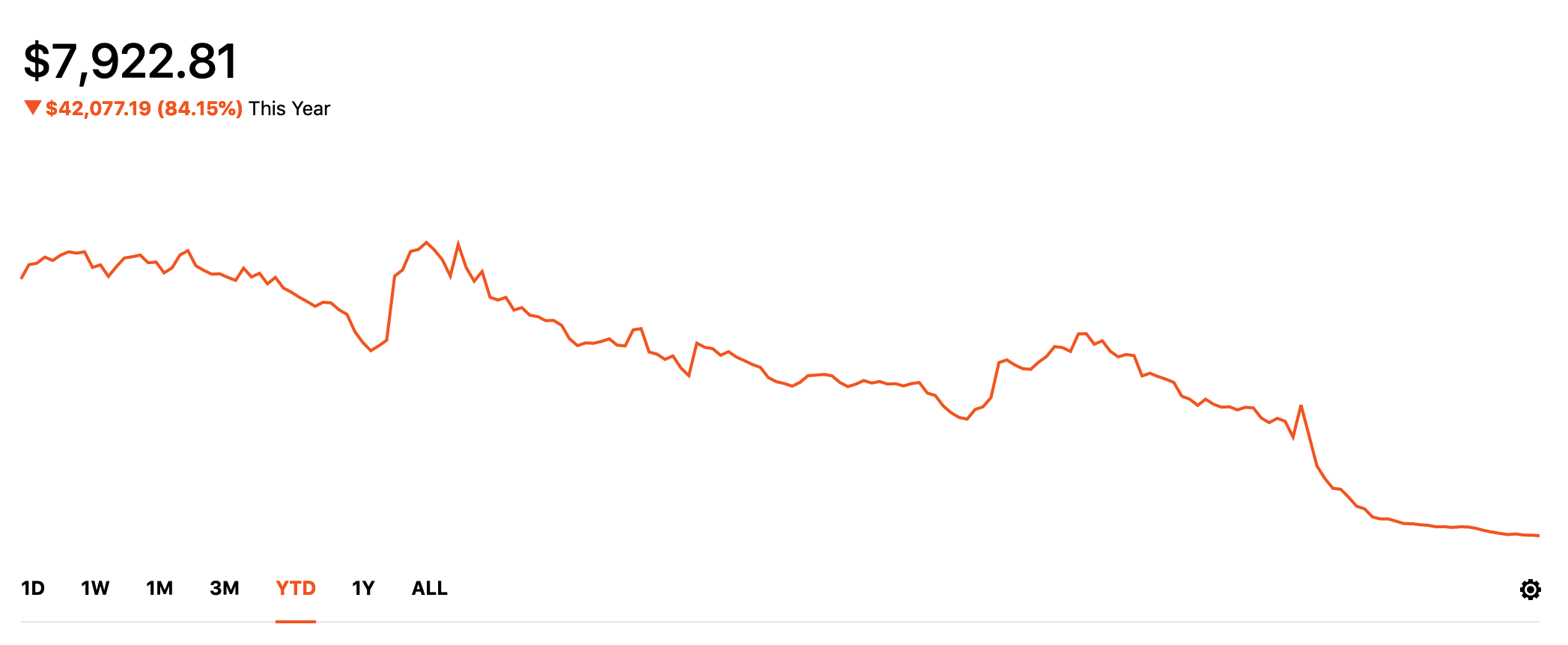
We committed $50,000 to this little project, with the intention of either being rich, or having $0, by the beginning of 2024. Can you guess which one we're closer to?
Look at that line. Is this the life that you want to lead? Lighting forty-two thousand United States dollars on fire in an attempt to prove your fringe thesis? Oh, and by the way, the absolute worst experience about this so far has been when you have an option that starts winning big, but then the underlying totally mean-reverts and you're left with nothing a few days later. It's like sand slipping between your fingers, except the sand is enough money to buy a very reasonably equipped sport utility vehicle. Are there lessons here? Are there lessons that we can draw from this? Maybe about our mental and/or spiritual health?
Maybe... but let's choose to ignore them.
Have a wonderful week!
The SqueezeMetrics Team