All the charts and data we refer to can be found on the Yacht Club page.
Hey everyone,
I don't want you to tell me what's going on; I want you to tell me how to feel about what's going on.
There's a lot of pseudo-intellectual, post-modernist prattle about subjectivity, relativism, and the nature and limitations of "knowledge," so it won't do to take the ideas too seriously, or at face-value—but it's certainly a part of our zeitgeist that objective truth is somehow mediated, in a very real way, by human experience and perception.
And not only is it interesting to note that people really do think that way—it's interesting to note that capital markets absolutely work this way: Stock prices go up and down because people buy and sell stocks, and people buy and sell stocks because stock prices go up and down. It's a mirror-within-a-mirror, the crowd seeing the crowd. A self-referential loop of "information." Subjectivity par excellence.
Indeed, modern markets have often been said to be "reflexive." This means that when we observe the thing, we inevitably influence the thing. It's the same thing as the "Observer Paradox," except it's actually quite obvious that the market works this way—of course we buy and sell because price moves, and of course price moves because we buy and sell. We all knew that.
Now what makes this kind of funny is that, in the United States, we're introduced to these cute concepts about subjectivity and the primacy of human experience mainly by way of students of "Critical Theory" and the Frankfurt School—who are self-described anti-capitalists. Their critique is that "consumer capitalism" is fundamentally alienating (in the Marxist sense), and it's actually just another form of domination and repression; and the "truths" we speak of are merely history-as-written-by-the-victors. Really, those "truths" aren't True—it's all relative.
And yet, it is only deep in the markets of consumer capitalism that we find this evident, manifest example of the primacy of human experience. Of subjectivism. Of absolute relativistic "truth." One wonders if these neo-Marxists would be comfortable using stock prices as an allegory for the mediated human experience of knowledge, truth, etc.
Now, with all that said, let's bring back the block-quote that we began with:
I don't want you to tell me what's going on; I want you to tell me how to feel about what's going on.
We tend make fun of people for speaking and acting this way, as if it's a failure of critical thinking. And we make fun of journalists who peddle feelings instead of news. But in our post-modern world of truth-mediated-by-human-experience, it's quite understandable. Indeed, it may be the more important thing to address!
And as we are people who engage with capital markets (which are a petri dish infected with relativism and reflexivity) we cannot critique. Rather, we must listen. So why do we, on this Sunday evening, discuss Truth, and relativism, and neo-Marxists?
Because of Friday's S&P 500 price-action, of course.
And let's talk just a little bit more about that.
But first...
- That was then
- This is now
- How should we feel?
That was then
Last weekend, we talked about how it looked like disintermediation was impacting the market—that customers were trading against each other, disagreeing fundamentally about what happens next. We expected some weird patterns to arise, and we got long an SPX strangle and long some bond volatility (gamma) to prepare for the weirdest outcomes.
And while TLT went down some 3% on the week (which was kind of neat), SPX just chopped around aggressively within a tight range, and ended up flat (not so neat).
Ultimately, we got the better part of a couple moves, and so we can't complain too much—but it wasn't exciting in the least, and we didn't really get what we wanted.
The big question going into next week is: Is there still some pent-up energy from the so-called disintermediation that we witnessed over the past couple weeks?
This is now
Our inclination is "yes." First of all, because we just don't think there has been any price movement to change anyone's minds about their chosen positioning; and second, because VIX is still a whopping 19.
VIX at 19 "implies" nearly 1.00% average daily moves. This seems vanishingly unlikely over, e.g., the next week, unless spot price can move down substantially. As such, it seems reasonable to want to be short volatility in some fashion (and that's not something we say very frequently nowadays).
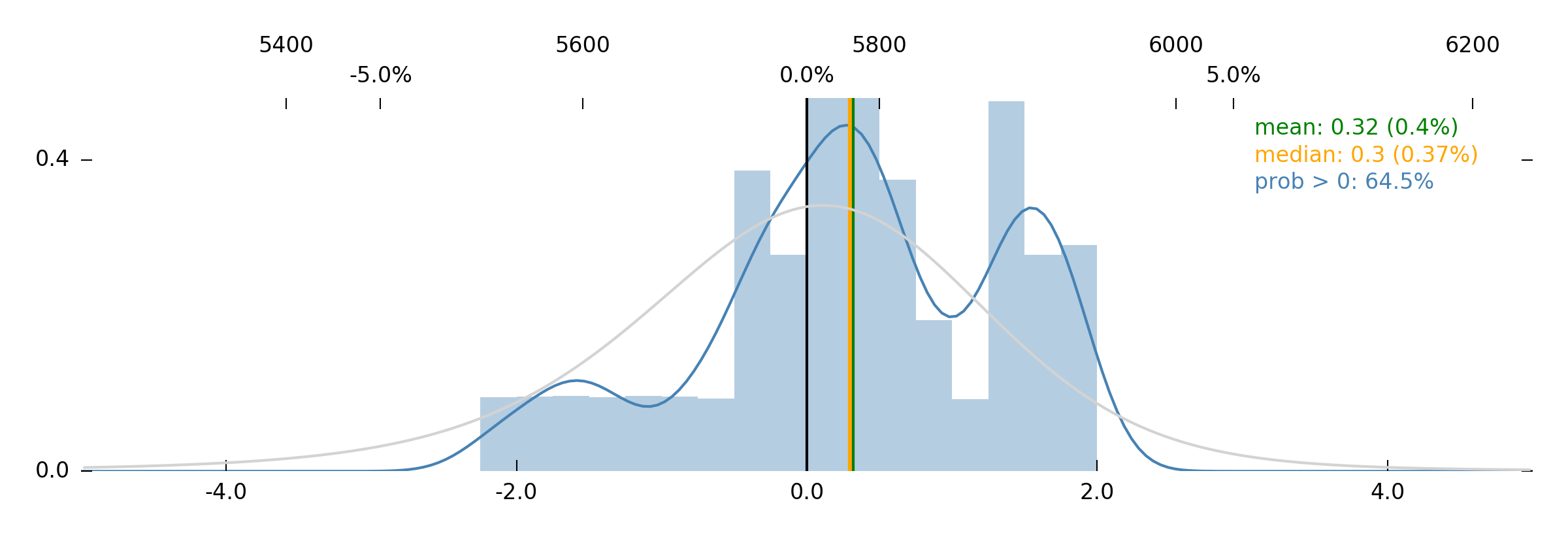
This interpretation is reinforced by a reasonably bullish 1-week forecast from Jim, which has advantages in betting on either no movement or a rally to ~5900. Stable-bullish.
The appropriate trade, then, appears to be "short gamma, long delta," or something more-or-less like a short ATM put. Naturally, any such structure can be loss-limited with a concomitant long put... but then whenever one feels the need to loss-limit one's short convexity, that's probably a sign that the whole thing should be sized down.
In other words, maybe a short ATM put is the right trade, but if that's the case, then your maximum portfolio gain for the week ought to be tiny. So if we're thinking that short vol is the way to go, let's not be too ambitious for our PnL. We will happily accept a very small win (or a small loss).
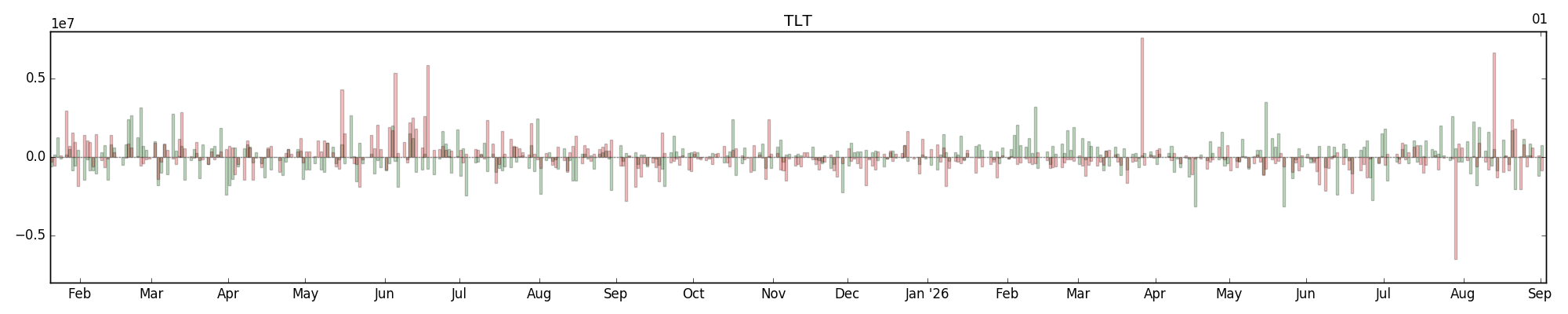
It's worth mentioning, in passing, that we're not sure what to do about
this. The TLT option flows included some massive bid-hitting and ask-smacking put trades in the last two days, and without actually sitting down and picking apart the tape, or picking up the phone and asking some questions, we're not sure what they mean. Since they seem to cancel out, we're keen to ignore them, and to fall back on our "tentatively bearish" overall outlook on bonds (will we
ever get to be long?).
Moving on...
How should we feel?
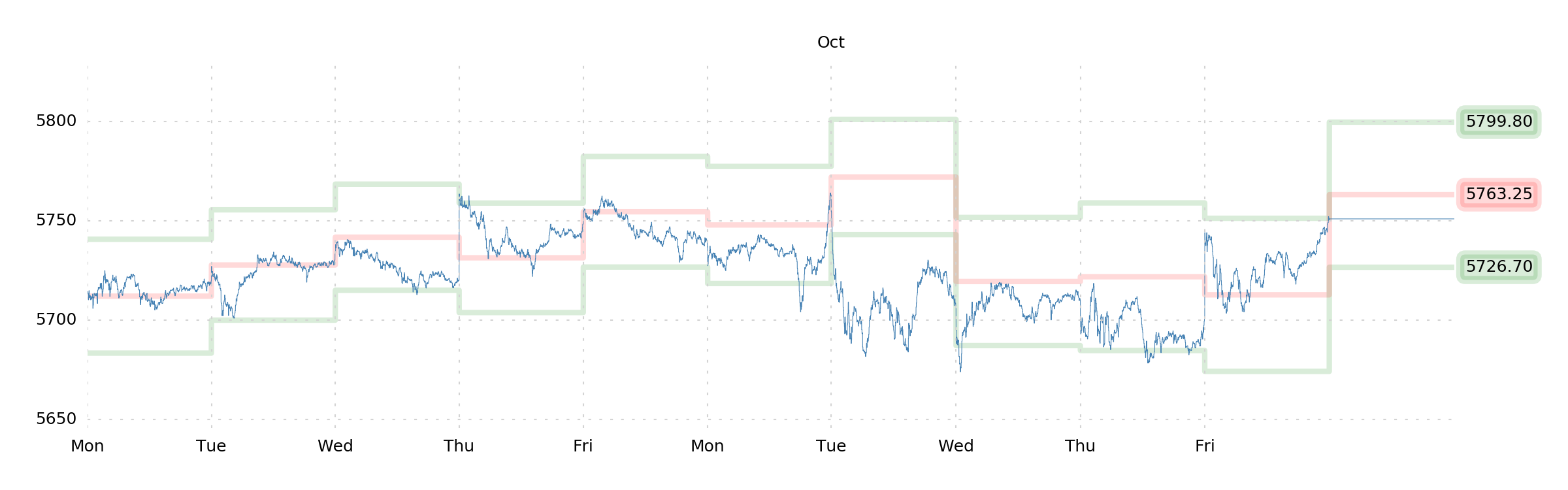
On Friday morning, we felt disappointed, to be sure: Our long strangle wasn't going to pay. But we also wondered how we were supposed to feel about the strong NFP jobs numbers, and we also wondered how other people thought they were supposed to feel. We wondered especially hard about this because we predicted that, due to the composition of 0DTE options as held by SPX dealers, there would be strong selling to oppose the good news, and that the index would end up "getting stuck around the Momentum band."
And that's what it did. It gapped up, sold off, and then went back up and got stuck at the Momentum band. How are we to interpret this? Or, rather, how are we to interpret how other people will interpret this? (Because they probably aren't going to say that the price-action is attributable to an accumulation of speculative interest in SPX 0DTE options that influenced dealer re-hedging which caused the price-action.)
Our bet is that it's bullish. The jobs number is bullish S&P, bonds going down is bullish S&P, and the fact that SPX landed at the Momentum band reinforces the idea that "yes, indeed, the jobs number is bullish S&P."
We can imagine some alternate universe where customers weren't getting speculatively long SPX delta via Friday's options, and where SPX rallied hard instead. People would, in that case, call it a "squeeze," and it wouldn't be considered as bullish going forward. We can also imagine another scenario where customers had sold only, like, far OTM 0DTE puts instead, and where the gap-up simply drifted down slowly through the day, leaving everyone more alarmed and bearish. Instead, we got a gap-up, sell-off, and bid into the afternoon. The bullish narrative is, we think, strengthened by this action. "The selling didn't stick." "There were ready buyers." Etc.
Of course we think that what really happened is a bit more mundane than the storytime intepreatations like "buyers took control from sellers" or whatever people like to say—but then, that doesn't matter. Because it's turtles all the way down. Funhouse mirrors inside of funhouse mirrors. And at the moment, we expect that people will—in their preeminent, subjective human experience—"feel" bullish, simply because of Friday's price-action.
Have we done a good job of "shaping the narrative?" Do you, dear reader, nod along with our critical reading of the market? Don't worry—you don't actually have to believe it.
Enjoy the week!
The SqueezeMetrics Team