All the charts and data we refer to can be found on the Yacht Club page.
Hey everyone,
One month ago, we said
this:
When the market is doing interesting things, we usually like to keep our notes short[er] and [more] to the point; because while lucidity is always in demand, it truly commands a premium when there's volatility to contend with.
This seems fitting for the present situation as well, so let's optimize for clarity, and let's focus on the situation in the broader market.
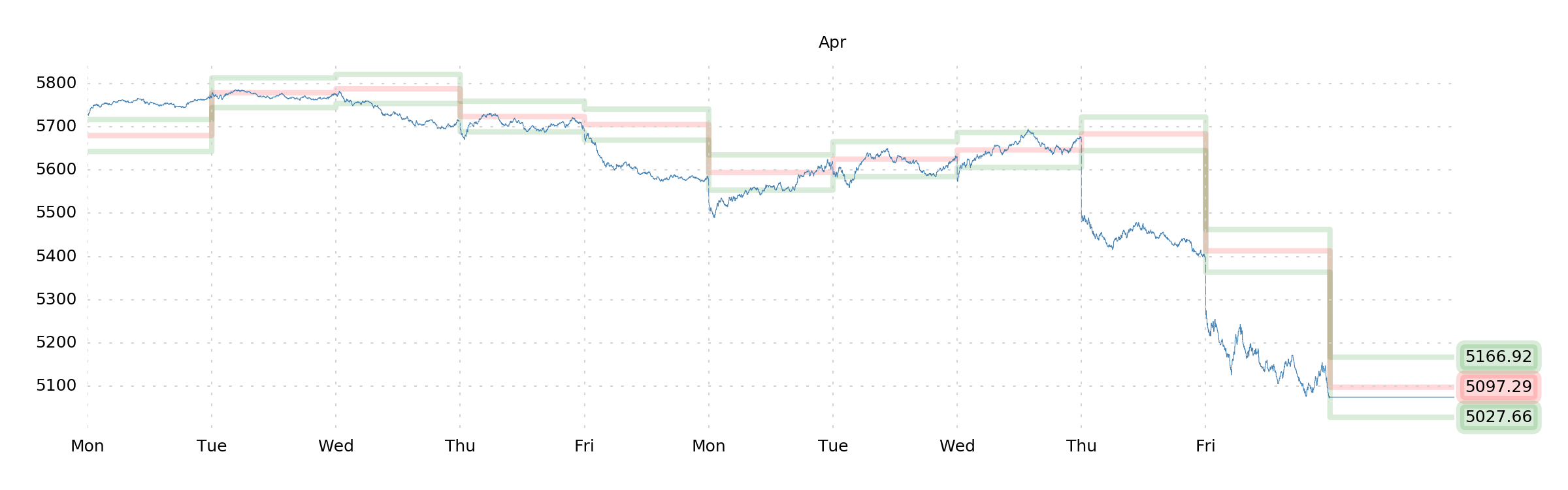
Last weekend, we had a couple things pointing to the same conclusion:
Most importantly, there was the game of "
bloody knuckles" that portfolio managers have been playing with the market, which we expected to result in a leg lower. Then there was the game of "chicken" that Trump has been playing with the market, which he seems quite keen on winning. Both led us here:
At this juncture, then, we're inclined to think that SPX achieves lower lows as people get themselves out of a position they've been hanging on to for a couple weeks. Feels bearish.
Our reaction was to get long puts, "for the delta and the vega," and to hold on to our long bond position at the same time.
This all went well enough...
...but now that things have changed, we have a new set of circumstances to contend with.
On Friday, we mentioned starting to sell some of those puts, since VIX was finally topping 40. We did this, and our remaining puts are all at-the-money and one month to expiration. Much calmer positioning.
However, on Friday, we also mentioned a new blip in the data, and a concerning one.
The takeaway from this one is that maybe somewhere around SPX 5150 you start getting "illiquidity." Like, the really bad kind. And everything below that gets worse pretty fast. By the time SPX is 5000 with a VIX at 60, you're in real hot water. Things are broken down there.
How did this happen? Well, during the course of the week, there was no net SPX put-buying. There was, to wit, net selling. SPX net put delta (NPD) was +3 on Thursday and +1 on Friday. Those are positive net deltas. Those are folks selling puts.
Now, generally speaking, when there's a really scary, ground-shifting bit of news, people buy puts to protect themselves from the potential consequences. Apparently, this behavior has been out of favor for quite some time (since the beginning of 2022), and, well, now we're in a bit of a pickle.
There's nothing particularly "remarkable" about current positioning or flows—there's just a void where there's usually insurance buying. Where people are usually saying, "Oh my—I'm scared of this potential outcome," there's just a sort of pregnant silence.
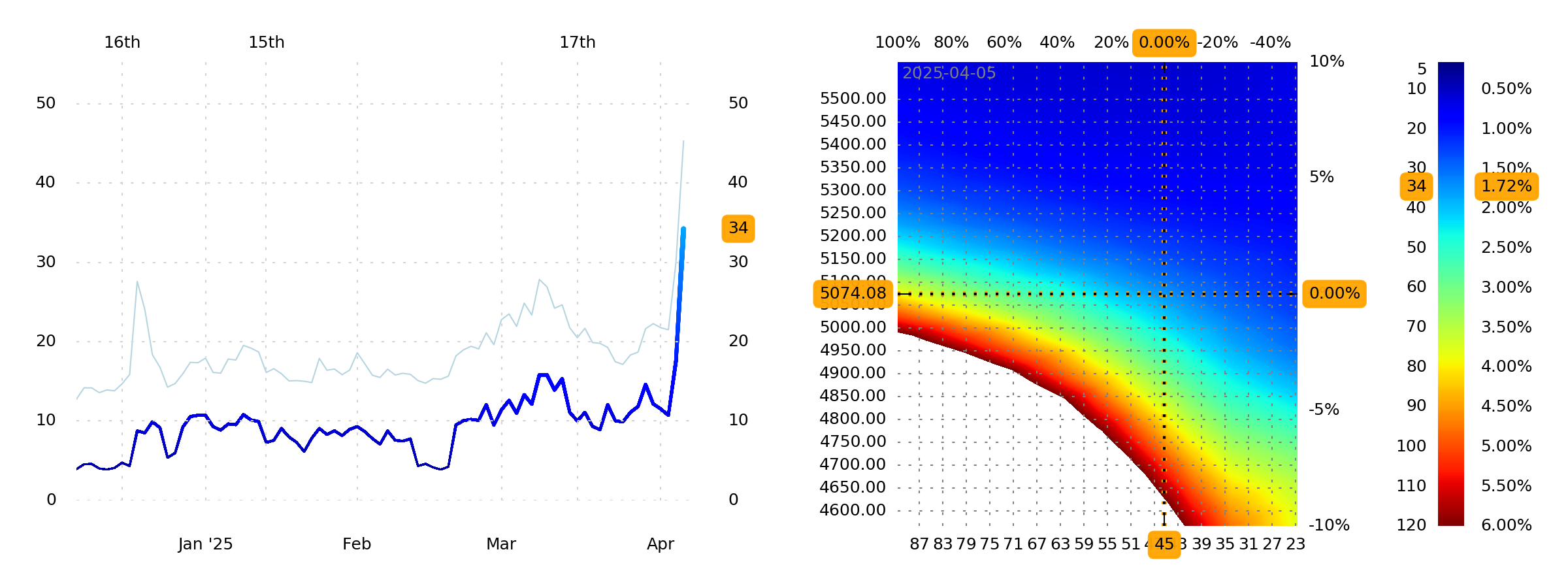
Now, given that our prior bearish stance was entirely predicated on denial (denial that Trump would go through with his promises, denial that SPX would keep going down and realized vol keep going up), maybe we shouldn't be too surprised if we're seeing the same denial in the GIV heatmap. But it's still jarring.
To clarify, what's special about this heatmap above is not the particular color that the crosshairs are currently on (which is associated with a volatility of 34, or 1.72% average daily close-to-close moves), but rather the counterfactual, the hypothetical scenario of spot price going down more and vol going up more.
Actually, we have another panel to explain what this means in a different language.
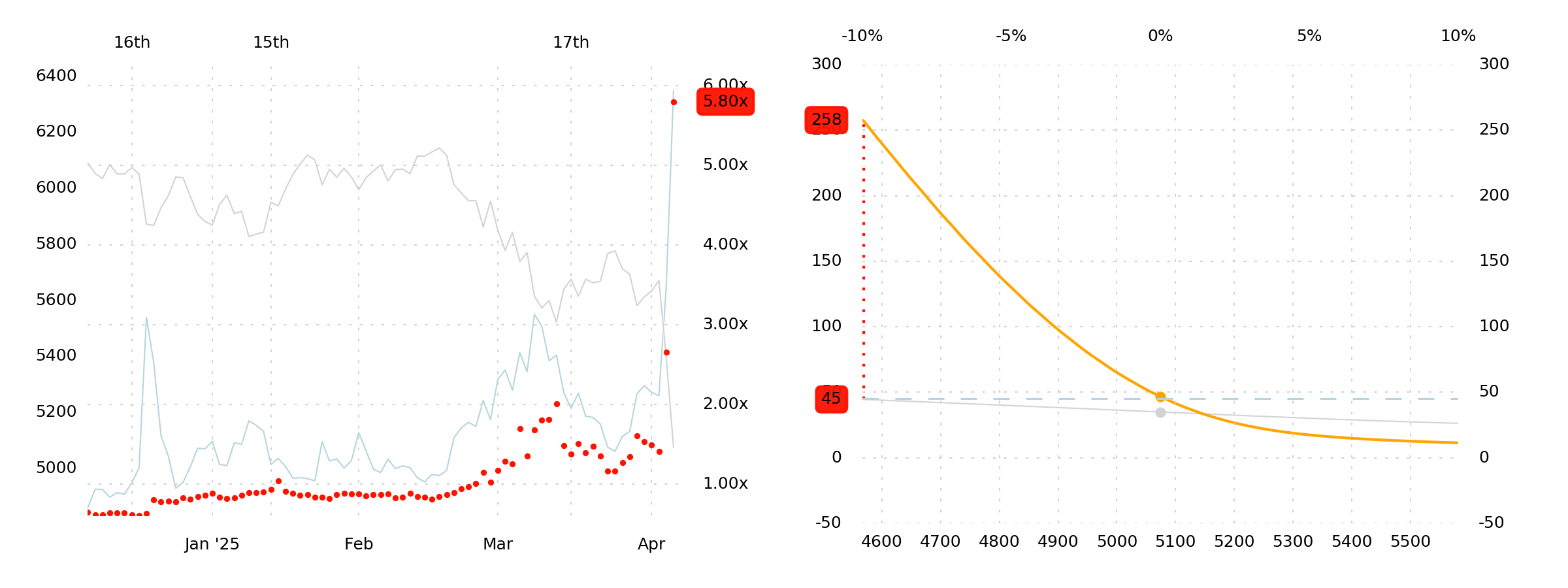
On the right chart, there's a "GIV skew," which tells us what a gamma-implied volatility is going to be in the event of a given move. On the left chart, there's the derived "Crash Risk," which is presently at 5.80x—which is high.
"Crash Risk" is a function of the difference between the 90% (10% below spot) 1-month SPX IV and the 90% gamma-implied vol (GIV). It's normal and healthy for that to be 2.00x or something like that. It's neither normal nor healthy for it to be 5x or higher.
Anyway, the implication here is that liquidity below spot is much,
much worse than current SPX vols and skew are implying. This is, more or less, the subject of "
The Implied Order Book," which explains how a bit of put-selling can turn into a vanna-induced nightmare of illiquidity. Pretty rough!
Now let's back up for a moment: We're trying to extrapolate stuff using historical numbers and an incomplete understanding of the world. (We always are.) So let's try to pare down and clarify what the data is telling us, without trying to quantify and interpolate on a risk that only shows up every few years (and is different in character every time).
Right now, what the data is telling us is that the composition (directional gamma, vanna) of Cboe S&P 500 options at 4900 is the same as it was at other times in history when there was a crash. At SPX 4900, market-makers will probably become substantial net liquidity-takers. The "implied order book" of the S&P 500 turns into dealer stop-losses instead of limit orders.
So, that's not really a "market" at all, but a hole where a market used to be: The land of circuit-breakers and weird dislocations and forced-liquidation and unexpected insolvencies.
Got it?
Now that we've established that there is, in fact, Crash Risk, we have four questions that we want to ponder:
- How do we position for a crash?
- How do pod shops factor in?
- When do we buy stocks?
- Trump?
How do we position for a crash?
Humbly! With fixed-risk. With a sense of calm, rather than urgency. And, probably, in this situation, with some ATM puts or VIX futures. The time for convexity is already over—the payout on volga/vomma isn't exciting anymore. If VIX climbs from 40 to 80, it would be great to be able to capitalize on that, but you're not going to get a convex payout, and when things get illiquid, sometimes it's hard to get a payout at all.
We mentioned that we are long ATM 1-month SPX puts. This is kind of a liquidity sweet-spot, since there's likely to always be an organic, two-way market at near-the-money strikes with a 1-month tenor (even if the screens look wide). Since we want to be able to sell these puts if things get really hairy, we do want there to be a market for them.
And if there's no crash, and if the S&P smiles and winks and teleports to 6000 in a puff of fairy dust, we will be perfectly happy losing what we've wagered here. That's important. Calm.
How do pod shops factor in?
If you were to consider what newfangled things are active in the market right now, it'd be the multi-manager platforms. The pod shops. Since new things present new risks, it's worth considering how these can impact things. Our
general opinion on pod shops is that they're a reimagining of the pre-Dodd-Frank bank trading desk, with excellent cross-margining capability and great resources. And like those old trading desks, we think they present more of a danger to the markets that they trade than they do to themselves. I.e., as a whole, pod shops are more robust than the market itself. Only legislation, and competition from other multi-manager platforms, kills them.
Still, individual markets and sectors can—and we suspect already have—been hurt by trades gone wrong in pod-land. A popular re-imagining of tail-selling in the pod world is "dispersion trading," which relies in one way or another on correlations being stable. When correlations move toward 1.00, these strategies stop looking like alpha, and start blowing up just like any other secretly short-tail strategy. At some point, we're all just buying SPX puts, because the buck stops there. Perhaps the fact that those puts are still pretty cheap (relative to the risks we perceive) means that there's more pain that can come from these strategy unwinds. We don't doubt it. But it doesn't change our approach.
When do we buy stocks?
Nobody would blame you for placing stink bids on stocks that you'd love to own. There's something simple and beautiful and satisfying about that, and some people have gotten rich like this. So if you want to place a $100 limit on Union Pacific because choo-choo trains are cool, do that.
But as for catching falling knives more broadly—nah. There's no real indication that we should buy stocks right now, or that risk will abate, or that flows will favor upside. This can change really really quickly, of course, but at the moment, buying stocks seems like an exercise in hubris. A misguided attempt to be the guy who bottom-ticked the tariff correction.
Heck, even Jim—who loves buying dips—isn't into it. He just thinks things are mostly fairly priced.
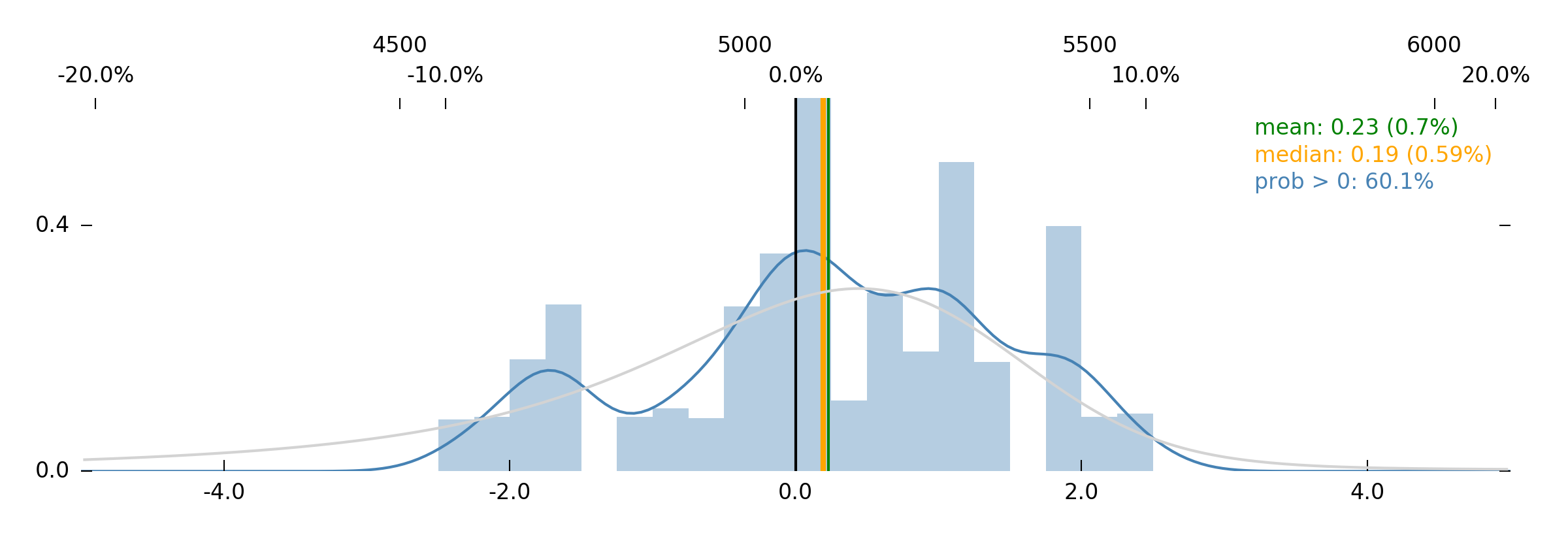
Keep in mind that the breadth of this distribution is a bit unusual. A five percent weekly move would be "average." Don't get tricked by this. Don't feel like you're missing out when it moves a percent and you haven't made money. Calm! There will be more, and clearer, opportunities in the future. There will be a lot of money to be made when this is over.
Of course, the question is, "when will this be over?"
Trump?
We apologized at the beginning of the year for inevitably talking about Trump. It really is unavoidable.
We ask you often, dear reader, to be cynical. Cynicism isn't a virtue (perhaps the opposite?), but it may be the most useful framework for making money in markets. Whether as service providers or as predators, as makers or takers, our job is mostly to suss out someone else's fear and profit from it. And so, in keeping with this dispassionate, ironic approach, let's consider what Trump is trying to do here.
Ostensibly, Trump wants to rein in inflation, strike more favorable trade terms, generate something closer to a trade surplus, and maybe even refinance the U.S. government at lower Treasury rates. He's stated quite clearly that the market response thus far has been "expected," and that he's comfortable with the idea of causing a recession. He just went golfing.
Now let's be a bit cynical: Trump is a showman. We needn't doubt his sincerity regarding his goals to know that he also likes a good show, and he'd certainly like to deliver something more tangible to the average American than "trade balance." So let's take a moment to appreciate the beautiful, dramatic symbolism of tearing it all down and building it back stronger. Of purgation and new beginnings. Of sacrifice and reward.
Viewed through that lens, this—what you are experiencing right now—is a trust fall.
If you are constant and loyal, and if you believe in him, you will be caught, and you will be rewarded; because once this is all over, everyone who bought the dip because they believed will be justified—and rich. And everyone who tore their hair out and sold will be laughed at (and poorer) for their unbelief. The greatest show on Earth!
So we can believe that, yes, perhaps Trump wants manufacturing back in America. He may be sincere. (It sure seems so!) But what matters more—and the reason to do it the way it's been done—is to "manufacture" a compelling narrative. A beautiful thing. A wealth transfer from the undeserving to the deserving! Rise from the ashes!
Can Donald-the-Bullet-Dodger, pull it off?
The ironic outcome here, which could certainly play out over the next year, is that Donald Trump gets exactly what he wants: Inflation gives way to disinflation. But then disinflation gives way to deflation. And the expectation—that Fed cuts will stymie the spiral—is wrong in A.D. 2025, with interest paid on reserves and no reserve requirements. Thus, just as "tightening" doesn't really work the same way anymore (leaving us with persistent inflation and the longest 10-2 inversion in traders' memory), neither does easing. Rather, lowering the EFFR from here could merely lower inflation in lockstep.
This would be ironic. This would blindside people. This would be the most ironic outcome for Trump trying to bend the market to his will.
We'll see. But either way...
And of course, this would be a good reason to own bonds.
Yes, we're still long bonds. Same positions as before, same size as before, same reasons as before.
You're receiving this note early because time is important in situations like this, and just a few extra hours to mull things over can be helpful.
Good night, and good luck.
The SqueezeMetrics Team