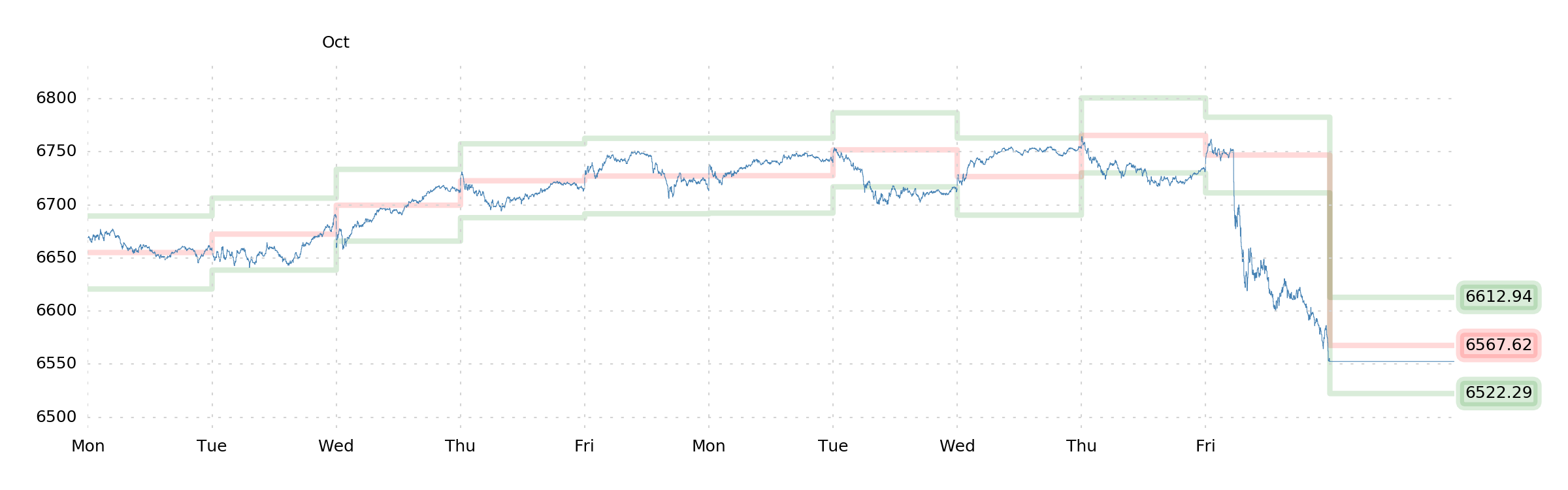
All the charts and data we refer to can be found on the Yacht Club page.
Hey everyone,
We were going to chat about correlations. We were going to talk about how there are a million little adorable nooks and crannies in the market that we can now explore with our new chart, and we were going to wonder, wide-eyed, at the interrelationships between things like Exxon Mobil and Charter Communications, or why a small mortgage REIT seems to lead the whole real estate sector, or why Bakkt Holdings seems to predict the price of gold... many interesting things. Cute, fun things. Curiosities.
But now we're distracted.
And so, in order to maintain clarity in this note (which is valuable right now), let's focus exclusively on the more timely concern of the S&P 500 is doing, and why, and what that means about what happens next. Two levels of thinking—high and low, strategy and tactics, mushy and pointy. First...
Strategy (big 'n mushy)
Frankly, we thought something like this (big new tariff threat) would happen a long time ago, and we've spent many months hovering uselessly over the 'Buy SPX Puts' button. But in the moment of Truth, as the fateful, long-winded, presidential rant-post about China showed up—we were primarily long some E-minis for an intraday gamble and long some single-name gamma (expressing our many and varied long/short bets).
In other words, we weren't prepared. Indeed, the only indication we had that it was getting to be a good time to bet on downside was a droopy DIX, but we'd
left off last weekend very cool and composed and self-assured—waiting patiently for more data.
Of course, Robo-Jim will tell us if it becomes truly significant, in the context of price and volatility and GEX+ and all that.
Well, Jim didn't tell us, because Jim cannot read the mind of Donald Trump. And unfortunately, neither can we—but if we were to assess the state of things right now, we'd say that there are two important points:
- Tariff threat is on-brand, and there's no reason to doubt his sincerity or ability to follow through (especially now that the market is implying that tariffs "work"), and
- VIX at 21 is too low.
Regarding point one, it seems like there's ample "political capital" for Trump to accomplish what he wants here, and there's an ostensibly overvalued S&P 500 to soak up the pain. (Indeed, if stocks were to decide to go down on their own, that would be a wasted opportunity.) And for all the talk about "chickening out," Trump was more than happy to own the downside last time. An early chicken-out can turn quickly into an even stronger reiteration.
Furthermore, breaking with China over "rare earth" minerals seems like a fairly winnable war, since there's no particular reason that resources can't be marshaled (largely already have?) to reduce dependency on Chinese supply (and there are also an awful lot of moneyed interests who'd like to curry favor by loudly investing in such ventures). This is especially true if we're re-firing coal plants, commissioning new nuclear reactors, and laughing at the EPA. Heck, separated uranium byproduct can go to market; other radioactive waste product can get dumped in the Gulf of America to create new and exciting mutant fish species.
So let's plan on riding this out. (And if you want to play the relevant momentum here, look at tickers like MP and UUUU. It might sound stupid, but don't underestimate how much stupid is still out there, waving stupid money around and looking for stupid places to put it.)
Regarding point two (VIX), well, that starts drifting away from "Strategy" and getting into "Tactics," so let's head there...
Tactics (small 'n pointy)
VIX at 21 "implies" an average of around 1.00% daily moves for the S&P 500. If you're looking at Friday's event as a one-off, and the days prior as what we're likely to immediately return to—maybe that makes sense. If, however, you're looking at Friday as having the potential to foster a change in market regime—well—21 vol seems pretty cheap.
When we think like this in "vol" terms, though, which is to say in terms of "average daily moves," we're thinking like market-makers or volatility traders, which is thinking in terms of either hedging deltas on some daily, or even more frequent, timeframe. We don't really care about this, and nor do we really want to compete with the people who do things this way (because generally speaking, they're smart and do a good job at making sure their prices aren't too far off from reality). Instead, we prefer to think in terms of slightly longer holding timeframes, (e.g., week[s]) because the fellow who's selling you the option really doesn't care much about its unhedged PnL on that timeframe. And then everyone can win.
And so, when we reorganize our thoughts around this approach, we wonder what 1-month percentage move is priced in to those same options. And the answer is... about 4.15%.
Is a 1-month move of >4.15% believable after SPX just moved 3% in one day?
We think so.
We really, really think so, actually. And this means that you can simply consider the idea of being long a 1-month SPX call, or put, or both. Our own preference is to lean toward the put side, since it feels like this could go on for a while, and that things were, previously, a bit bubbly—but you wouldn't be wrong for betting on the Trump Always Chickens Out (TACO) outcome.
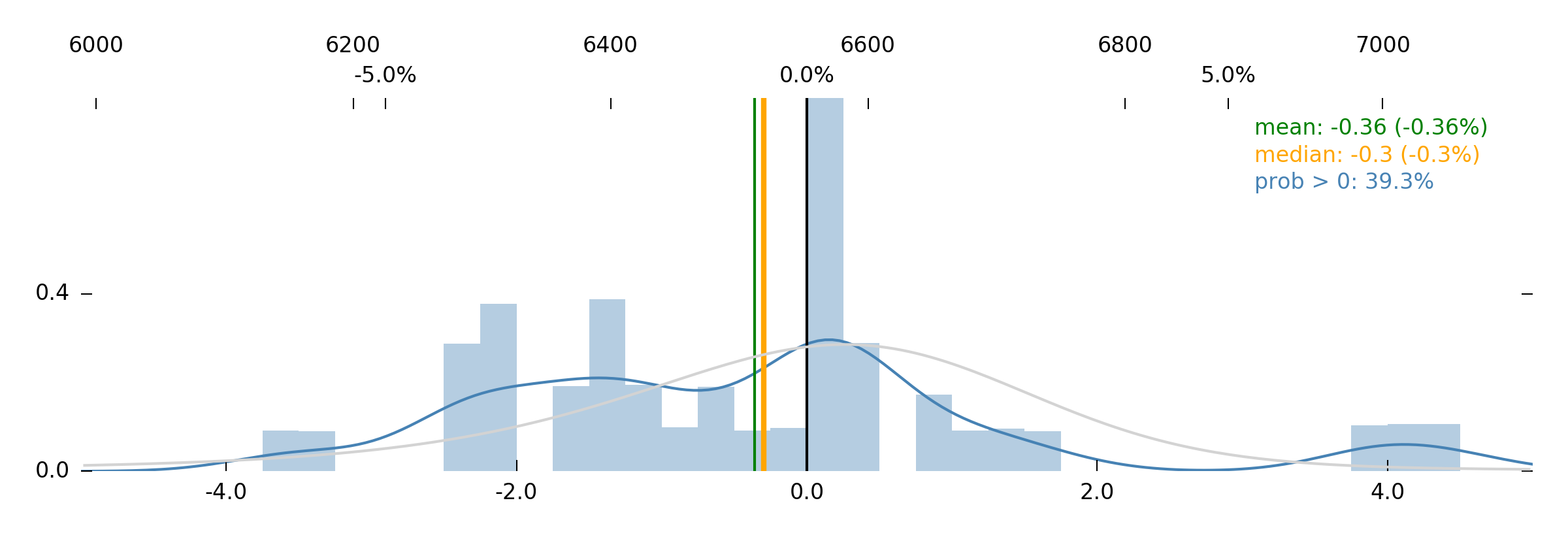
In support of our own bearish sentiment—for the first time in what feels like a century—is the inimitable Robot Jim.
Yowza, look at that distribution. A probability of upside of 39.3%? A lump of advantageous probability down at –2.0 MAD? The distribution is huge. Tails abound.
So can we just assert that we think there's a lot of potential downside here? And that a 21 VIX means we'd be fools not to take the bet?
So that's it. We're going to happily buy a put (1-month, ATM), and we're going to be satisfied with whatever happens.
That's it. That's the note.
Enjoy the week!
The SqueezeMetrics Team