All the charts and data we refer to can be found on the Yacht Club page.
Hey everyone,
This past week, in all its excitement, afforded us an opportunity to think more about this:
We'll need a sense of play. Of whimsy. We'll need to revisit old concepts to view them through this new lens. We'll need to try out some new things, too: Data and methods. We'll need to talk more about single-name equities, where a lot of these opportunities may lie. We need to be degenerates, but scientific.
So maybe that's it: Our ambition is for 2023 to be the year of Degenerate Science.
Since we have no idea what "Degenerate Science" means, though—or how we ought to actually look for long vol bets—we thought we'd do what everyone else does: Blatantly launder some legitimacy with a comparison to real science.
But first...
- Getting Started
- Not So Fast
- Schrödinger's Call
Getting Started
Overall, we felt pretty good about the week. We had no strong directional outlook, but we mostly had the right idea, and we weren't surprised by any of the wiggles.
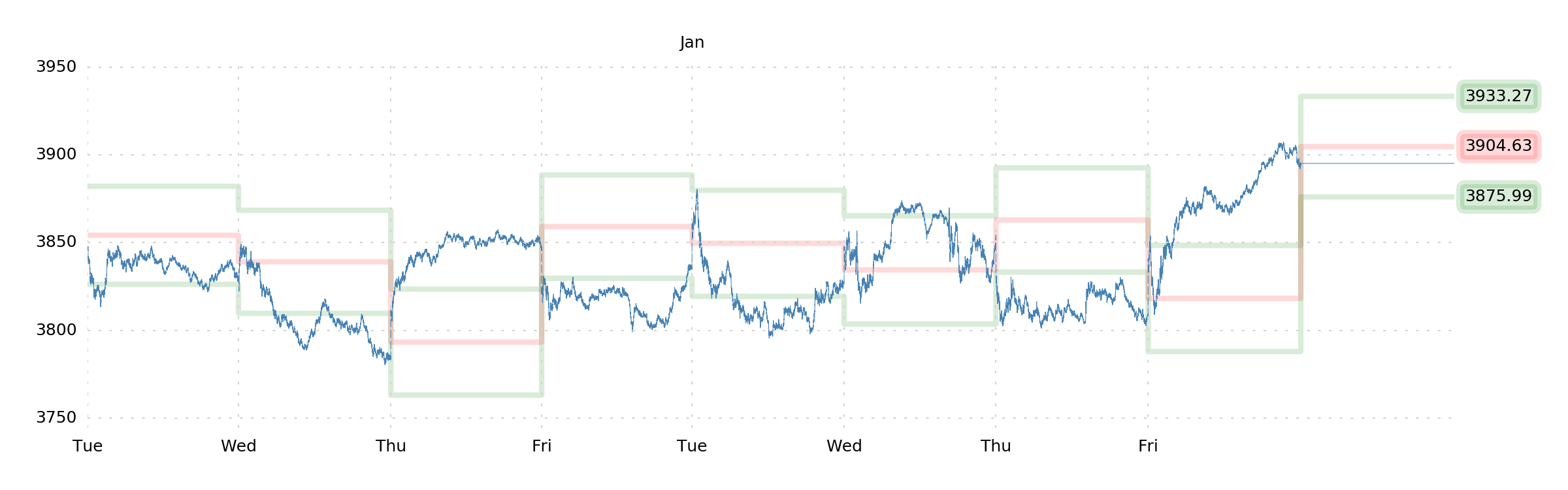
We favored modest upside on Wednesday (from Tuesday's put-buying), modest downside on Thursday (the put-buying stopped), and then a slightly larger range on Friday (3750–3900). We thought Friday would lean bearish intraday, though, so we ultimately took a li'l loss on the week in E-minis.
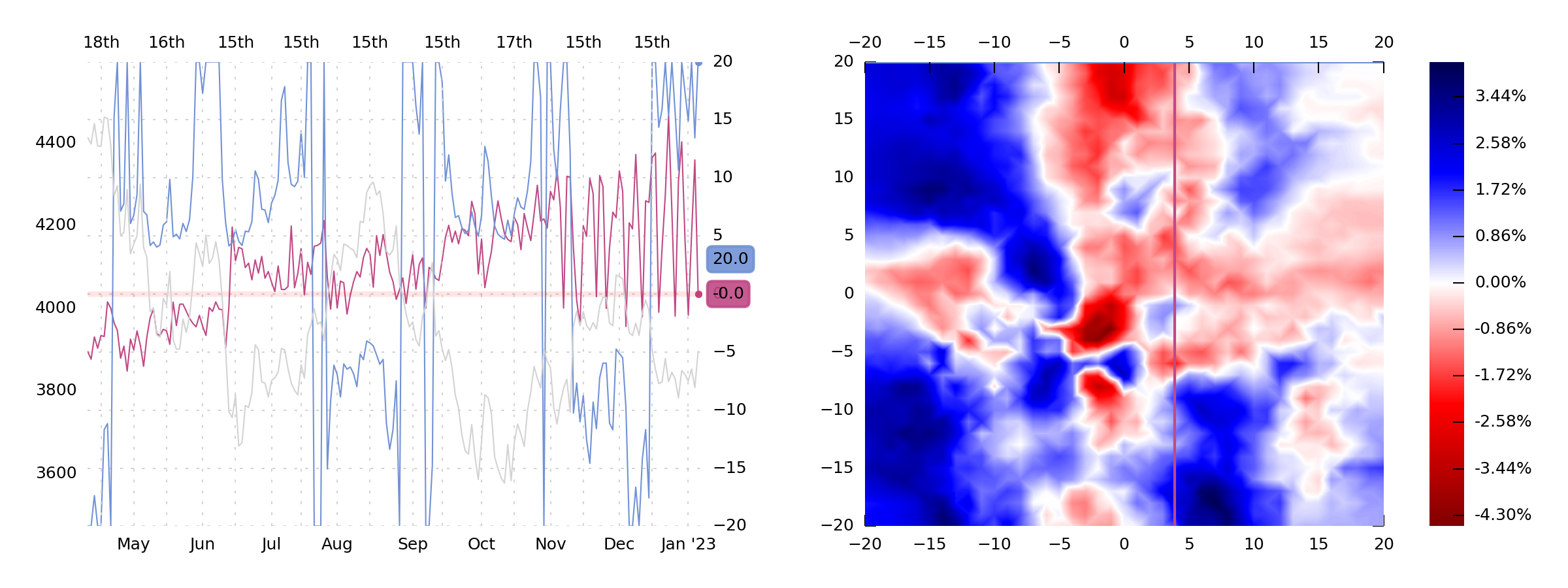
The current positioning/flows situation is probably best expressed by NPD, which has continued to exhibit a curious pattern (read: choppy mess).
Why does it look like this?
Yes, it's because of near-term option trading (e.g., 0DTE, 1DTE). While there's been a reasonably steady flow of sellers in the farther tenors for quite a while now, the activity in front-week options has been very indecisive. Sometimes you see net buying, sometimes net selling.
Because the delta impact of that near-term net buying can be very large, NPD has been poking at 0 NPD a number of times recently (ever since November)—though the rolling 1-week average NPD (which is what Robot Jim uses for forecasting) has been hanging out around +5.00.
Friday's NPD was exactly 0.0. Meaning that for every dollar of put delta bought by customers, there was one also sold.
It is always worth noting that 0 NPD is a reason for caution, and a foreshadowing of vol-of-vol. So if we get some more prints near zero, there will likely be an edge in long gamma.
But let's not get ahead of ourselves.
Not So Fast
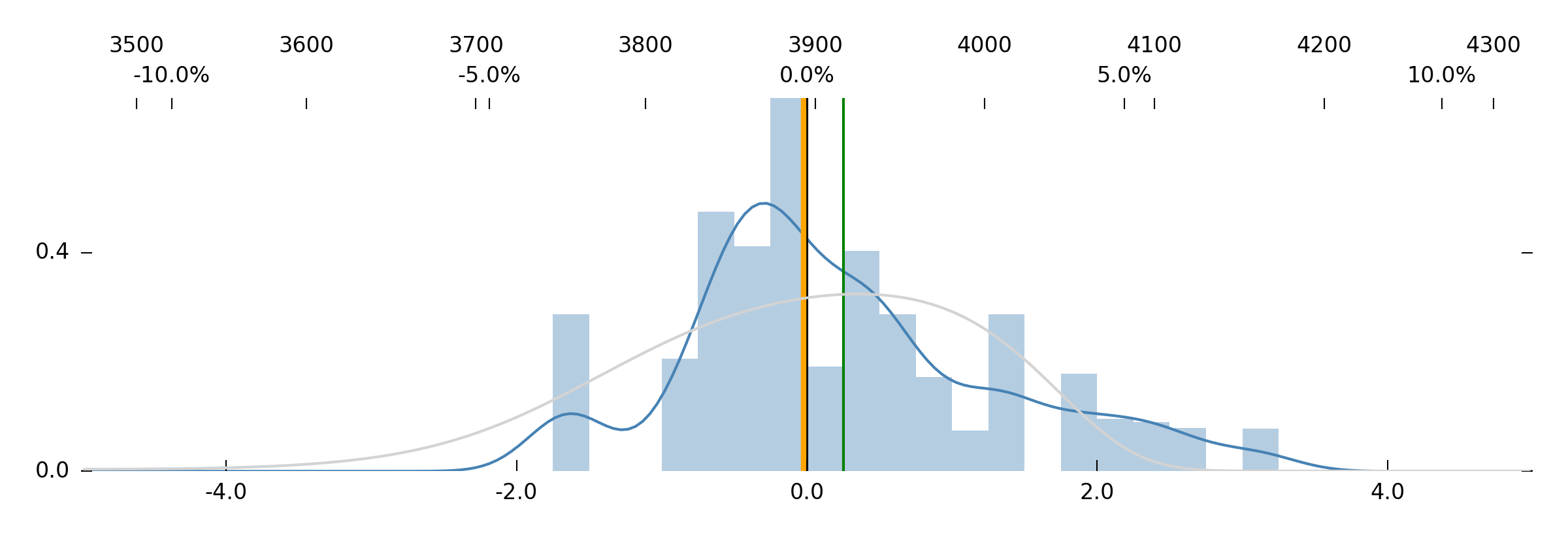
In reality, Robot Jim's 1-week forecast looks an awful lot like it's looked for the last couple weeks, and it's hard to get excited about that.
The mean is above 0 because there's a fleeting right tail advantage, but the median is squarely set at 0.0. This means that, for all intents and purposes, we don't have a directional edge. And like so many of our recent forecasts, this looks pretty boring—with a bit of favoritism shown for a small decline (mode of distribution <0).
It is not hard to imagine why a small decline is favored. Ceteris paribus, customer-sold puts decay in such a way that cause dealers to sell the index as time passes. So it's natural for price to decline, absent other forces.
Of course, you could also just say, "That distribution looks like a bear market" (good probability of drifting down, small but +EV probability of a big "bear market rally"). This is a correct observation. Jim is telling us that this is still very much a bear market.
Taken together, this makes us want to take a little bet on mean-reversion. A bet on SPX making its way back down toward 3850.
However...
If you look at the 0 and 1DTE put-buying activity on Friday (see the Chart Appendix PDF), you'd get the impression that a whole lot of other people were keen on making the same bet (and that they started taking this bet starting around 2pm on Friday, betting the rally had gone too far).
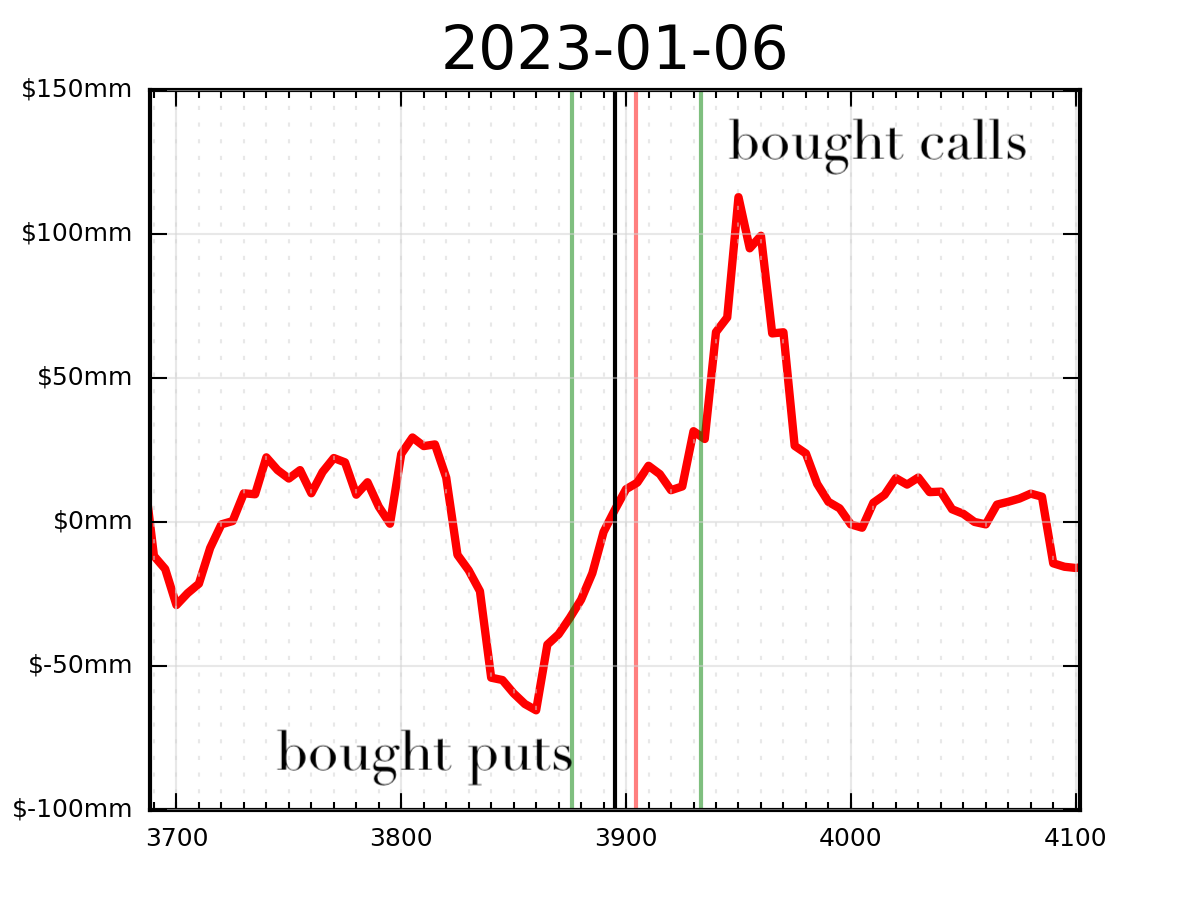
And the upshot of that new positioning is this 0DTE dealer plot.
Dealers are net short gamma around spot right now—a very unusual set of circumstances relative to the last couple weeks. And this means that there will be a good deal of selling pressure (-$50mm) if SPX cruises down to 3850 tomorrow, and a whole ton of buying pressure (+$100mm) if SPX cruises up to 3950.
This makes us take that underpriced left tail on Jim's forecast a bit more seriously again. It could happen. There are actually reasons for it to happen now.
And that makes us think that a little OTM call position on some high-beta trash might be a nice bet. The SPX option complex actually supports the possibility of a rally in growthy stonks right now, which has not been the case recently.
So really, Jim's distribution seems like an appropriate guide for the week: Good possibility of SPX converging back on 3850 or lower, but some potentially juicy edge in the right tail—if only temporarily.
We will dance through this week with these things in mind.
Now let's talk about Science.
Schrödinger's Call
"You start by looking for cheap vol."
That is how everyone begins a conversation about buying options. Maybe you'll screen for objectively low IVs, or maybe you'll screen for low "IV Rank," but either way, the idea is to look for something "cheap." Everyone knows that vol is a "mean-reverting process," right? So buy it when it's low, and sell when it's high!
And if your goal is to find long vol opportunities, this might make enough sense that you'd be compelled to try it, or at least to make it a big part of the way you think. But you, dear reader, probably either know—or at least suspect—that this isn't going to work, no matter how hard you back- or forward-test it.
We're not interested in proving or disproving it, though; because what we want to address about "screening for low vol" is that it's fundamentally, conceptually doomed from the outset, and it isn't even worth trying. It's intellectually lazy, it's reductive, it's defeatist; and it is intrinsically the wrong approach to the problem. Yikes.
Why, though?
Well here's where we pull in the "real science" allegory.
...
In quantum mechanics (the world's most popular intellectual affectation), there's something called the "uncertainty principle."
Basically, the idea is that the location of, e.g., an electron, at any given moment, is uncertain; and if you try to home in on the exact position of the electron, you are less able to measure the momentum—owing to the methods you must employ to find the position. So there's a tradeoff between knowing approximately where the electron is, and knowing the wavelength of the wave-particle.
Ultimately, the best you can do is to accept a probability of where the electron is hiding and what it's doing. There are many different possible states, and we're simply not privy to which one is "true" at any given moment. Thus, "uncertainty."
Of course, folks don't respond well to uncertainty, so people all thoroughout the 20th century got their bowels in an uproar about whether the fact that we can't find the answer actually means that there's no objective truth (that, e.g., the electron isn't actually in one place at all, but rather in some weird meta-real state where it somehow coexists with itself in multiple physical locations). Some were willing—delighted, even—to claim that this "quantum state" of probabilistic unknowability cascades into other facets of reality. Cue nihilistic philosophical discussions on "quantum determinism" absolving us of moral culpability and other such intellectual onanism.
Erwin Schrödinger, though (clever fellow), found this all very distasteful, and came up with a droll thought experiment where a cat in a box somehow gets killed by radioactive decay—and the exact moment which the electron gets slung off is unknown. According to this "quantum superposition" idea (whereby the electron's position is actually, simultaneously in lots of places at once) we must accept that the cat—whose fate was completely tied to this unknowable quantum determinacy—spent at least some time inside the box simultaneously alive and dead.
Schrödinger argues that, just because we can't find the exact answer of when the cat met its unhappy fate, doesn't mean there is no answer. Cats obviously can't be dead and not-dead at the same time, and we can't just declare a bunch of stupid "alternate realities" because of our inability to measure something.
(Ironically, Schrödinger's thought experiment is mostly used nowadays by pop-science cretins to explain why there must *indeed* be infinite possible universes brimming with undead zombie cats—exactly the nonsense Schrödinger was fulminating against.)
Anyhow, his thought-experiment concludes with a brilliant aphorism that we'll be printing out and hanging on the wall (
p.8):
There is a difference between a shaky or out-of-focus photograph and a snapshot of clouds and fog banks.
...
Fog. Dead cats. Why are we talking about this?
Because that aphorism is exactly what we need. Schrödinger insisted that it was "naive" to accept a "blurred model" of reality. Just because you have a hard time measuring something or can't get perfect precision doesn't mean that there must be multiple universes and we exist in a simulation and perhaps experiencing the color green isn't a necessary precondition for the genus "human" in a hypothetical semantic tree—those questions are for stoners, or philosophers.
Indeed, the scientist, to the extent that he accepts the "uncertainty principle," then sets to work on rigorously defining those probabilities inherent in the problem of measurement. And it's those probabilities that Schrödinger is referring to as a "snapshot of clouds and fog banks."
So, to the extent that we have a picture of a cloud (i.e., a probability density), we ought to be expending our efforts on that—not on extrapolating "uncertainty" to mean that we won't be able to figure anything out, ever. Is there some alternate timeline in the multiverse where our TSLA puts actually paid off? Maybe. But it's not doing us any good to think about it.
This is the trouble with "screening for low vol." It's an epistemic shrug. It's reductivist in the same way that believing in undead cats is reductivist. It's lazy. It's defeatist. It's losing the battle before it even begins. There's no progress to be made from "buying a call on XYZ because its 'IV Rank' is really low." To the extent that there's causal inference there at all, it's dismally weak.
Rather, we need to find real, sensible reasons to believe that a the probability density favors buying a particular option. And if our probability density isn't good enough, we can try to do a better job at measuring. The idea of "screening for vol" is defensive, negative. Unfortunately, something that's "cheap" can always get cheaper (especially an option). We need, rather, to be aggressive, positive. We don't care what the option costs, as long as there's some reason to believe it could get way more expensive.
This all might sound a bit crazy, a bit contrived, or a bit nitpicky. But as we begin to think about our Degenerate Science, this seems foundational. We don't want blurry photos. We want nice, crisp shots of clouds. There's a really big difference—and we're pretty certain that this will be the difference between success and failure when it comes to trading from the long side.
We're going to need some perseverence for this.
And cats. Lots of cats.
Enjoy the week!
The SqueezeMetrics Team