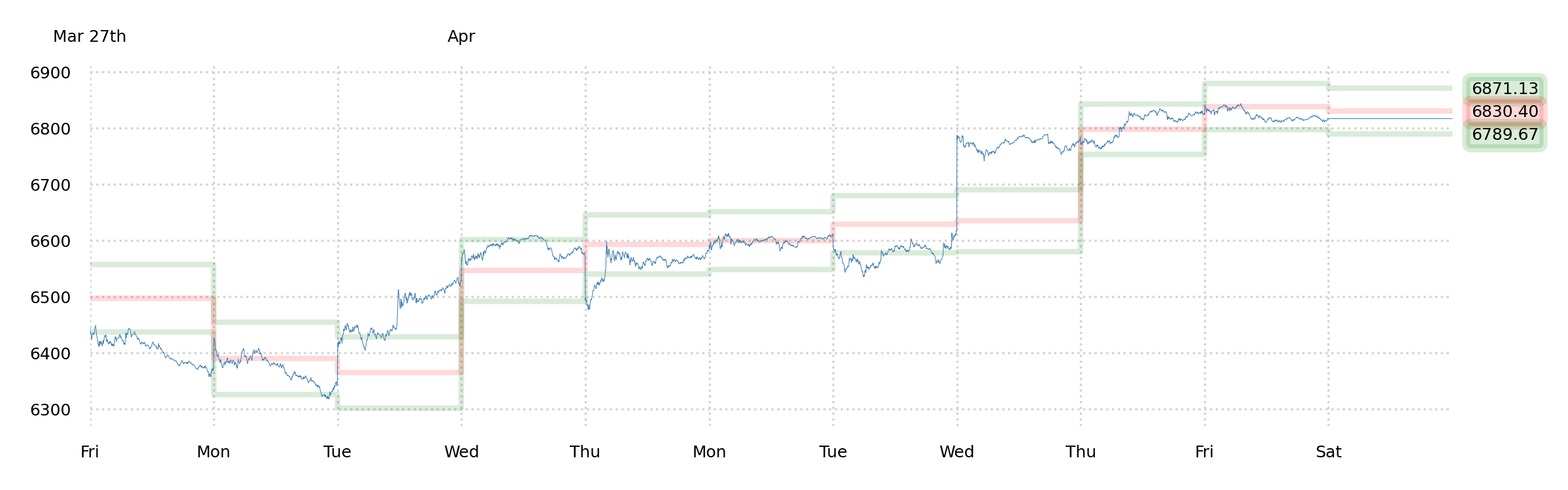
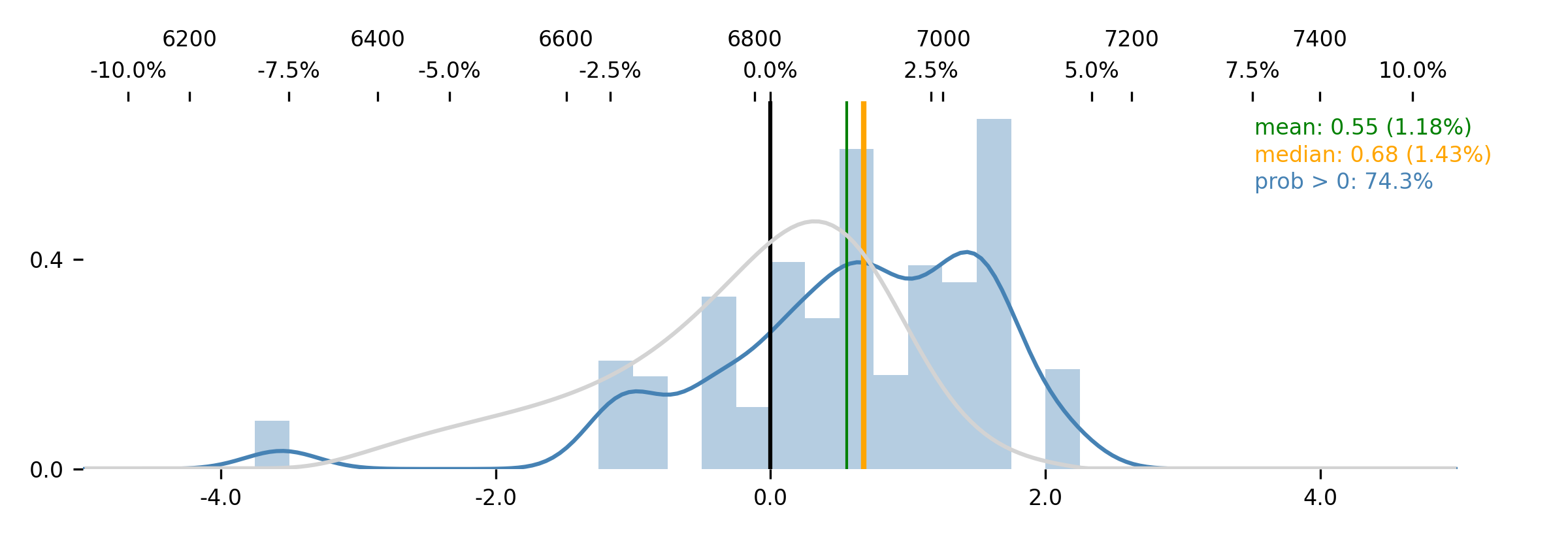
All the charts and data we refer to can be found on the Yacht Club page.
Hey everyone,
Last weekend, we updated the API to make it a bit easier to use. So that was cool.
This weekend, we're going to talk about modern art and reality and truth and the theater.
Sorry.
...
The feature of modernity that most animates markets is relativism, and as a symptom, reflexivity. We've made much of this in the
past. Objective truth is always "mediated" by price.
Stock prices go up and down because people buy and sell stocks, and people buy and sell stocks because stock prices go up and down. It's a mirror-within-a-mirror, the crowd seeing the crowd. A self-referential loop of "information." Subjectivity par excellence.
But objective truth is also mediated by the "media." In the last few decades, this hasn't mattered much to the market, since the role of financial media has been highly regulated. Trump, and his
"disintermediation of the media," threw all that out in the trash.
The media is a lot like a market-maker. It is a medium (it's literally the plural of medium). It is an anchor. It is meant to represent some truth to its clientele, and it thereby provides an immensely valuable service. You can, cynically, argue that the media is stupid, or crass, or that it's corporate and evil, or that it merely "manufactures consent"—but you must admit that it nevertheless provides some baseline, however inaccurate, for public awareness and discourse. It quotes an NBBO for the market of "things that happened." And thus, we can imagine that a "disintermediation of the media" would make things a bit more chaotic, unhinged.
The first big symptom in the market of this new arrangement took place
a year ago, when Trump held the market hostage, threatening to tariff everything—not for any real purpose except to "manufacture" a narrative.
Now let's be a bit cynical: Trump is a showman. We needn't doubt his sincerity regarding his goals to know that he also likes a good show, and he'd certainly like to deliver something more tangible to the average American than "trade balance." So let's take a moment to appreciate the beautiful, dramatic symbolism of tearing it all down and building it back stronger. Of purgation and new beginnings. Of sacrifice and reward.
Viewed through that lens, this—what you are experiencing right now—is a trust fall.
If you are constant and loyal, and if you believe in him, you will be caught, and you will be rewarded; because once this is all over, everyone who bought the dip because they believed will be justified—and rich. And everyone who tore their hair out and sold will be laughed at (and poorer) for their unbelief. The greatest show on Earth!
The "trust fall" seemed very likely to result in a big, dramatic buying opportunity—because that was the point. You were rewarded for "playing along" with his weeks-long, one-man show. For laughing when you were supposed to, and applauding at the end.
This next act, though, is even more daring. Even more modern, even more transgressive!
Will we be rewarded if we play along?
- Hung out to dry
- Out on a limb
- Chekhov's gun
Hung out to dry
We began the week with some reservations, and with a bearish-neutral outlook. We noted that Robot Jim had a tight, mean-reverting step-forward, which suggested that we flip between short and long in a fairly tight range. We danced to this, and to the 0DTE maps, which had a good amount of information.
It went fine (better than it should have), but "bearish-neutral" wasn't the way.
By the end of the week, we were meaningfully short S&P via E-minis, and we were waffling about converting those E-minis into SPX puts to benefit from potential vol.
It wasn't working.
Now what?
Out on a limb
Jim's bullish.
We're on our own.
The raw data simply does not support being short this market. But we just can't get over our subjective feelings.
So let's talk more about those.
Chekhov's gun
You are in a modern art gallery. There's a single magenta brushstroke on a canvas. A whole, plasticized pepperoni pizza is draped over the edge of a coffee table. A banana is duct taped to the wall. Each of these "pieces" is on loan to the gallery from some "investor-philanthropist," and each was last sold for at least five million dollars. Is this art—or is this fraud and money laundering?
Why not both?
What matters much more than what comprises "art" (we could argue about that forever) is the face you make when you look at it—which is going to depend on the circumstances. On one end of the spectrum, you might touch a finger to your chin and frown, nodding meaningfully; at the other end, you might proclaim loudly, "my nephew could have done this, and he's two!"
Which one of these responses you choose is dependent on the current social circumstances: Is it crowded? Are the other people apparently admiring the piece, or giggling at it? Are the patrons wearing fancy clothes? Is the artist present? Are you there with your girlfriend who studies at the Tisch school? When you really think about it, it becomes a very complex question of social status, and value, and truth.
Like a banana duct taped to a wall, the question of whether the Trump production is modern art or fraud and money laundering is not the question (why not both?). The question is how we respond to that production. And since we, being single-minded and cynical, are chiefly interested in how to make money—our question is how this production ends.
In Act One, a year ago, we were captivated by the "trust fall." The lone Theater Kid strutted and fretted his hour on the stage, muttering a monologue, wondering aloud what to do with this loaded gun in his hand. Should he shoot himself? Should he shoot his audience? Or should he show mercy to the spectator, and grace to himself? "I'LL DO IT!" "Or maybe not."
Perhaps you have heard of "Chekhov's gun."
If in the first act you have hung a pistol on the wall, then in the following one it should be fired. Otherwise don't put it there.
It's a narrative principle for the would-be author. But what if the author is a madman, and has no such principles?
In Pirandello's absurd, "meta-theatrical" Six Characters in Search of an Author (1921), there's "no author": The players ramble and argue and declare they are the audience, and then the stage crew are acting inside of a play-within-a-play, and then the players declare that the play is "madness," and then someone drowns, and then someone shoots themselves, and then the players are confused about it, and then the curtain falls. Fin.
What is narrative?
What is acting?
What is reality?
Perhaps we're being uncharitable—but honestly, we find these kinds of productions insufferable. It's the navel-gazing faux-intelligence of a precocious, overindulged child. No, it's not interesting to disassemble, in so many words, "objective truth." It's just histrionics, and an abuse of a hostage audience.
What's interesting, to us, is the point at which the audience responds negatively to the abuse. When does a plurality of spectators agree that the soft, bruised, $5mm duct-taped banana is just... kind of stupid? At what point does the crowd tire of the second act of the play, when the gun is the biggest, most loaded gun that's ever been loaded, and the main character is more uncertain than ever where he should point it and whether he should pull the trigger?
Yes, we already said that in the modern market, "objective truth is always mediated by price." And last week, the market said that the war ("I'LL DO IT!") now became a ceasefire ("Or maybe not."), and the market didn't particularly care that the reality on the ground didn't reflect that, because, well, price had gone up, so... it must be true! Subjectivity. Reflexivity. Et cetera.
But there's a limit to how much credulity even the market can lend, and how much of a narcissistic Theater Kid's narrative violations even the thoroughly modern man (accustomed to madness) can tolerate. Shoot the gun or drop the curtain already!
And so we have a feeling, just a feeling, that the market won't be able to suspend disbelief, and to laugh and applaud for this Act Two of the "trust fall." Not only does the prospect of an immediate reward seem much less likely, but, glancing around, people seem much less interested in pretending it's clever and playing along.
Do we, dear reader, seem naïve in expecting a rational response from market participants? Perhaps—but let's reassert our underlying cynicism: We believe that the way to make money in the market is to prey on the fears of your counterparties, and the path that gently assuages the collective fears of market participants is the most likely path.
And today, the foremost fear is the "fear of being wrong," the "fear of missing out," or the "fear of appearing a fool." Better to buy a good chunk of stock exposure now than to wait and be called a "sucker" and a "panican" all over again. Right? In just a few short months, we could all be golfing with our clients and laughing at how stupid other people were to actually believe that Trump was actually going to "end a great civilization" and "bomb Iran to the stone age," et cetera. Comedy gold! Don't those fools understand the Art of the Deal?
The upshot is that people bought a lot more than they should have this past week. They "frontran" another "trust fall," betting that it would all blow over. But ironically, this makes it less likely to all blow over. The most likely outcome now is the one which directly addresses these fears—SPX settles a bit lower. The upside that people were afraid of simply doesn't materialize.
If this sounds like an unsatisfying answer—we agree. It's not very dramatic or interesting. But it's the ironic answer, the cynical answer, and probably the right answer. The most likely outcome is for the S&P 500 to settle a bit lower than it is right now in the coming days.
Now where this
could become interesting is if the coming weeks become a mirror image of the later stages of last April's drama, wherein portfolio managers' vega hedges
stopped working, and eventually led to a real selloff.
Because S&P is down 8.00% in the last month and VIX is only 21, that is a problem. It means that, as a PM who uses SPX vega / VIX products as a hedge, I am probably losing a bit more money than expected, and moving uncomfortably close to some risk limits. In recent years, this has given rise to a certain
"bad behavior," whereby PMs appear to hold their breath for a little while and then deleverage after a rally. It's actually remarkable how
replicable this has been.
For this to happen, you would want to see SPX trending down over the next couple weeks, and for VIX to remain unresponsive. This would tee up "real" volatility, just like it did the first time. But with a bit of extra powder from Chekhov's gun.
For our part, the fear and the narrative fragility that we sense here is enough to make us want to continue holding our short SPX delta. We don't need the promise of new lows—even though we'll be watching for these circumstances.
Bearish.
Now before we wish you a fortuitous week, dear reader, let's echo a timely disclaimer from
exactly one year ago:
We aren't being facetious when we say that all of this is a "game," and "subjective," and "fake," and we really do think that you need to equip yourself with a harsh cynicism if you want to understand what's going on and to succeed at your job right now. This comes at a cost, however, in that you may start to identify yourself with the sharp-edged intellectual tools that you must use to navigate a harsh market.
Indeed, cynicism is a tool, not a personality. Irony is a sad truth—it's worthy of a sigh, but not worthy of bitterness or schadenfreude. Don't become the tools of analysis that you must use. Equip the tools, and then discard them. The workman does not eat his dinner with a shovel.
So whenever you're given the opportunity this week, go hard in the opposite direction. Listen to Beethoven's 6th. Take a walk in a pine forest. Seek out some moss and stone and dappled shade. Pick some wood sorrel. It tastes citrusy, you know. Isn't it all so grand and beautiful?
Enjoy the week!
The SqueezeMetrics Team