All the charts and data we refer to can be found on the Yacht Club page.
Hey everyone,
When the market is doing interesting things, we usually like to keep our notes short[er] and [more] to the point; because while lucidity is always in demand, it truly commands a premium when there's volatility to contend with.
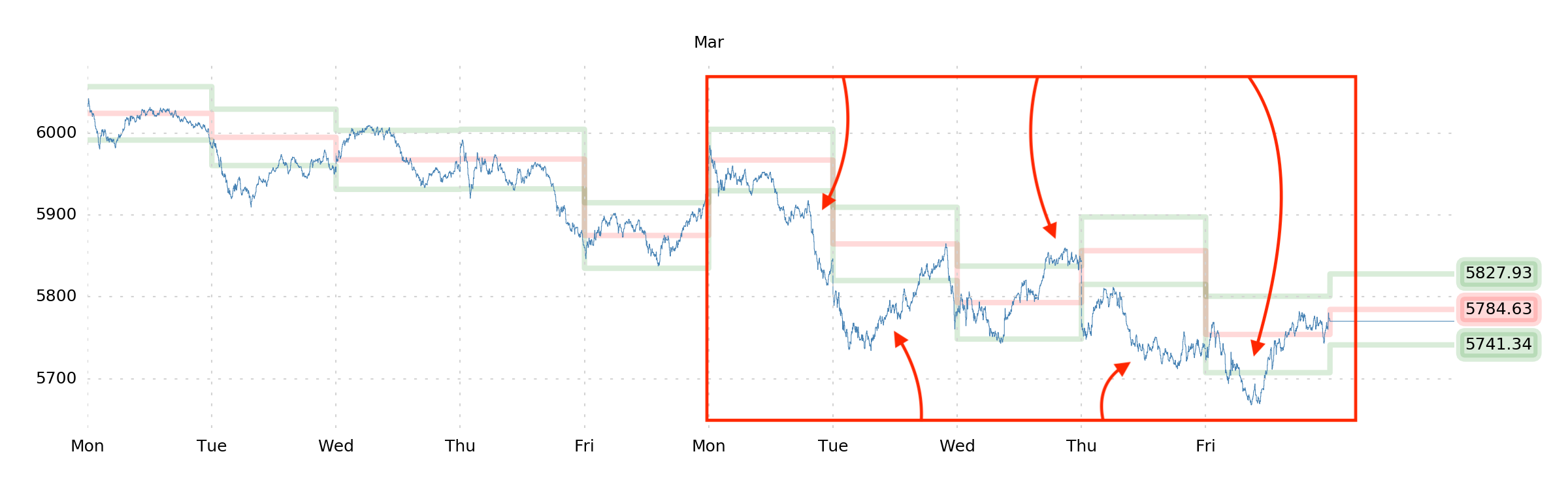
And there has been some volatility to contend with lately. For context, recall that the Support-Momentum (SuMo) bands represent useful guideposts for intraday trading and volatility expectations—and that every day this week spent time outside of the bands.
That is a lot of wiggling.
At least partly, however, this is a testament to how muted the response of implied volatility has been to this downturn—because the SuMo bands are derived from the 1-month SPX ATM implied volatility. The 1-month S&P straddle, right now, implies a 1-month average move of... just 4.5%.
To put that in context, SPX just fell 4% in the last two weeks, and has been moving, close-to-close, 1.29% per day on average over the past week. An average move of 1.29% corresponds to an ATM volatility of >25%. But the actual SPX ATM volatility is a measly 19–20% right now.
This is all to say—it makes sense to be long SPX options. They're either fairly priced or cheap pretty much no matter how you slice it, and that's wonderful. On
Friday morning, we took advantage of this situation by buying an ATM call for next Friday, trading our long E-minis for what we thought were cheap SPX calls.
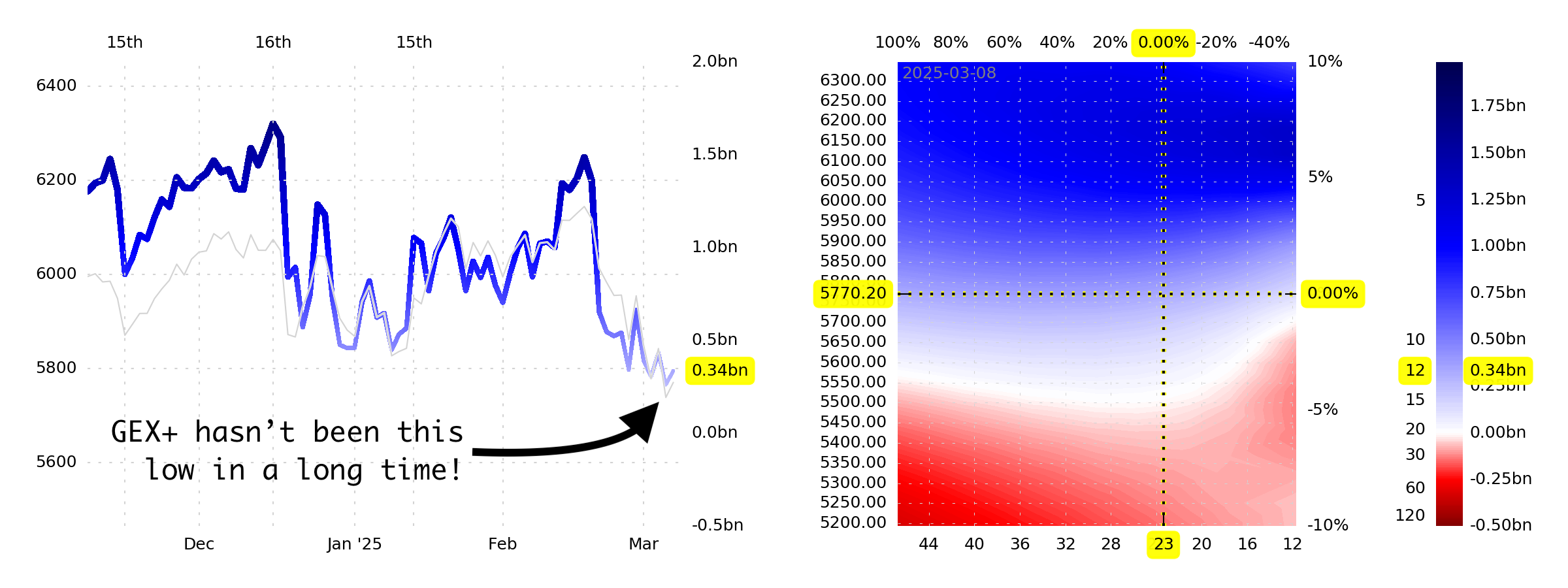
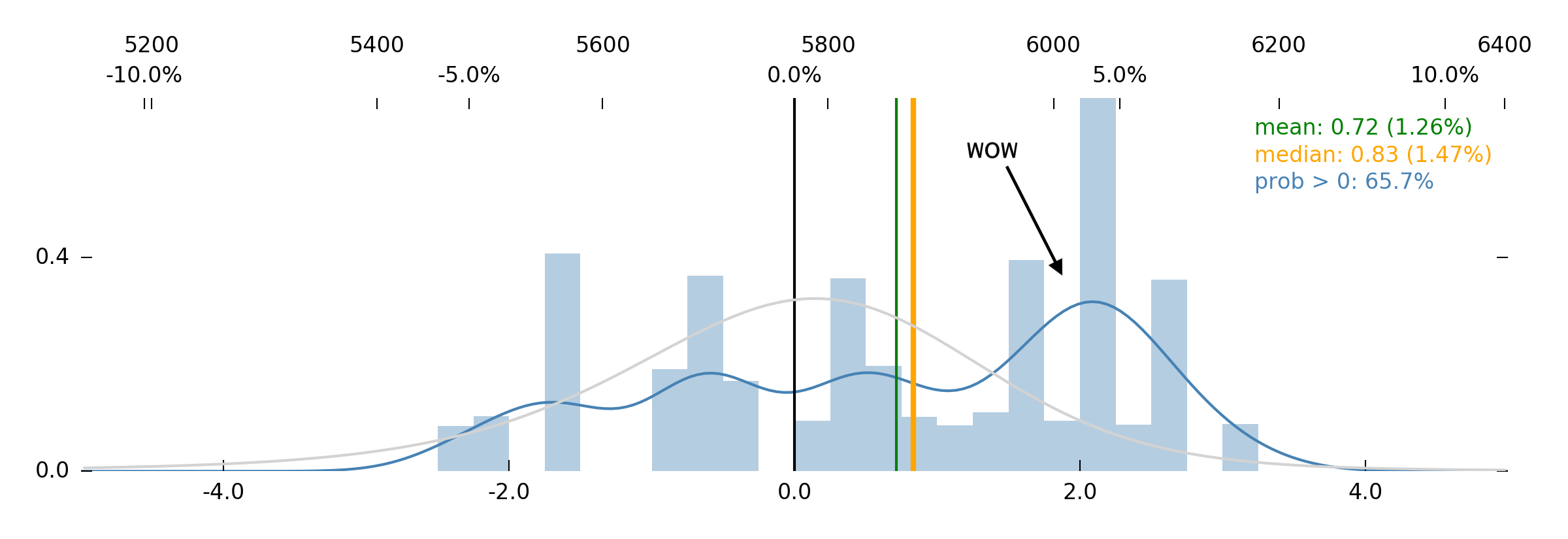
This weekend's data once again bears this out as a reasonable idea for a trade. Note that, on Jim's current 1-week forecast distribution, the clearest source of edge is the strong possibility of a +2.0 MAD move. This would imply a total reversal of SPX to 6000; a retrace of that 4% decline.
This is an ideal situation to own calls (and if we're being honest, it makes more sense to own OTM calls, perhaps struck closer to 5900, than our own ATMs). We don't really have to believe anything in particular about tariffs, or whether America is Greater now than it was a week ago, or whether the Bundeswehr is big enough to repulse the Soviets—the data gently points toward an outsized and underpriced possibility of a rally. And that's the making of a good bet.
At the same time, however, we have to qualify our "bullish" outlook here with what has by now become a common refrain (literally repeated every day this past week): The data also tells us to "buy the dip, sell the rip."
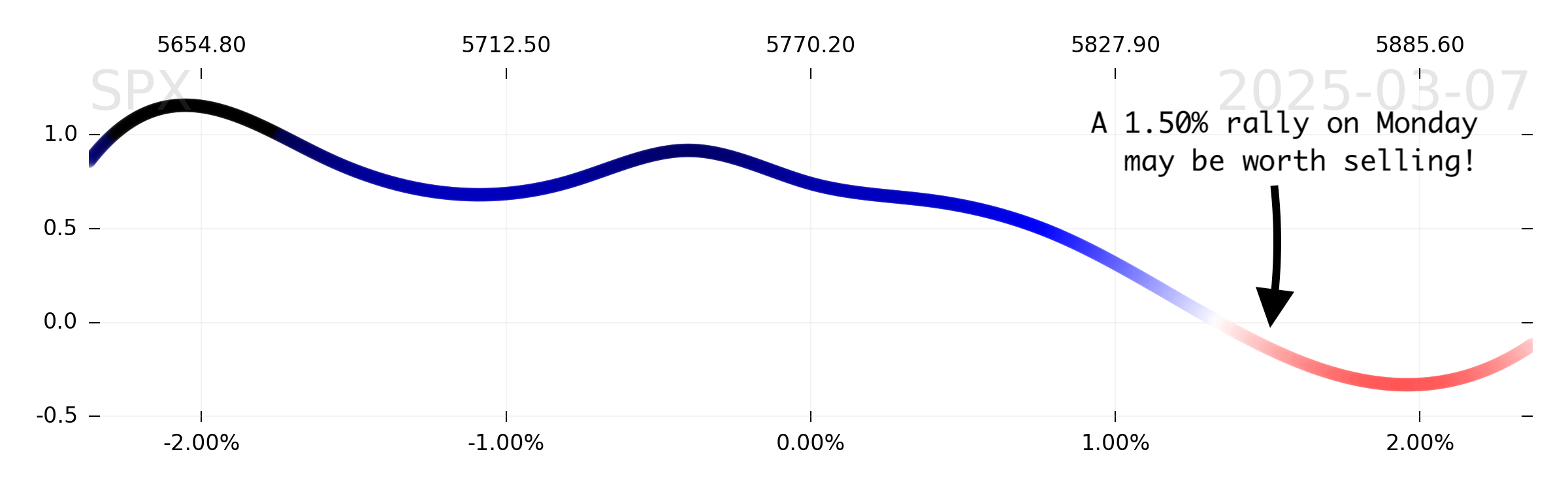
This can still be seen quite clearly in the step-forward plot.
If we do manage to rally some 1.50% on Monday, this plot suggests that Robot Jim's subsequent forecast won't be so balmy. Suddenly, Jim's forecast will reverse!
How do we thread this needle?
Well, our plan is to delta-hedge. We will hold the call that we bought, but in the event of big upside on Monday, we'll sell short some E-minis against it. Ta-daa! That way, we maintain our long-gamma, long vol bias, while also being sure to take some profit as the opportunity arises.
We flatter ourselves in thinking that this all sounds quite reasoned and logical. Upside bias given the data? Natural. Sensible. Delta-hedging a call? Sobriety itself. Cool-headed professionalism.
So let's be sure to mention that, so far, our "logical" explanations of index action, and our [more-or-less correct!] idea to "buy dips and sell rips" has still netted us nothing more than a –2.84% portfolio loss this past week. It hasn't been all sunshine, lollipops, and rainbows. We can argue all the we want that we're doing the "right" thing, but it hasn't turned a profit.
Although part of that loss is coming from another position...
Let's talk about that.
On
Wednesday, we bought bonds! Our
intention is to hold on to this position for a while, since we think it has longer-term potential. The instrument of choice was CBOT bond futures (leverage and tax considerations). The reason to buy bonds was multifaceted. Let's try to reduce it to a checklist.
- CFTC's CoT ULTRA BOND Dealer Short positioning at 135,000 (highest since we've started watching in 2022), predicting modest 1-month upside in TLT.
- Bonds trending up. Trend is demonstrably useful in bonds.
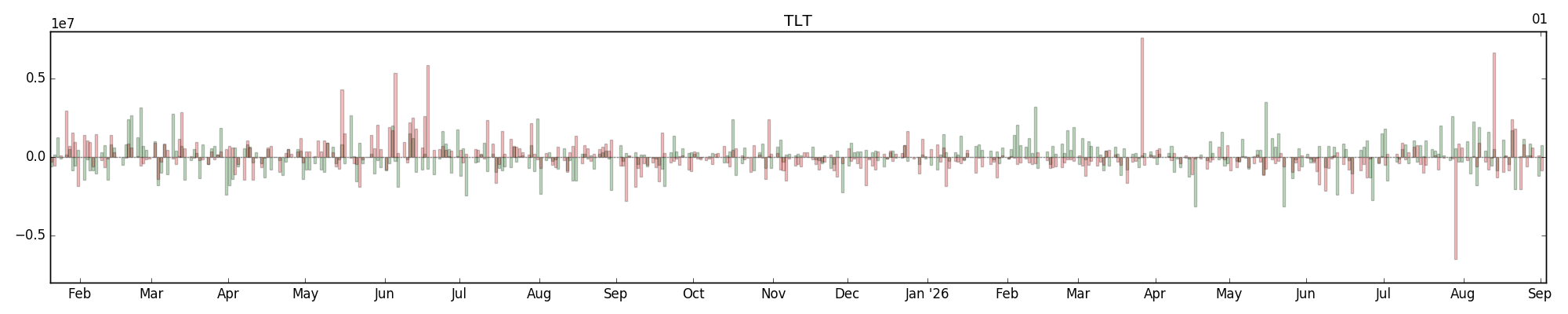
- In TLT option flows, the insane call-buying stopped. Those bought calls started bleeding deltas over the past week, and they should no longer inhibit bond upside. Recent flows have been neutral to short delta. Bullish!
- Commodities and oil have been trending down. This is strongly associated with positive TLT returns on the 1-week timeframe (see the k-scope).
Now, if we're being clear-eyed about this, we have to admit that each of these signals can revert, and that really, they're only useful up to the 1-month forecast range anyway. But that's a good thing, because it means our positioning is readily falsifiable and that we're not just blindly buying bonds because we like catching falling knives and other types of masochism or because we like how good and sonorous and resonant the word "bonds" feels when we gently whisper it to ourselves at night. Rather, we have a "scientific," falsifiable reason.
With that established, let's indulge in a bit of "macro" prattle.
We also like the idea of being long bonds for another simple reason, and that's that people are only just starting to adjust to the idea that Donald Trump, the 47th President of the United States, is not tweeting out the level of the Dow Jones every day. He was expected to do this, but he is not. Instead, he's talking about how he wants inflation down and bonds up.
Does it seem too simplistic to be long bonds because this overbearing bully of a President wants us to be? You may think that—but people didn't think that it was a bad idea to be long stocks if the same bully was going to tell stocks to go up. So yeah.
But there's even more than this, and it harks back to a
prior discussion about the role of the Fed in controlling inflationary impulses.
In the past, a Fed target funds rate of 5.25/5.50 meant that everyone who borrowed would somehow have to make up the difference between [getting paid] 0% and [paying] the discount rate of 5.50%, because the Fed wasn't going to pay you 5.40% (why would they?!) for doing nothing. Today, no such sacrifice needs be made. Today, in a bid to acquire even more control over rates through interest-on-reserves (and, let's be clear, that worked as intended), the Fed appears to have lost a policy lever, and, perhaps, opened a box of unintended consequences.
All other things being equal, this should mean that inflation is now stuck where the Fed commanded it to be—at the imposed discount rate, where there is perfect liquidity for money to be borrowed and lent in any amount, with no frictions. And any subsequent attempt at raising rates further to combat inflation will, indeed, either do nothing at all, or entrench inflation further by setting the new ultimate, global, ultra-liquid, money-clearing rate even higher.
With this interpretation, you could perhaps understand why inflation has, so far, been very sticky. You may also understand why a bet on higher rates of inflation isn't crazy. But what we're not quite sure we understand is what happens in the event that the Fed actually cuts rates (like the market is predicting). Wouldn't that actually be... deflationary?
As traders, we are bit part actors in a grand drama, and as bit players in any grand drama, we are either victims, or beneficiaries, of dramatic irony (there is no in-between). As such, we are always sniffing for irony, because it will either bowl us over and laugh at us as we're liquidated, or it will bowl over our enemies and leave us flush with cash.
The ironic outcome here, which could certainly play out over the next year, is that Donald Trump gets exactly what he wants: Inflation gives way to disinflation. But then disinflation gives way to deflation. And the expectation—that Fed cuts will stymie the spiral—is wrong in A.D. 2025, with interest paid on reserves and no reserve requirements. Thus, just as "tightening" doesn't really work the same way anymore (leaving us with persistent inflation and the longest 10-2 inversion in traders' memory), neither does easing. Rather, lowering the EFFR from here could merely lower inflation in lockstep.
This would be ironic. This would blindside people. This would be the most ironic outcome for Trump trying to bend the market to his will.
And of course, this would be a good reason to own bonds.
Alright, enough of that.
We're long bonds. We're long stocks (via SPX calls). Last week, we lost money and didn't get any work done. But this week is a fresh, blank slate. An open field.
By the way, the air is starting to smell like spring. Most people will never say that spring is their favorite season, because it's uncool to like spring. Spring is too pure. People are too jaded to like spring. Don't be like those people. Breathe it in. It's awesome.
Enjoy the week!
The SqueezeMetrics Team