All the charts and data we refer to can be found on the Yacht Club page.
Hey everyone,
We've made a big deal of "un-tradability" lately. It's been the yardstick by which we measure whether a measure is... actually a measure, rather than a target (a la Goodhart's Law). In other words, when a number that's coming from the market is untradable, we at least know that it hasn't been corrupted by traders, and maybe it will still contain some signal for us.
In the case of VIX, when VIX became largely tradable (with the introduction of VIX futures in 2004), the whole volatility landscape changed, and what was once a signal (pre-2004 VIX) ceased to carry that same signal. We proposed that the signal may have been abstracted, post-2004, into the relationship (specifically, the difference) between SPX realized vol (RV) and SPX implied vol (IV).
And that's what the Realized-Implied Spread Calculation (RISC) is. And yes, it contains signal, even today. Part of the reason that RISC contains signal is that, unlike VIX, RISC is still untradable.
And yet you, dear, clever reader, might argue that spread between IV and RV is very obviously tradable (buy or sell an option and delta-hedge it, you numpty), and that it always has been—so let's ramble about that for a moment. But first...
- Weekly
- Weakly
- Untradability
Weekly
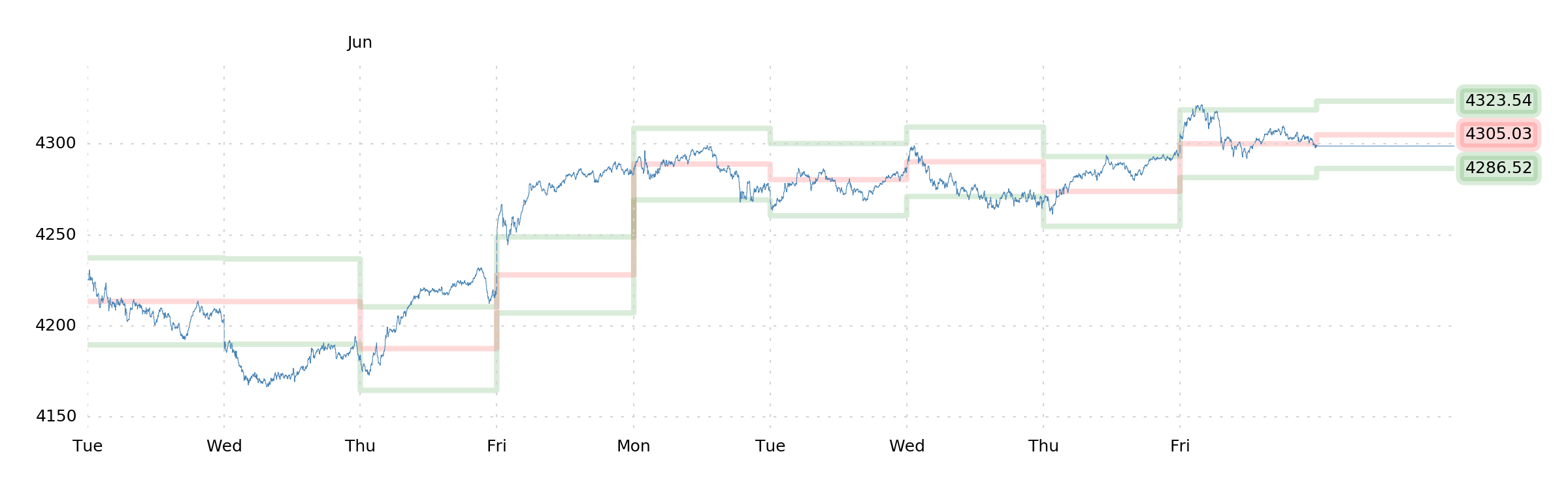
Last weekend, we basically said that the only way the index would get dragged away from this stifling band of high GEX+ is if there's a big overnight gap. Absent this, not only did we expect tight ranges (0.25% per day or so), but we expected to have no edge in buying or selling options, or in betting on a market direction.
Well, there weren't any big overnight gaps, so...
Once again, our engagement with the market was limited to E-mini limit and stop orders. That trading went very well, relying on SuMo bands and 0DTE dealer hedging needs. Our only big fail was a Friday morning bid—we took a bet that Friday's Momentum band would carry SPX higher. Didn't work, index closed at Mid.
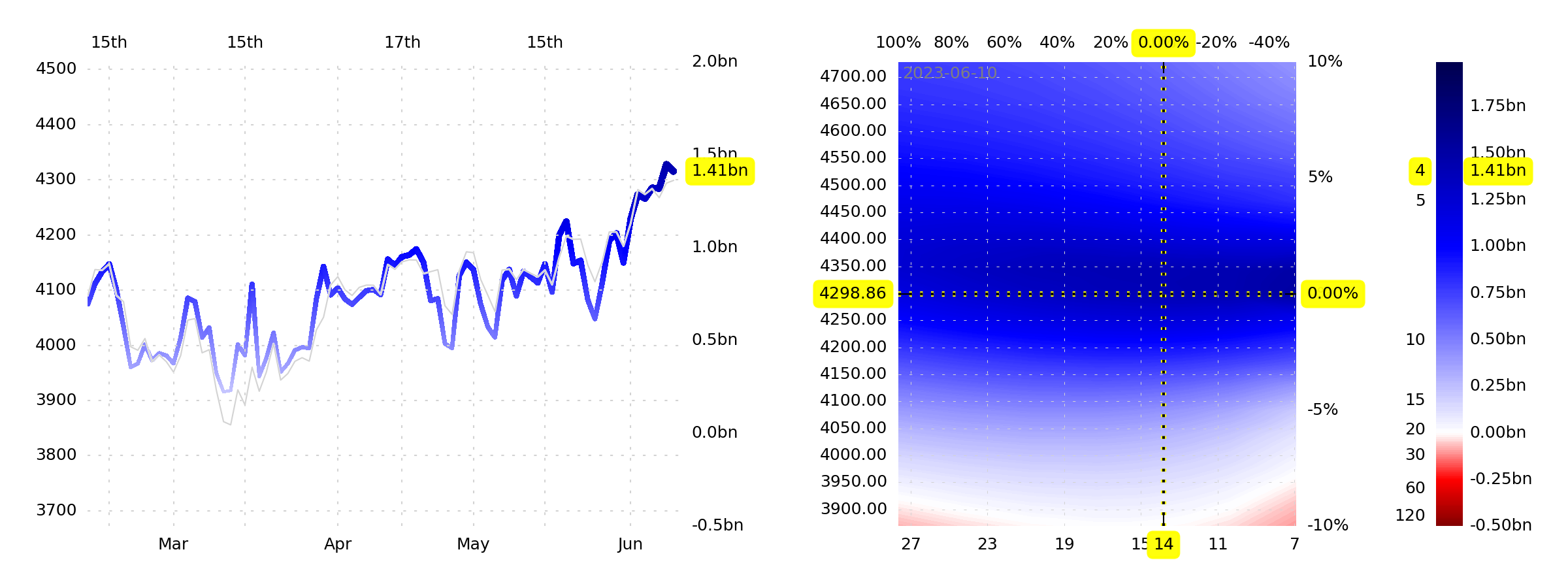
Meanwhile, GEX+ stayed just as high as ever. Like we said last weekend, GEX+ hasn't been this interesting in literally years!
So as we look forward to next week (which, ceteris paribus, doesn't look like it'll be too interesting) let's revisit an idle thought we had back at the beginning of April—right after the March quarterly expiration.
Weakly
Pretty much all of Friday's 1.44% gain was ostensibly squeezing JPM's (JHEQX) oversubscribed SPX collar strategy. The short call strike at 4065 has long been a totem for silly market commentary ("it'll pin there, it's gonna pin, look out for the pin"), and to an extent the dealer long gamma at the call strike has become a self-fulfilling prophecy. But until now, the awareness of the collar hasn't hurt JPM's fund. Friday was the first time it's happened: Folks genuinely frontran the roll and cost the fund some meaningful performance.
Two things can really hurt the JPM collar: If SPX shoots above the call strike before the roll is accomplished, causing the short call to lose money; and if SPX drops and pins the put strike before the roll is accomplished, causing the put to provide no principal protection.
People are now clearly aware of this new game (let's call it "Pop the Collar"), so keep it in mind. Moving on...
Well, one of the reasons that GEX+ is so high right now is that people are trading alongside the JPM collar, which is struck just 20 points above current spot and expiring at the end of the month. Folks are betting that we pin this strike, because that's what's "supposed" to happen.
But as you all know by now, we're big fans of irony, and the ironic inversion of a really high GEX situation that everyone thinks will pin is a situation where call-sellers get squeezed and the JPM overwritten call gets its convexity weaponized against it. This doesn't have to be a high-probability scenario for it to be worth considering.
This is, after all, pretty much what happened in late 2017 through the beginning of February of 2018. Call-sellers got squeezed—and then Volmageddon happened and reversed the squeeze right quick. Now, we don't hope to suggest that this situation is similar in any way except the sold calls themselves (VIX futures were also getting smashed via XIV/SVXY at the time), but it's very much worth consideration that this already-interesting GEX+ situation could become even more interesting.
This is
especially true if more people learn about what's going on—so we've decided to
raise awareness this evening and see what people say, and do, about it.
Is this something that plays out this week? Maybe not, but with FOMC on Wednesday, there's something to be said for positioning speculatively long SPX into Wednesday afternoon in case the call-sellers start suddenly getting offsides, and feel like they're getting squeezed. Like we said last weekend, gaps (up or down) have potential to move quite a bit (more than you'd think based on recent moves), and FOMC probably has enough liquidity-gap potential to break us out of this GEX+ band. Like we said, it's a unique situation, and it's worth noodling about.
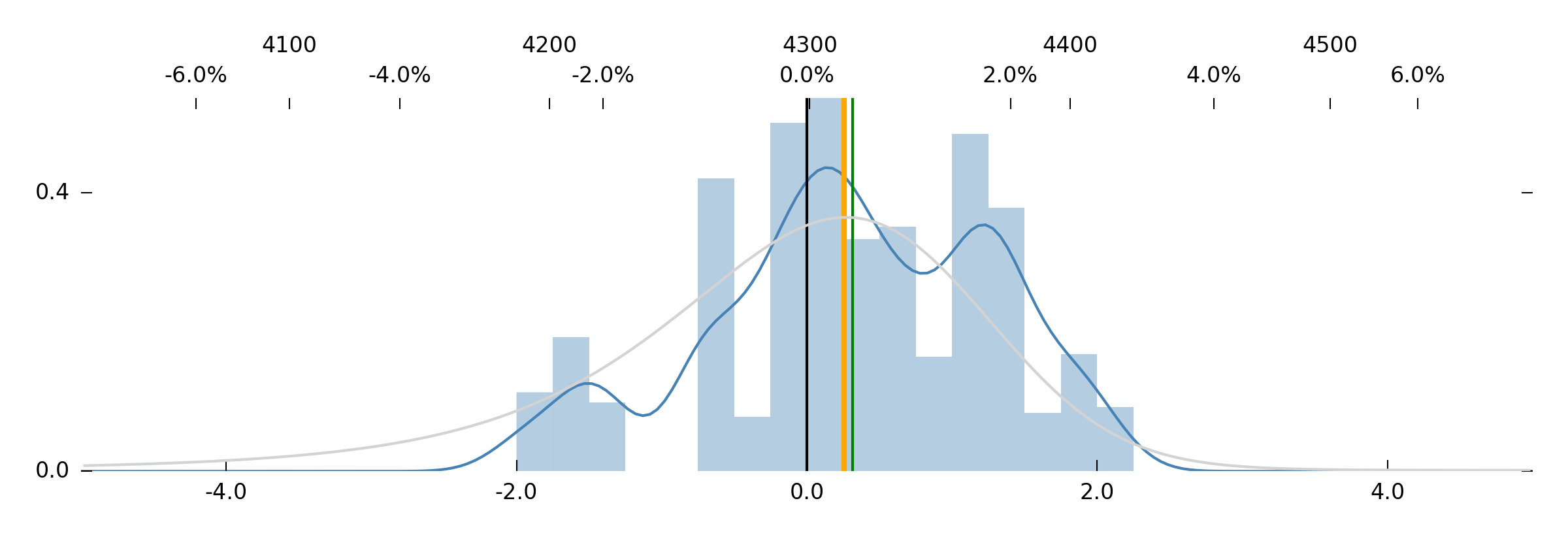
And hey, for what it's worth, Jim, in all his multidimensional silicon wisdom, doesn't disagree. There's a modest preference for stability and upside here, with an actual edge in betting on something like a 2.00% weekly return.
We must reiterate, though, as we blab about speculative long positions—this is still not a bull market. What we're strategizing about here is a squeeze, purely technical in nature, and liable to be quickly reversed if it occurs.
So for now, rest easy—this is all hypothetical. No big-picture item has changed (folks aren't buying puts yet). There's just an interesting technical setup appearing that we want to keep tabs on. Think about it.
Untradability
Storytime: In 2016, we started thinking about something that we called
"gamma exposure" (GEX). The idea was that, because of the cumulative impact of delta-hedges on the underlying, existing options—even those expiring a month or more away—would directly have an effect on the underlying price, its daily range, and its direction. We were particularly interested in this impact as related to the S&P 500, because it seemed to tell us a lot about the index, day-to-day.
GEX was not readily tradable. There was no way to say, "Ah, I think GEX will go down tomorrow, so I'll buy pure, 1-day gamma in order to bet on that." There were, at the time, Friday expirations on Cboe's SPX ("Weeklys"), and they weren't even all that popular. Among other things, an enterprising trader could, however, buy a next-Friday ATM put and delta-hedge it if he felt that gamma was underpriced, and that GEX was due to rise. Or, like we did, one could aggressively sell put spreads, betting that high GEX was going to keep things stable for the time being.
When Monday and Wednesday expirations were listed, the whole situation was supercharged. Now, with M, W, and F rolling expirations, something much closer to "pure gamma" was available to trade—and while it took a couple years for the prices/IVs of those near-term options to adjust to the reality of GEX (near-term option prices need to reflect the totality of delta-hedging needs of all existing longer-term inventory), they eventually did.
Here, GEX became closer to being "tradable." One could regularly buy or sell a 2-day option, and that 2-day option always had an "implied volatility" associated with it, which targeted a particular degree of expected movement in the underlying. Our "gamma-implied volatility" derivations, which predicted next-day volatility, were becoming less unique—the market now presented a measure, a tradable measure, of really short-term vol.
As liquidity and volume in near-term options steadily improved, the "measure" of gamma exposure and, implicitly, of short-term vol, became a readily-tradable "target." What used to be an everyday edge turned into something we could rely on less frequently. Our data "agreed" with the market more often. Eventually, by mid-2021, normal
people were even frontrunning OpEx by buying very short-dated puts, anticipating drops in GEX and subsequent increases in volatility. People were directly trading GEX. GEX was, obviously, quite tradable.
Now, here's the point: Our contention would be that, if there had hypothetically been no Monday, Wednesday, and Friday expirations—if options expired on every third Friday of the month and that's it—you'd still see a sustainted, notable edge in calculating S&P 500 GEX as a measure. And this is because buying or selling a 1-month option and delta-hedging it is a skilled, margin-intensive, and boring process that only a few people (like you, dear reader) are masochistic enough to participate in. What's more, you'd be accepting more than just the gamma risk you hoped to acquire (lots o' vega in there), and you'd be subjecting yourself to a messy, path-dependent PnL with low-frequency feedback (yuck).
This is what we mean by "untradable." There would be, in this idealized world of only monthly expiries, no way to actually trade GEX. You'd have to accept a whole bunch of slack in the process.
In the exact same way, the relationship between 1-month IV and 1-month RV (RISC) is untradable. If you go out into the market, sell a 1-month ATM call, and commit to a daily delta-hedge, there are tons of ways for your trade to go wrong, even if you're right. E.g., the 1-month call could imply 0.80% average daily moves, the index could subsequently realize 0.60% per day over the course of the month (you were right!), and you could still lose tons of money, depending, quite arbitrarily, on the path of underlying returns.
Nerds: Yeah, a volswap would come pretty close to solving this exact problem, but you're not finding any markets for volswaps out there, are you? Nor will you in a post-2008 world, until something rather dramatically changes about bank capital and regulation, etc., etc.
Compare this to the relationship between VIX and VIX futures. Sure, they don't track perfectly, but you can be quite sure that your VIX futures contract is going to converge upon, and settle to, the value of VIX at the time of expiration, and it's going to wiggle 1:1 with it as it gets closer. This is what makes VIX "tradable." It's going to, more or less, work as advertised. It's going to give you the exposure that it promises. It doesn't require you to jump through a thousand capital-intensive, brain-pretzeling delta-hedging hoops, only to be right about your trade and still lose money at the end of the month.
So, on the scale of "tradability," VIX (via futures) is much, much more tradable than RISC, and that's at least one big part of why RISC gives us a signal in the S&P 500 where VIX doesn't. Tradability matters a great deal!
Time for a metaphor: If an untradable measure is a tranquil mountain pond, perfectly reflecting the spruces at the far bank; a tradable measure is that same pond with a thousand diapered monkeys in motorboats, screeching and mashing on laptops and telephones, obscuring that once-still reflection. When a "measure becomes a target"—when a market-derived number becomes directly tradable—it's inevitably overrun with these monkeys.
That clear, alpine picture, that still reflection, is what we're always looking for—and it seems like you frequently find that reflection in the nearest natural abstraction of the tradable number. The next pond downstream. A place that's similar, nearby, related, or similarly descriptive, but not directly tradable. Somewhere without those monkeys.
Does that make sense?
Now, in light of all this, let's close with a half-baked thought: Before VIX became tradable, high S&P volatility was enough to offer an edge to anyone willing to "be greedy when others are fearful." Lots of wiggles in the price of SPX would scare people away, and would provide an opportunity for buyers. VIX futures (2004) subsequently made that volatility tradable, made that risk manageable, and eventually took away the signal.
But in 2006, something else happened that, actually, seems a bit different from this: VIX options were finally listed. VIX options aren't about implied volatility, but rather the volatility-of-implied-volatility In other words, "vol-of-vol."
So here's the question: In the same way that VIX futures themselves, by making IV tradable, pushed a signal into a more abstract form (RISC, the difference between RV and IV); did VIX options also, by making vol-of-IV tradable, push a signal from one place (comparably, the volatility of RV) to a more abstract form (like the difference between volatility of RV and volatility of IV)? In other words, is there a RISC, but for vol-of-vol instead of vol?
Not sure if that goes anywhere, but happy to hear thoughts.
In the meantime, enjoy the week!
The SqueezeMetrics Team