All the charts and data we refer to can be found on the Yacht Club page.
Hey everyone,
We feel bearish. In a mess of extraneous words, let's try to explain why.
One-week at-the-money SPX implied volatilities on this past Monday morning were something like 12.5%. That means that if you bought a straddle for Friday, you'd be betting that the weekly move would be in excess of "a distribution with a 1-year standard deviation of 12.5%."
To make this make more sense, we prefer to think in terms of the mean absolute deviation (MAD), which refers to the average (mean) instead of the standard deviation. So instead of saying that a 12.5 vols corresponds to a probability density with a weekly standard deviation of 1.76% by doing this math...
12.5% * sqrt(5/252) = 1.76%
...we prefer to "convert" to MAD by subsequently multiplying by the square root of two over pi, like this:
12.5% * sqrt(5/252) * sqrt(2/pi) = 1.40%
We prefer this because it gives us a more realistic idea of what's actually being priced by the market. A 12.5% IV corresponds to a weekly average move of 1.40%. I.e., a weekly average move of 1.40% is actually what's "implied" by the option prices themselves. So if you buy the straddle and the S&P 500 moves up or down more than 1.40% by the closing bell on Friday, you make some money. That's the cutoff.
Last weekend, we expressed that the big takeaway from the data was...
Taken together, the message from Jim's distribution appears to be, "be long vol."
...so the question that we should be answering as a retrospective this weekend is—did the S&P 500 move more than 1.40% on the week?
And the answer is yes. It went up 1.45%. Which is... not enough to make any money. So—failure.
But we're nonetheless going to tell you that we made some money this past week, and so let's be quite clear that the reason that we made some money was because we were leaning long delta with a strangle comprising a call leg that was nearer to spot than the put. This perhaps seemed rational based on our 1-week forecast distribution, which had the bulk of the probability differential somewhere up around SPX 5700. So it made sense to emphasize the long call and spend more money on it...
But SPX didn't make it to 5700, or any of the actually-OTM call strikes that would have been the natural choice if you were feeling "long vol." Indeed, it didn't even make it to 5650 (which we proposed as a good cheap call strike last Sunday). So how did our calls end up in-the-money, netting us a profit?
Because of cowardice. Because we struck them at 5600 instead of 5650, and for no other reason than we wanted a higher probability of success. We wanted to feel good.
And so, to recapitulate:
- We didn't make money because we were right about the magnitude of the move ("be long vol"). The magnitude of the weekly move was rather in-line with market expectations.
- We didn't make money because we were right about the probability density. The index didn't even make it to the region with the highest probability advantage.
Instead, we made money because we wanted to be "winners." Sissy cravenness. Pusillanimity. We made money because we simply chose an arbitrarily lower strike price for our "long gamma" bet so we'd have a better chance of making some money, because then we'd feel better.
Here's the thing—
We're trying to express to you, dear reader, that this is genuinely bad behavior. That we did something intellectually dishonest. And we genuinely believe that, in the long run, the market punishes people who are dishonest with themselves, and rewards those who are honest and consistent.
But it's still hard to express this to people, because it's really easy to say, "Look at the PnL. We did fine!" In case you haven't noticed, everyone forgives everything when the PnL line goes up. "Better lucky than good," etc. It's really tempting not to think about it when you do something wrong when it turns out fine. It seems excusable.
Why are we thinking about this?
Well, firstly because it's simply something that's worth thinking about per se, because if you're actually trying to consistently make money from the market, you can't be sloppy or inconsistent like this. You can't be timid and break your own rules. If you're playing for good feels and dopamine, the market will be happy to give you the dopamine you crave—but it won't give you long-term profitability at the same time. You have to want long-term profitability, for its own sake.
The second reason we're thinking about bad, weak, inconsistent, scared sissy feel-good behavior, though, is because we think this concept generalizes. I.e., that it extends from the personal, the individual; to the collective, the public. A common theme in our research inquiries and in our findings has been that selling tails is one such example of feel-good "bad behavior" on a broader scope, which leads the whole market into turmoil, and we could rationally place this kind of behavior inside of a broader taxonomy of collective-cowardly-wishful-thinking.
We recognize this cowardice only because sometimes we are intellectual cowards ourselves. And we mention feel-good cowardice right now because we're suspicious that the market, like us, is exhibiting a very basic form of it right now. Let's talk a bit more about that.
But first...
- T–5
- T+5
- "I don't know what all the fuss was about!"
T–5
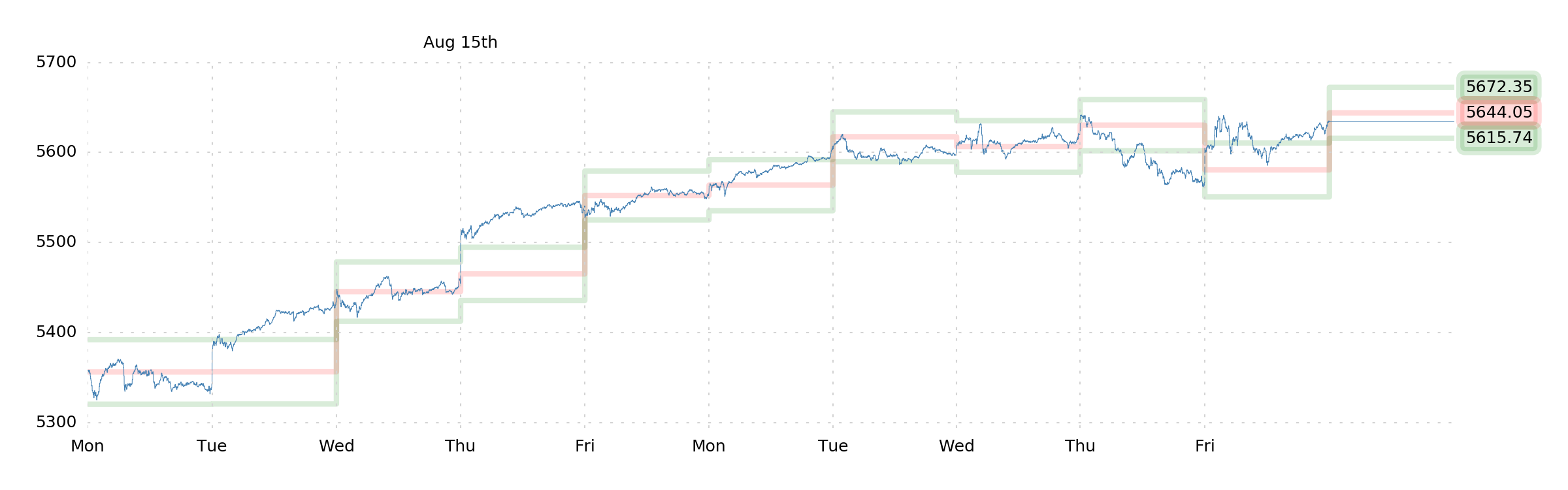
SPX was up a bit.
The most notable feature of the week, in retrospect, was that the OTM customer-bought 0DTE calls didn't "work." I.e., every time we got close to the point where dealers ought to have hedged their 0DTE short gamma by buying SPX, it got stifled. This isn't something we're accustomed to seeing, so we're not sure how to categorize it, but it seems symptomatic of "passive, organic selling above spot." A forest of patient limit-sell orders.
Robot Jim thought a run to SPX ~5700 was underpriced. There were a number of times we thought we'd make that journey, but it never happened.
T+5
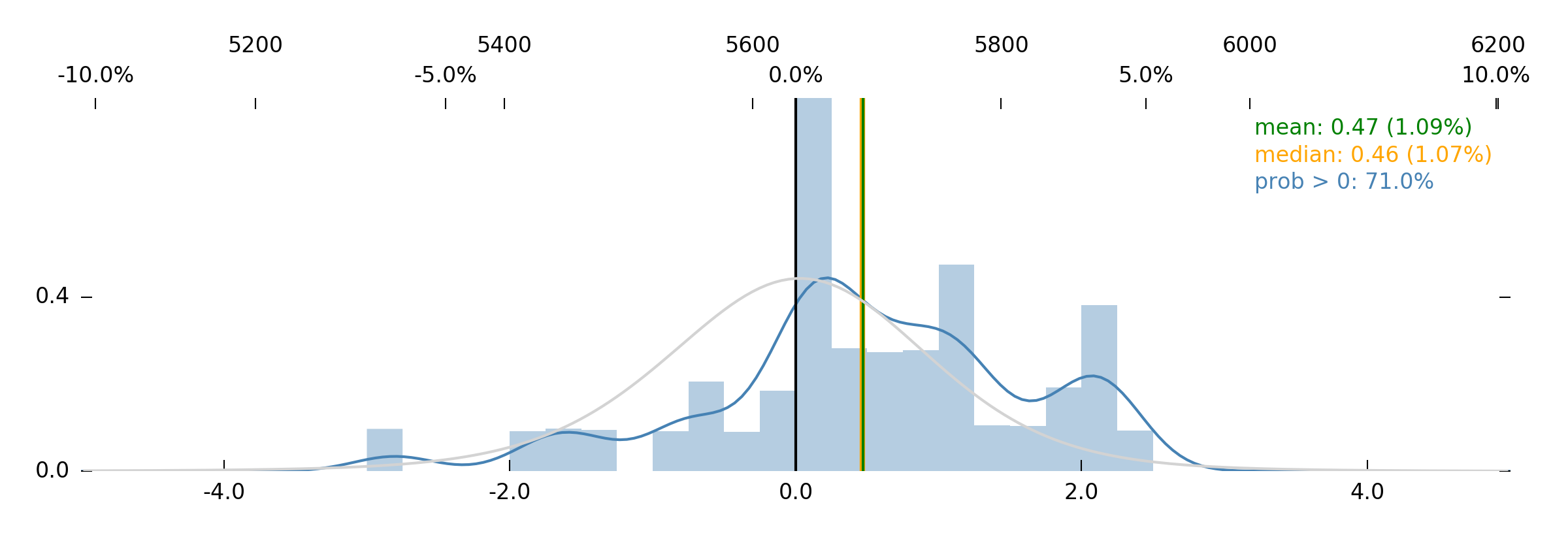
Jim is still very optimistic.
This is a classic bullish-momentum distribution. Probability of a loss is low (gain probability is 71%). Strong support or a rally are underpriced. The most notable region of the probability density is the +2.0 MAD return, which Jim thinks is underappreciated. Something like a long 5825 call option would seem to be in order if Jim is correct.
It's a cheap punt, so it's certainly worth considering. But we have divergent thoughts.
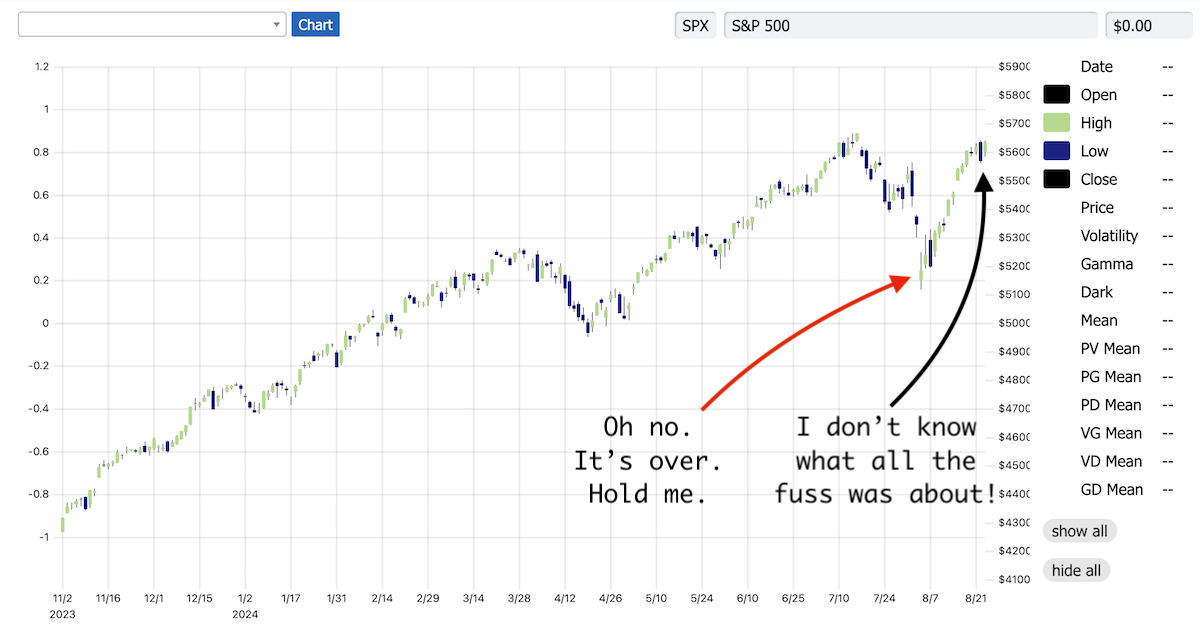
"I don't know what all the fuss was about!"
Last weekend, we talked all about VIX, and how it failed to function "properly" at the beginning of the month. Because at the beginning of the
"Recession!" selloff, VIX was 40 (too expensive) and two weeks later it was 14 (too cheap). Problematically, it didn't track S&P 500 realized volatility very well, which made it hard to justify using VIX / SPX vol as a hedge at any point. And then if you
did use vol as a hedge, you kinda got bamboozled.
We proposed that this kind of situation can result in de-grossing, since the sharp uptick in realized volatility compels a wide variety of asset-owners to lighten up exposure to stay within risk limits. There "should" be selling as a result.
Now, as you recall, our only real conclusion was that it was sensible to be "long vol/gamma," because while there was certainly some destabilizing influence here, it wasn't some kind of immediate risk. (Indeed, we went into the week net long delta.)
Subsequently, there was no evidence of de-grossing during the week (except, perhaps, for the failure of those 0DTE call ramps). Au contraire, there is only the evidence of a collective sigh of relief. Unclenching. We made it back to where we started. If you were caught on the wrong side of the "Recession!" move, you're now "breaking even."
And this is why we expect that there's been some "bad behavior"—some collective dishonest, cowardly feel-goodery. What we suspect is that folks held on through this rally less because they were comfortable being long with SPX RV pushing 1.00% per day, and more because they were, broadly speaking, unhedged against the sudden onset of recessionary data, and were unwilling to pay 40 VIX for the pleasure of acquiring a hedge at a bad time.
So they waited and crossed their fingers instead. They carried too much risk relative to what they should have, but they rode it out.
And it worked! Phew!
But now that we're butting up against all-time-highs again, with "Recession!" still in the back of our minds, and with a palpable sense of relief that we didn't get caught swimming naked—don't we asset managers now consider de-grossing after one of the most substantial upticks in realized volatility in recent years?
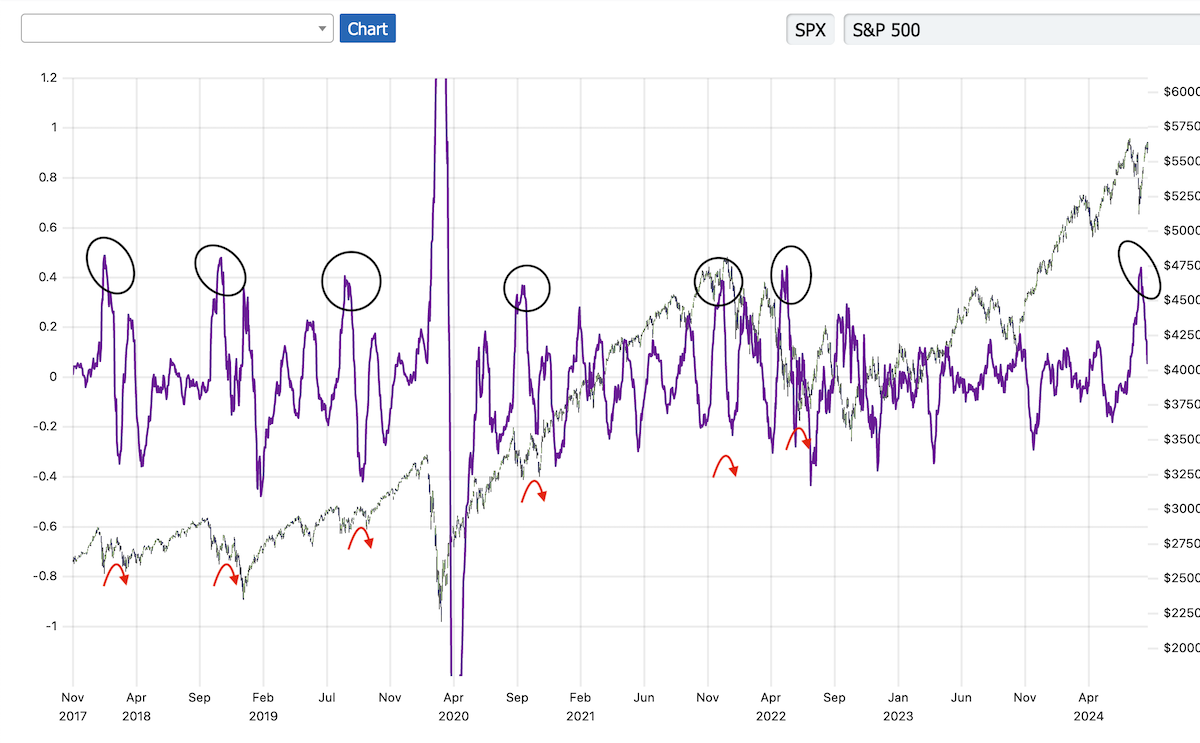
Seriously, pull up the
Chart of the SPX Volatility predictor. The rate of the increase in realized volatility was not only notable on its own—it's also historically associated with
unsustained rallies.
This phenomenon goes hand-in-hand with the reduced utility of VIX as a portfolio hedge against realized volatility, which is what we talked about last week (note that we're looking at more recent in the chart above, and not, e.g., pre-2015 data).
We suspect that this also betrays the "bad behavior" that we were talking about. In the absence of a VIX that "works," portfolio managers are more likely to clench their cheeks through the pop in realized volatility and degross later on. This is a pattern, it seems—and it's a sensible pattern when you understand that folks are having a hard time hedging, for which there is no ready solution (tangentially, we wondered last weekend if this was one reason Cboe is pushing variance futures again).
Should people be de-grossing on these upticks in realized? Yes. Their models tell them that they should be. But the irresponsible thing—holding through the volatility—has been working. They don't want to lock in the loss and incur high trading costs while doing so, so they quietly neglect to rein in the one variable they they're supposed to be controlling.
This is weak, inconsistent, scared, dishonest sissy coward behavior (very much like our own). They only do it because it feels better to hold on than to "sell at the lows." And that the pendulum should swing the other way once the fear has ostensibly subsided makes perfect sense. Do you believe in Karmic retribution, dear reader? A cosmic justice? A balance to the Universe?
(We don't either.) But we do believe that this spike in realized volatility, and this introduction of recessionary fears, is not over with—and nor has it been properly digested. With the reason being that it's exceptionally difficult for portfolio managers to hedge against that uptick in volatility, leading them to hold tight and de-gross later on.
And we're at that point right now.
Jim says stay long. For the first time in a long time, we're disagreeing outright. We want to own some SPX puts here.
If you want the best of both worlds, Jim is telling you that the "smart" bet is a melt-up to 5800. That possibility can be owned quite cheaply with a short-term call. But right now, we're more keen on getting into a 1-month+ OTM put position (5400?) that would benefit from some more mean-reversion in the S&P 500—this time to the downside.
Does this all make sense? tl:dr In the same way that we recognize that own cowardice and inconsistency is ultimately bad for our equity curve, we believe that broad-market cowardice and inconsistency is bad for the broad market's equity curve. And because of the failures of VIX [as a product] in recent years, we think asset managers have been playing a game of wishful thinking that's manifested, in this case, as prolonged rallies after suitably large increases in realized vol—which subsequently revert. That's where we are, and that's what we want to bet on.
Sorry for all the words, and enjoy the week!
The SqueezeMetrics Team