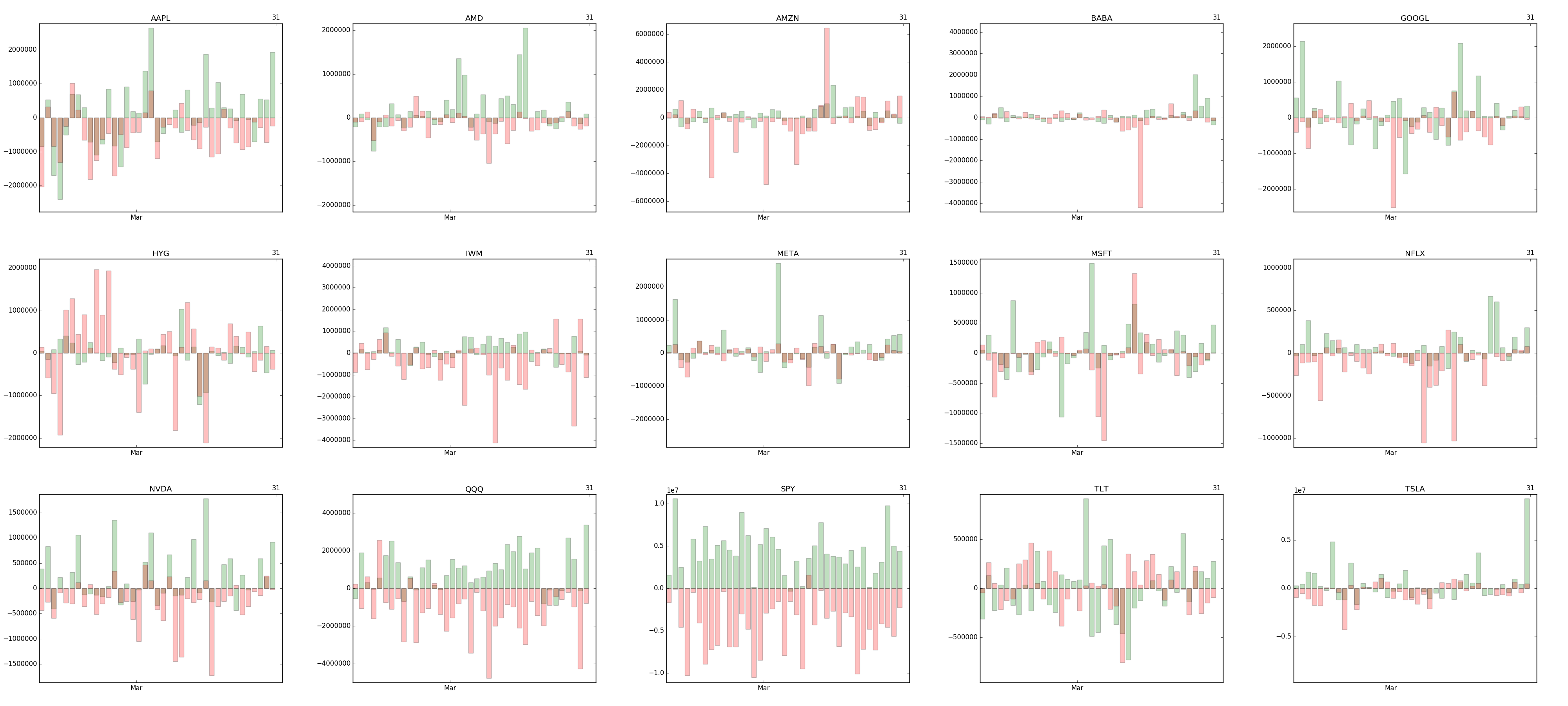
All the charts and data we refer to can be found on the Yacht Club page.
Hey everyone,
Let's keep it casual today.
First, let's pat ourselves on the back...
Way back on a Sunday at the end of January, we said we'd start getting bearish. The next Thursday (February 2nd), we turned that into "meaningful exposure," and we've been riding the bear train ever since, rolling short delta and long vega—relentlessly betting on SPX down and VIX up. As of today, the S&P has fallen 7.6% since February 2nd, and VIX has risen six points. So that's cool.
Now let's temper our conceit...
But this process took six weeks—largely owing to month-long FOMO bid for stocks (seen in DIX), which was a longer and stronger bid [and stupider] than we anticipated. We paid for the privilege of holding SPX puts this whole time. Worth it? Yes. But it wasn't clever or exciting or glamorous or super-profitable or anything like that—it was a slog and we did not enjoy it. And if you were in the same boat, you probably didn't enjoy it either.
Now what?
We're talking about this trade as if it's over—but it's not over. It's definitely changed, though, and that's what we need to address this week. Let's start with just enough background, then let's introduce the new circumstances.
So
the idea is that ever since yields went up last year (to around 4.50% on Treasury bonds), a lot of investors gave up on holding stocks, bought some yield, and started constructing "positive-carry, positive-convexity" payouts in the S&P using SPX options (short put, long call). We called this an "
ego-hedge." Whoever does it remains blameless in the eyes of their investors (they don't miss out on a big SPX rally and they don't lose money waiting). Of course, the net consequences for the S&P are big, choppy ranges and an overall bearish bias—since to the extent that selling puts and buying calls is even bullish, it's a
"mincing bullishness; a fleeting, nihilistic, non-committal bullishness that will run scared if things don't turn out well."
In keeping with this, the idea is that if Treasury bonds approach those yields
again (which people were generally unprepared for, given the dominant "un-flation" narrative and MOVE dropping below 100), you initially get the same correlation from stocks (stocks go down with bonds), but eventually, stocks get the raw end of the deal—because given another opportunity, people (think defined-benefit plans and anyone with similar mandates) give up and sell stock to buy more of that juicy yield. Hence, we expected to see a "
big, deep bid" for that yield and a stock-bond correlation break as stocks get ignored or sold. Bonds up, stocks down.
This actually happened for the first time on Friday. SPX was –1.45%, TLT was +3.45%. But this happened when 20-year T-bonds were yielding just over 4.00%, and had recently been yielding 4.24%. It never made it to 4.50%, where that "big, deep bid" theoretically sat.
The reason it never made it there was that people got spooked by a narratively significant high-profile bank insolvency on Friday (Silicon Valley Bank)—the bank itself a victim of the same hopeful "un-flation" narrative. And so, a legitimate but vague fear of contagion took over, and folks instinctively bought VIX calls and TLT.
Has this situation made yield more desirable? Is this a true risk-off signal for people? Does this mean our 4.50% yield target is being frontrun? Or, alternately, will all of this concern evaporate if the FDIC cleans up the blood by the end of next week and the Fed decides to hike only 0.25% and somehow simultaneously assuage all our fears about uncontrollable inflation and perpetually high rates?
Let's stay in our lane.
Last time we talked Strategy, we had a three-step process all laid out.
First, SPX falls with bonds (which happened over the past couple weeks). Second, the correlation breaks as folks favor the yield (which happened Friday). Third, those ego-hedgers and their sold puts end up getting squeezed as their buy-the-dip-by-selling-puts strategy starts generating unexpected losses, demanding that those puts be rolled for a loss—thus pumping more, desperate negative deltas into the S&P.
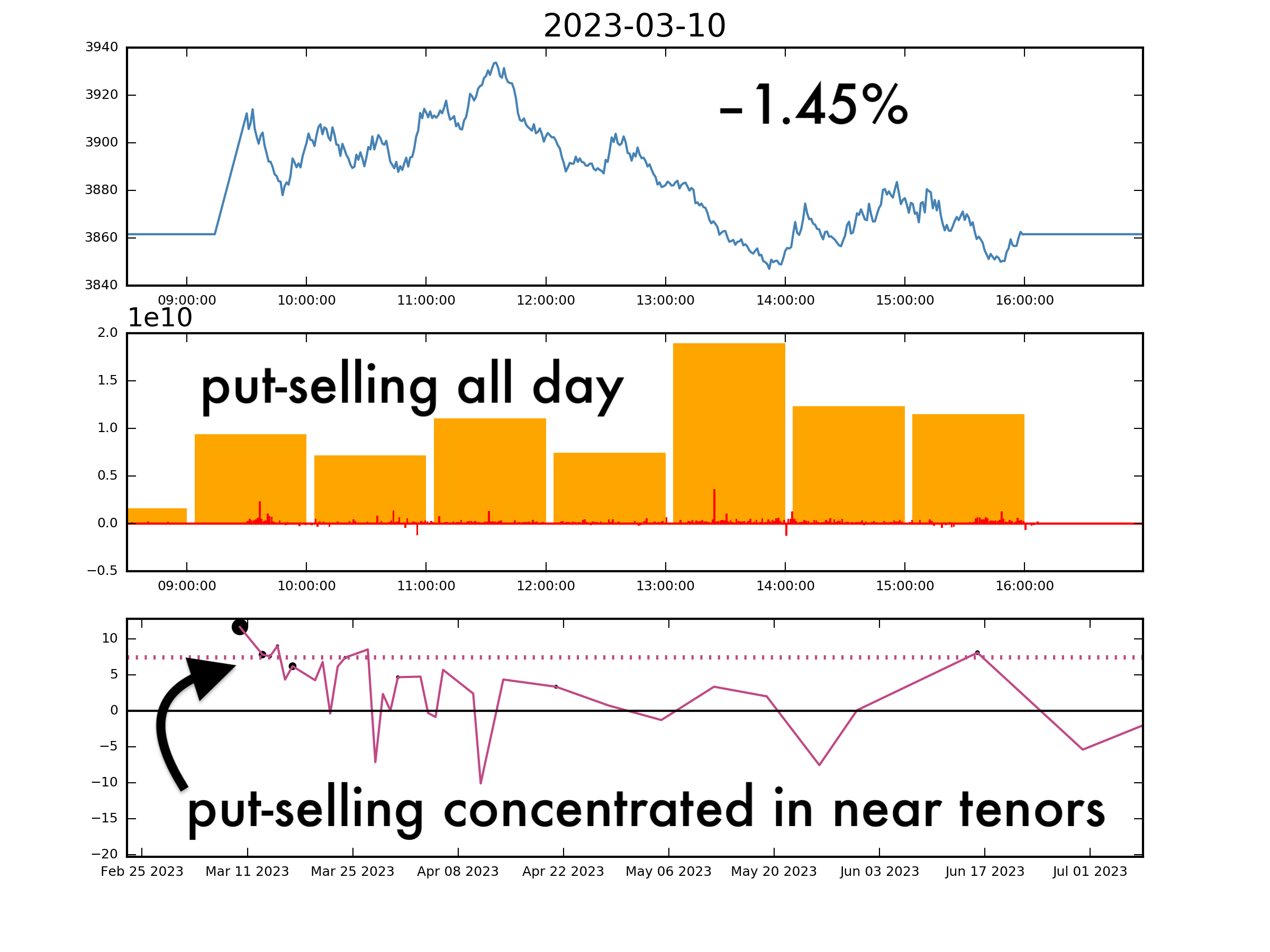
This last part is on deck right now. It's on the verge of happening. But the put-sellers are fighting the good fight. Friday looked like this.
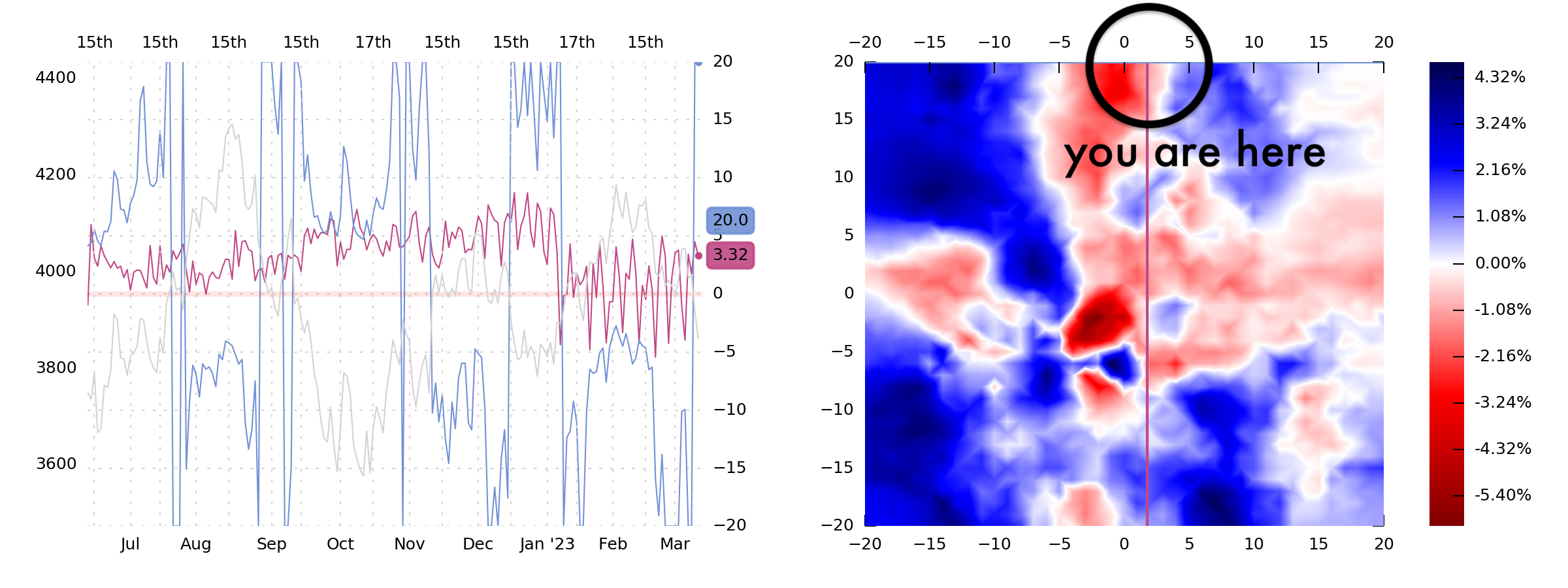
That summed up to an NPD of +3.32 for Friday. Which comes after an NPD of +4.50 on Thursday. That's right, the S&P went down 3.27% over two days and put-sellers bought the dip the whole way down. This is a pretty exceptional situation, in that there is currently a historically unprecedented number of near-term expirations, and customers are net short puts on all of them. That hurts right now, and there's no sign that they've capitulated at all.
To make matters worse, VGR is now +20. This means that, writ large, customers are positioned poorly. I.e., they are very exposed to vanna, and if vols continue to rise, they're very much caught on the wrong side of it. If VIX goes up more, the deltas of sold OTM puts will rise suddenly and unexpectedly, in a way that cannot be hedged by buying or selling the underlying. Customers will be strongly compelled to cut or roll their sold put positions—a particularly painful form of forced selling.
This is exactly the sort of situation that inevitably occurs when customers are confidently selling puts for a while. And now that we've had two days of unpleasant MTM losses for put-sellers (coming from both delta and vega), it is very believable that an unwind begins in the event of more S&P downside. A squeeze, really.
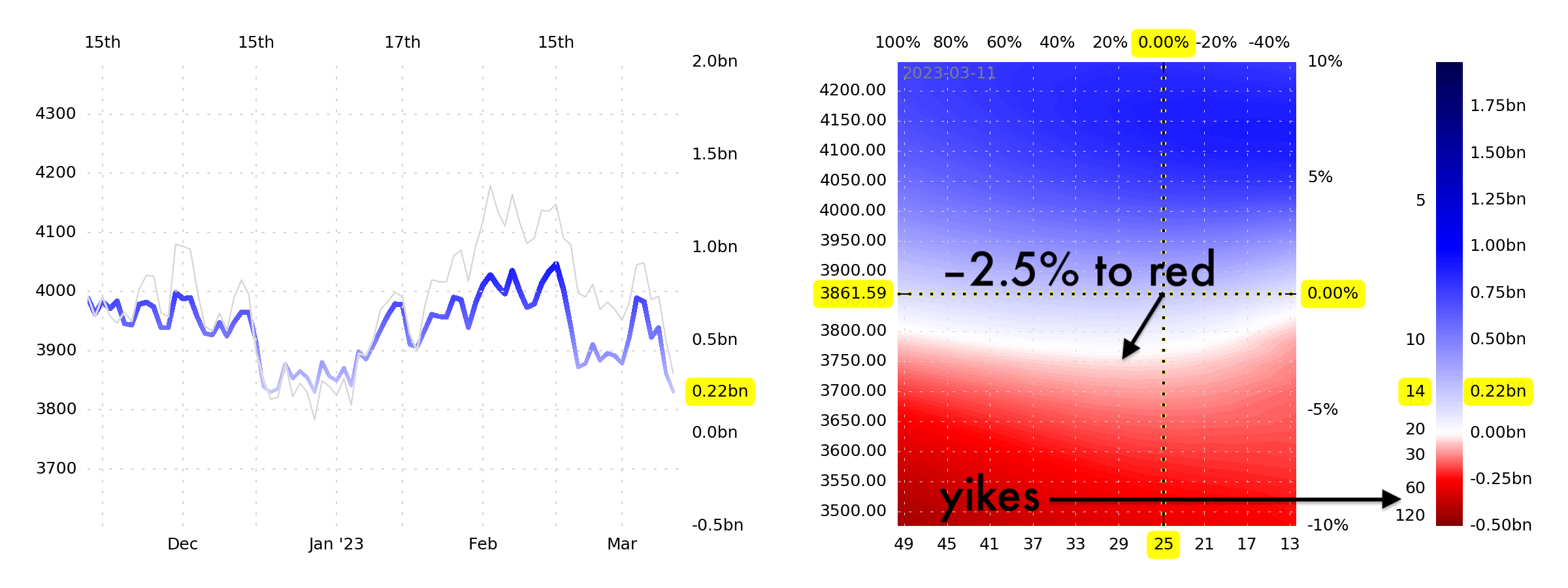
And if you want things to get really hairy, understand that GEX+ is right now on the verge of generating sustained high volatility, making all of the above even worse.
Incremental SPX losses below 3750 would be guaranteed to be volatile owing to dealer positioning, and liquidity would rapidly dry up the lower the index falls.
This is essentially why we've been neutral to bearish for over a year now. When customers sell puts, this is what happens. This danger is always lurking. Like we said at the
beginning of 2023:
For us, this all adds up to (A) a bearish bias (if you want a bull market again, you need people to buy puts), (B) a keen awareness of lurking Crash Risk (it's nearby), and (C) a strong preference for long volatility positions (long calls, long puts, long strangles).
Scary stuff, right?
Now take a deep breath.
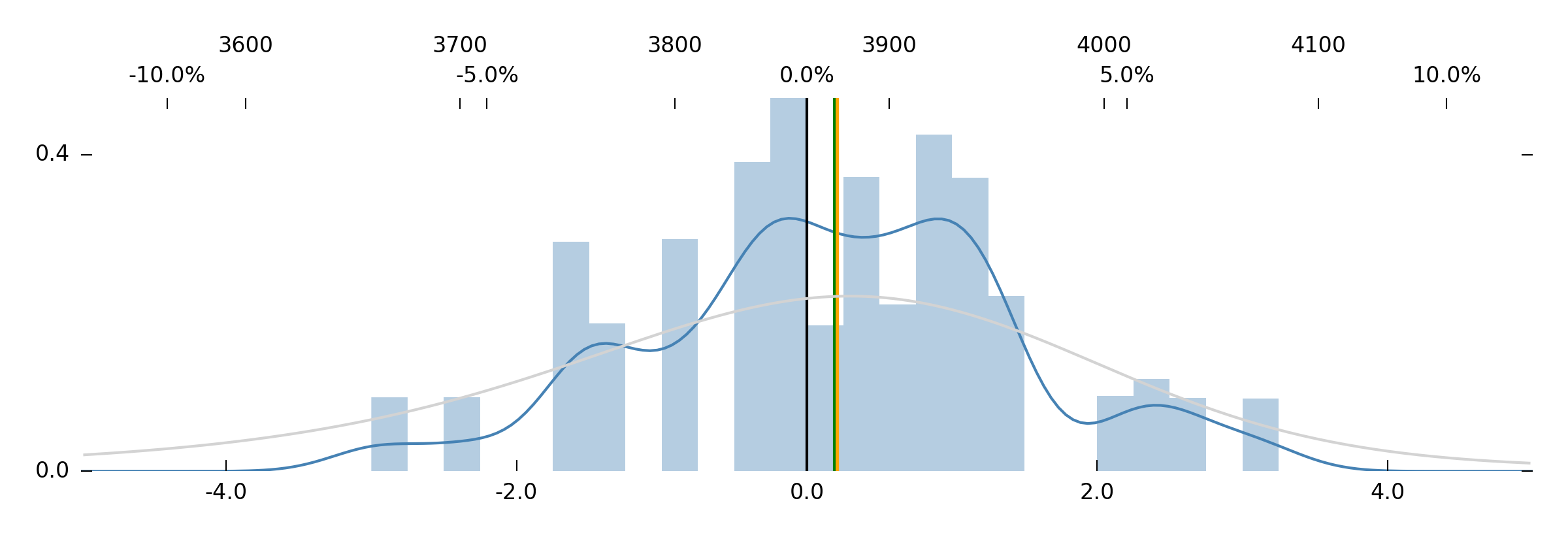
This is what Robot Jim's 1-week distribution looks like right now:
This is hardly bullish, especially given the circumstances, but it does have one notable feature—Jim clearly thinks volatility is overstated.
We mentioned 3850 as a sort of SPX "target" many times in the past couple weeks, as it's where Jim said we had an edge in betting on a decline. And so, even when Jim's mean expected return was 0%, there was frequently an edge in betting on a run down to 3850.
Well, we finally made it there. So, how much more aggressive should we be? Jim is expressly of the opinion that volatility doesn't naturally expand from here (see above that the market's implied left tail is way fatter than Jim's), so betting with a long option doesn't seem like the right idea—despite all of the doom and gloom we just expounded on above.
You may object, here, that our bearishness over the past six weeks has been mostly discretionary—and that while Jim hasn't expressly disagreed with us most of the time, nor did he agree. So why would we start listening to Jim now, after all this time?
By no means do we wish to contradict any of the put-seller-squeeze stuff, which is a very proximate risk (and let's clarify that it has nothing to do with 0DTEs!)—but our guess, all the same, is that this particular bank-run scare is founded on incomplete information and boosted by narrative power. In reality, depositors seem likely to be made whole, or nearly so, and the FDIC is probably going to do a bang-up job of restoring confidence in short order. Thus, it seems likely that some of Friday's action should mean-revert this week—and if it does, then the immediate risk of put-seller squeezing is mollified.
Temporarily mollified, anyway. Because realistically, nothing about positioning, or sentiment, or circumstances will change when the Silicon Valley Bank collapse is no longer a headline. The only difference will be a continuing, low-grade fear of contagion—of heretofore underappreciated higher-for-longer rate risk cropping up elsewhere. "Cockroach theory."
So our guess is that Jim is right. Volatility underperforms this week. VIX falls. The FDIC assuages our immediate collective fears. But all the while, the real risk persists.
Early on Friday, we rolled our St. Patty's Day puts out to April. We took some profit on that position, but we anticipate a near future where we re-up that put exposure once again.
We've held our breath for the last six weeks. But right now, we can take a moment to breathe and look around—go for a stroll. Though it's not quite weather for drinks on the veranda yet.
Strategy stays the same. Enjoy the week!
Addendum: A desperate-looking joint press release just dropped from Treasury/Fed/FDIC that's purporting to support depositors and plug banks' duration holes by offering a new type of liquidity swap window thingy—basically letting banks borrow against an inflated value of longer-term bonds. Seems inflationary. Seems politically problematic, might come under fire (and that would be terrible if it did). But also seems clever, because it totally negates the dilemma the FOMC had in choosing between hiking (and endangering banks) and neglecting to hike (letting inflation burn). This seems to make a 0.50% hike more likely on the 22nd. This also, in our opinion, looks pretty bad, because any impression that SVB was a "small fire" that could be resolved by FDIC alone (which is what we assumed they would go for) has now been made narratively impossible. Implicitly, this is a big fire. Our guess is that this just draws the timeline up. E-minis are rallying (+1.40%) and we should get some immediate stability. But now the after-effects look even worse.
Other stuff:
- Want to look at single-name flows? Do so. NFLX and NVDA should be able to get some turbo-beta off of those recent put-buys!
- We turned up the dial to 11 on our science project, and we've now lost $10,000 in our "Degen Science" portfolio. We've bought a whole lot of deep OTM options, and, well, we haven't hit any home runs. Let's see if we hit one or run out of money first.
- The 0DTE dealer hedging situation has $100mm sold by dealers on the way up to SPX 4000. This is coming from customer-sold puts, and it fights against a relief rally.
Stay safe out there!
The SqueezeMetrics Team