Hey everyone,
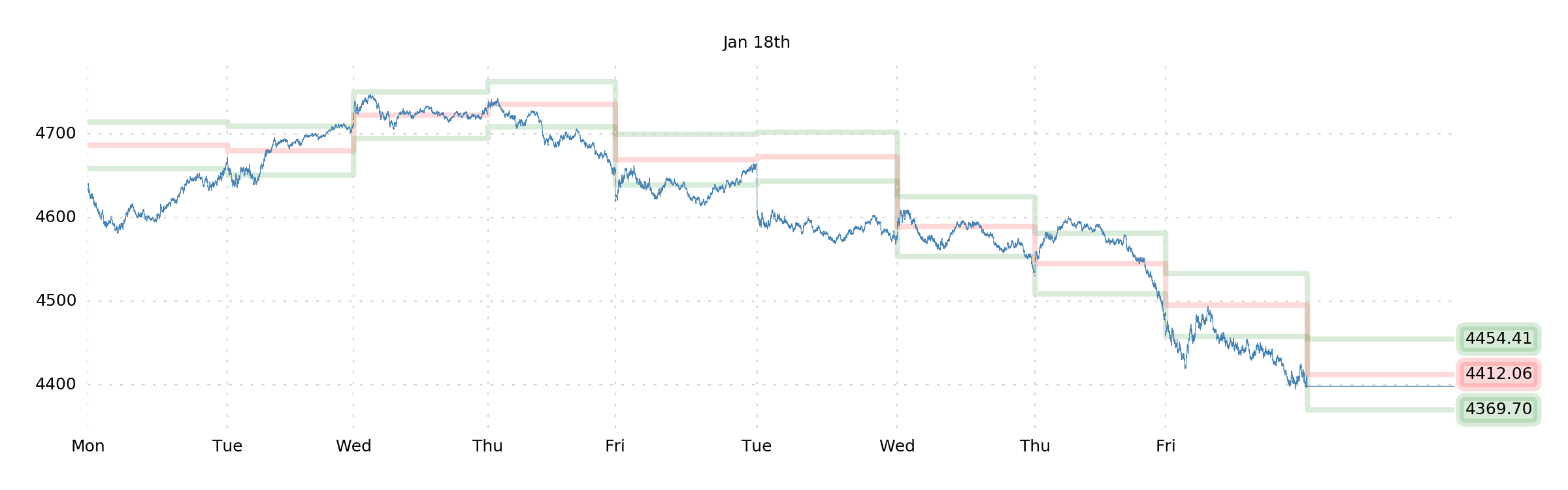
Oh, that was frustrating. Sure, we expected the market to move in "broad swaths," we expected a "choppy, directionless market," and we expected the "transient" bid to evaporate in the event of any upside. We've been harping on all that for a month now.
What we still did not expect was a relentless grind downward all week.
And to add insult to injury, this is exactly what we were positioned for last week!
This time, we just ended up with a long E-minis position about 150 points higher than the Friday close. That hurts.
But pain is how we, um, grow, or something like that. So let's use this opportunity to take a step back, and to place ourselves in the context of not only the data, but also of those large, amorphous and irrational human forces that—try as we might—we'd be fools to try to quantify.
- Little picture
- Big picture
Little Picture
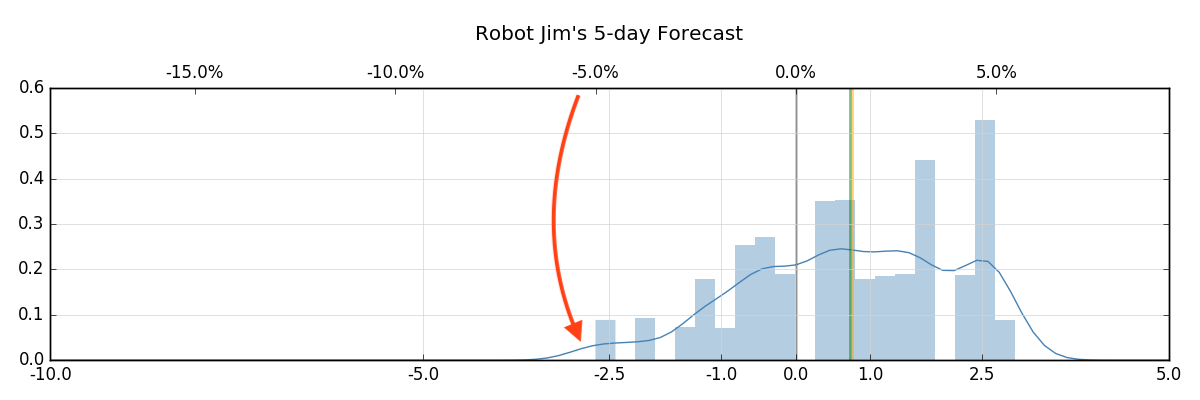
This week deserves the "You Are Here" arrow drawn on last weekend's forecast.
This is a tough break, because when we position ourselves, we do so with respect to the maximum expected loss. I.e., "If the worst were to happen, would we still be solvent?" that loss actually ought to be a tough break for the portfolio—or else we're doing it wrong (not taking enough risk). So this ~2% probability event was indeed a tough one, as it ought to be.
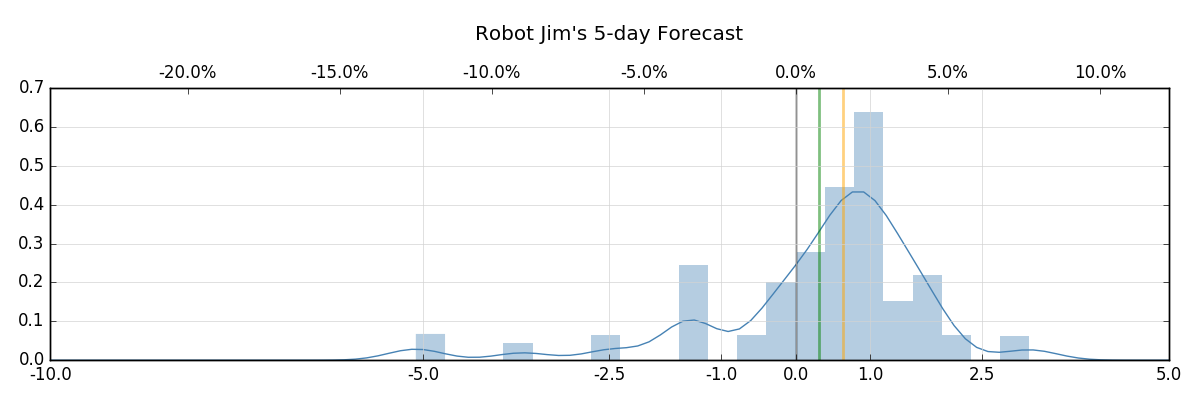
Let's follow that up straightaway with Jim's current 1-week forecast.
The shape is markedly different. Whereas last weekend still strongly featured the characteristics of a market dominated by chop and poor customer positioning (the distribution was flat-topped [platykurtic] and broad-shouldered), this weekend shows us something much more conventional: Strong left-skewedness, and a more "normal" peak.
Nerd Note: As a general rule, if the kernel-density-estimated probability density [blue line] peaks at 0.4 on the y-axis, that's a distribution that's more Gaussian in nature [normal, mesokurtic]. If the peak is lower, that's flat-topped [platykurtic], and if it's higher, that's, er, pointy [leptokurtic]. Note that last weekend was at 0.25—platykurtic.
Being that the whole point of being long E-minis last week was that we knew we could withstand a 5% decline, and it was worth taking that risk for the strong mean and median return—seeing the left-skewed distribution this weekend makes us want to get the heck out of any linear long instrument (and any uncapped short volatility or variance).
So you can be sure that we're going to be getting out of our long ES position, and swapping it for something fixed-risk (ATM calls, call spreads?) that gives us a similar delta exposure, but without incurring the left tail.
Next question: Why is the left tail there at all?
For the last week, there was no left tail in the data. That's because, on a day-to-day basis, there was going to be enough liquidity coming from both the reasonable passive bid coming from DIX, as well as from the reasonable passive bid coming from GEX+. Not only were there a normal to [relatively] large number of buyers of S&P 500 stocks (DIX), but also, SPX dealers were compelled to keep buying into declines (GEX+).
Now, after less-compelling DIX prints on Thursday and Friday (~43%), and after GEX+ has actually made its way to zero...
...a lot of that guaranteed bid disappears. The fact that price relentlessly plowed through that large and persistent passive bid, eroding it to this extent—is really quite remarkable. But that's more something to talk about in the "Big Picture" subheading.
Meanwhile, as the passive bid of GEX+ disappears, and as DIX gives up a bit of strength, other forces become more prominent, like NPD and VGR.
And you'll note that NPD/VGR doesn't have a balmy forecast (and hasn't for a while now). So when we see that Robot Jim, in his forecasted distribution, has sampled at least three unique historical events with 6-12% weekly drawdowns from here, well, that's why.
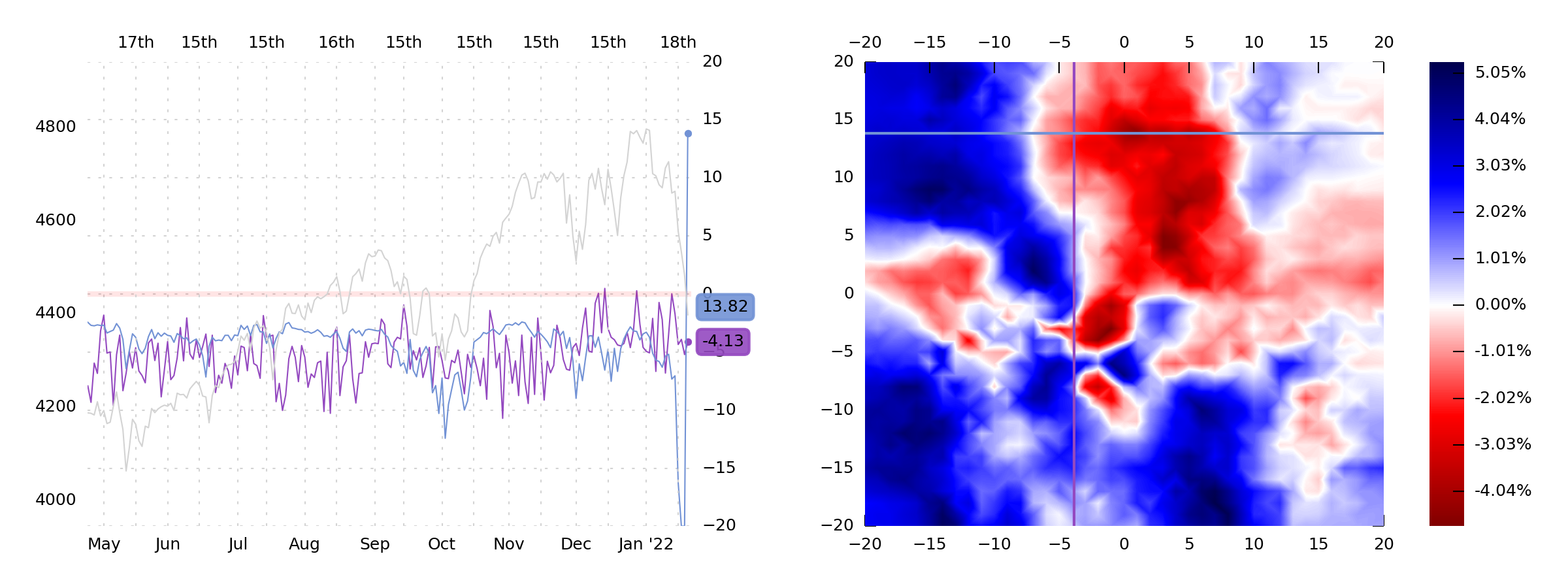
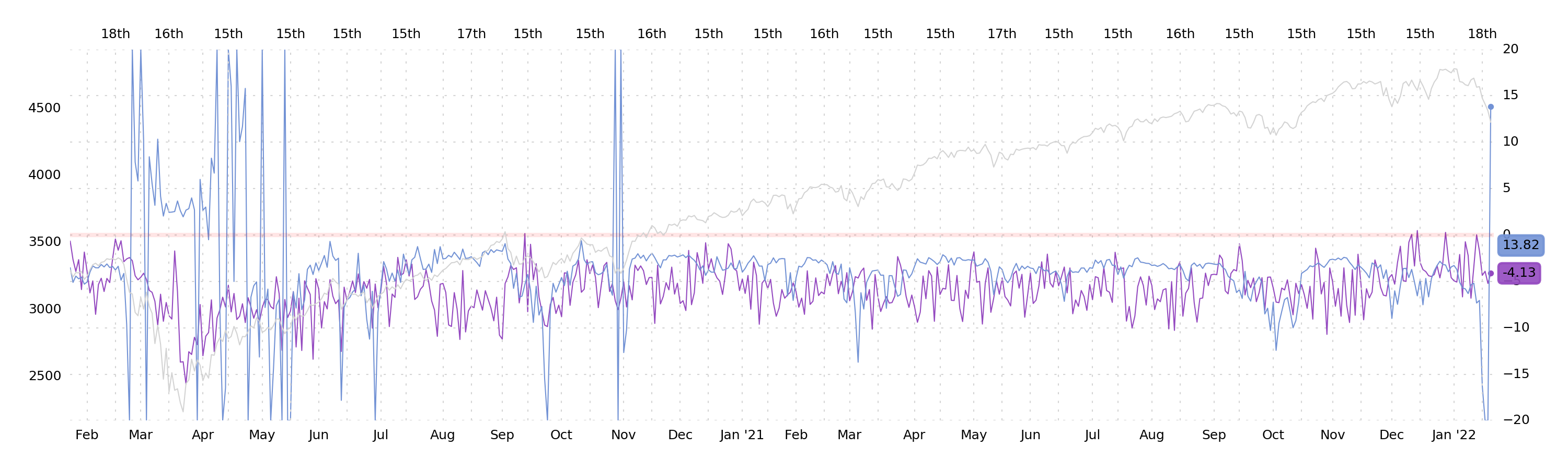
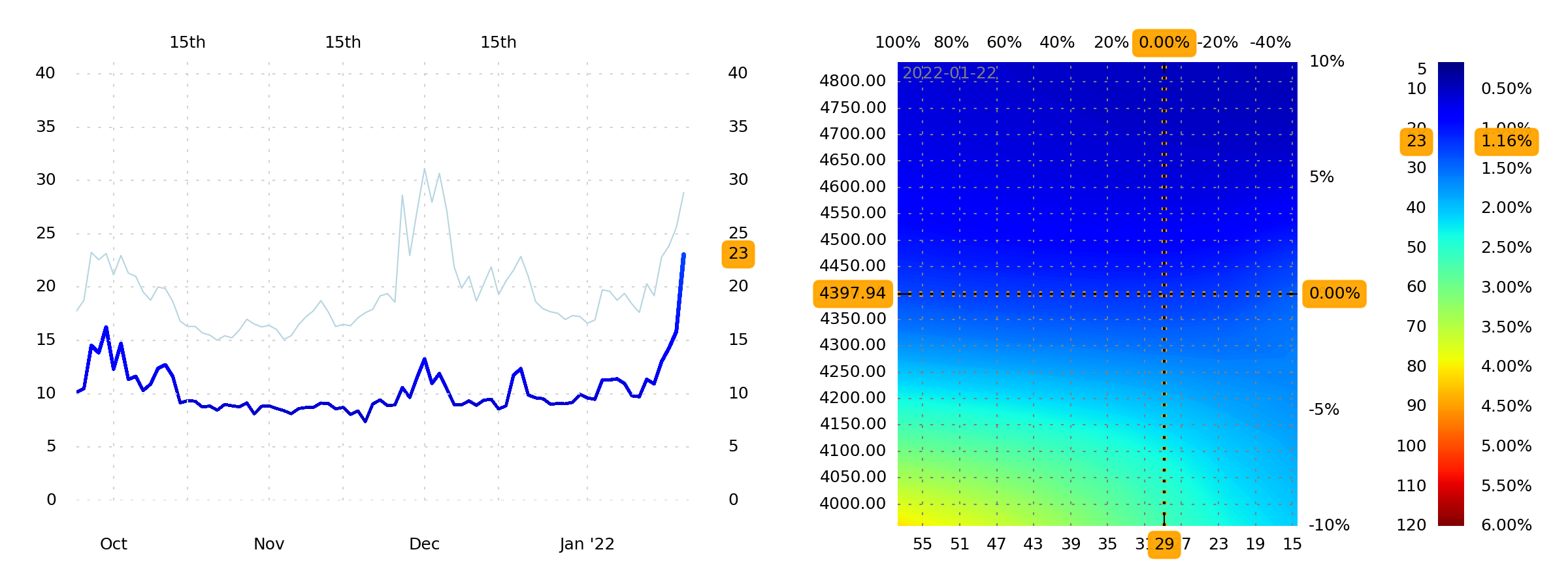
A word on VGR (which is at +13.82): A positive VGR means that customers actually have more vanna risk than gamma risk (unusual). As such, everything is very touchy. Changes in IVs actually have a greater impact on delta risk than comparable changes in spot price.
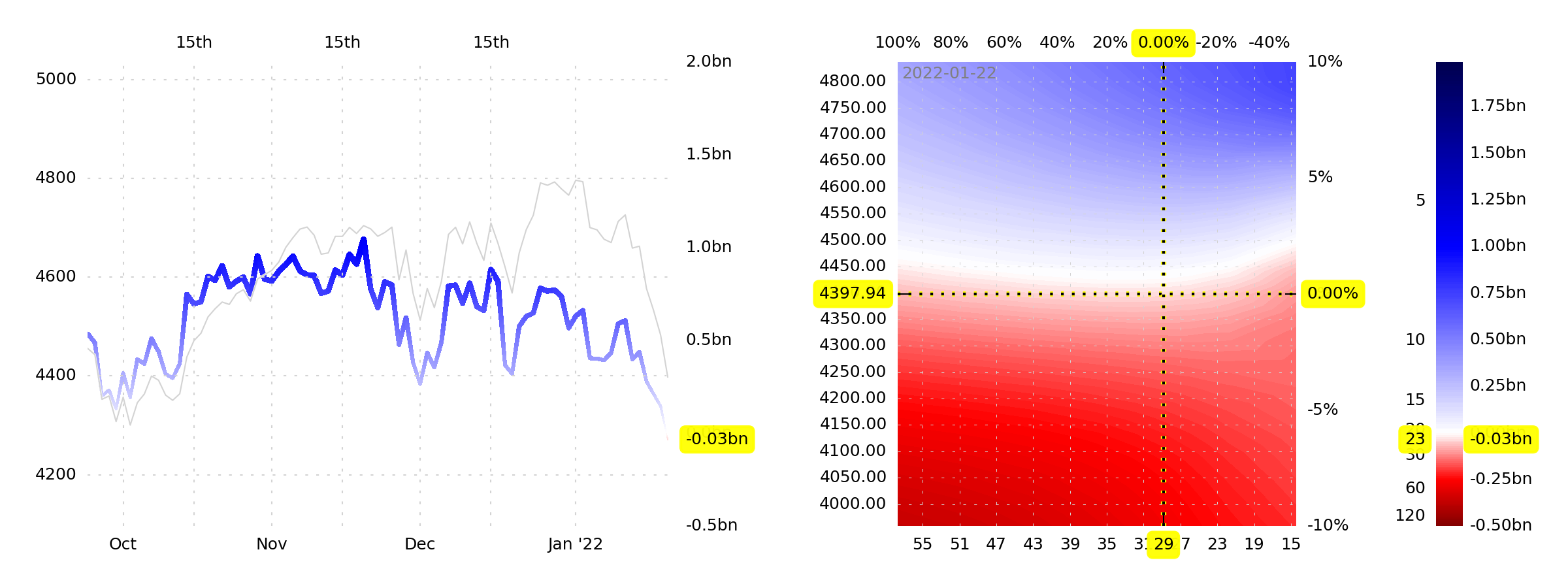
Historically, this has led to situations where the importance of NPD is magnified. You can see this in the heatmap. But also, if you look at NPD/VGR through the March 2020 crash, you'll note that when NPD indicated some decent net put-buying was occurring, that's when pure "long vol" positions really stopped working; and when NPD finally indicated huge put-buying was occurring (NPD -15), that's when things totally stabilized for SPX.
This isn't to say that we need tons of put-buying to get SPX to realize some upside—far from it. Robot Jim is very clear that historically similar events still favored nearly +2.00% median returns over the following week, and that's data from 2004 to present. But, as we've saying for over a month now, put-buying would still be a big, big deal for the bulls. Alas.
Two more things to mention: (A) Crash Risk, and (B) what GIV means for positioning.
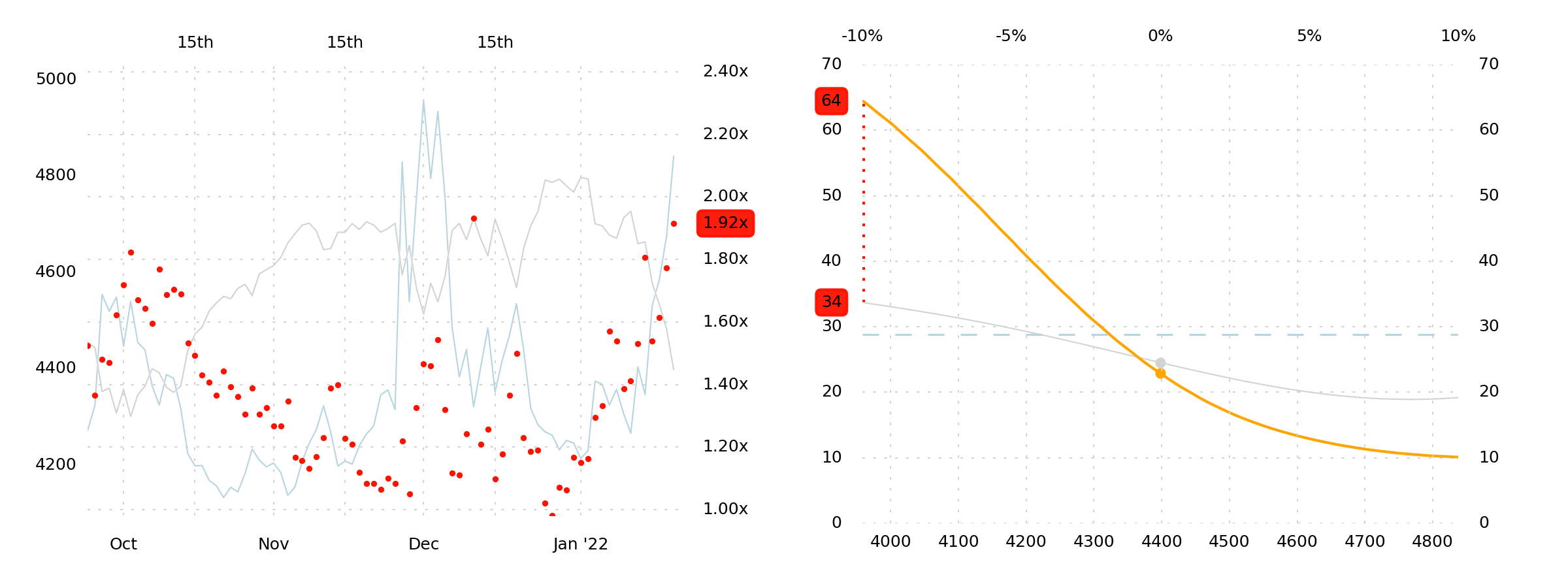
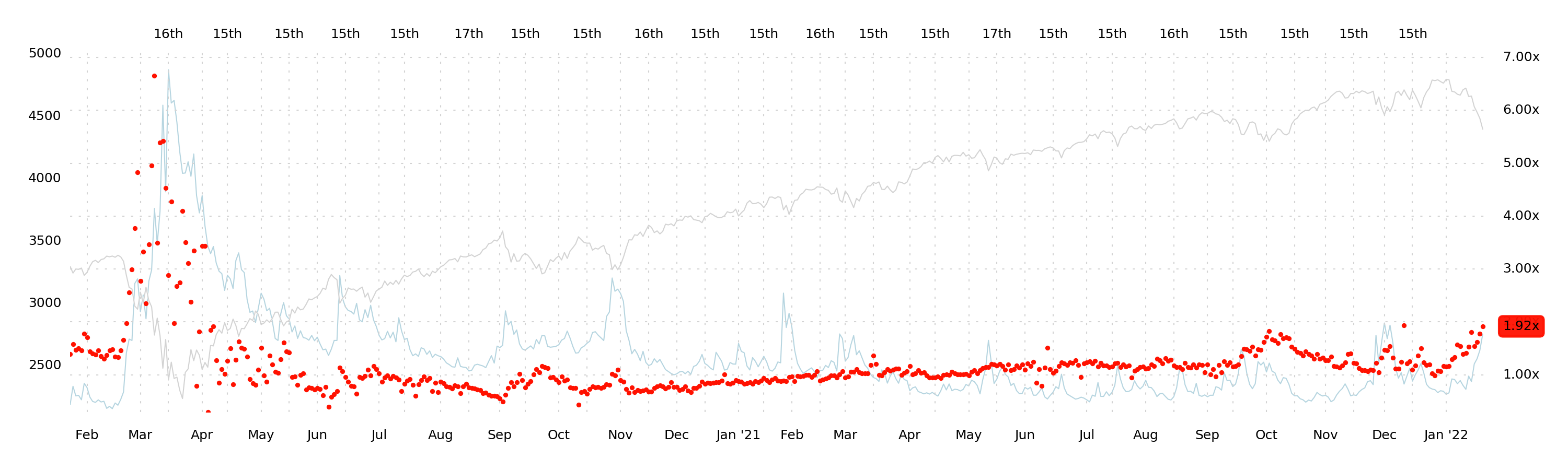
Regarding crash risk: There isn't any. Right now, CR(x) is around 2.00x.
(A) 2.00x is what Crash Risk should be in a healthy market. It means that dealer positioning with respect to left tail risk, and the price of left tail risk itself, are aligned. When Crash Risk is 3.00x or more, that means that the left tail is getting to be underpriced (which happened right after the first leg down of the Covid Crash).
So, we're not there. There's no possibility of a cascading vanna-induced selloff—which means there's no crash in the cards. And that probably obviates concerns about the most violent left-tail events that Jim sees. This is important.
(B) However, just because that left tail doesn't have any evil intentions doesn't mean that at-the-money volatility is overpriced, and that we should all be selling volatility.
Right now, GIV is around 23, and 1-month ATM IVs are
about the same (VIX a bit under 30). Compare this to the beginning of December (left plot), when GIV was 13, VIX was 30.
Back then, we were short as many VIX futures as we could get our hands on.
This is not a time to be short volatility. And while we've been saying that repeatedly for over a month now (thanks to NPD), it really stands out at this moment, with GEX+ shouting it in our ears. The upshot is that it's actually a pretty great time to limit risk by being long options. First of all, that naturally protects us from convexity, and second, it's pretty fairly priced right now.
So our thoughts above about being long ATM calls makes quite a lot of sense in this context: If the trade doesn't work, the risk is precisely fixed; if it does work, it was worth paying the very reasonable premium. (And one can leg into a call spread very easily if it becomes preferable.)
That was a big section on the Little Picture. Now let's say a little bit about the Big Picture.
Big Picture
The Big Picture is necessarily subjective, and hand-wavey. Maybe to some people who are more qualified, that's not true; but for us, anything mushy is mushy. We don't build long or short positions on subjective mush.
Now, if you look back to the last time we used the word "subjective" in a Sunday note (a rare occurrence), you'll arrive at
10/31 (SPX 4600), where we aired our suspicions about upcoming returns:
But... if you'll allow it, we'd like to inject a bit of unusually subjective color-commentary here: Things feel very odd right now. Some of that has to do with the composition of our data, sure (Friday had very little put-buying again, VGR is fairly unstable, high GEX+ appears to be enforcing anticorrelation among component stocks/sectors [making you wonder what they'd be doing without SPX GEX], etc.), but there's more than that.
For the first time since the pandemic, a feeling of foreboding seems to be setting in. The sense that some things are subtly breaking. As degenerate equity and equity vol traders, we try to stay away from the big-picture philosophizing and the macro blabber and to keep thoughts on a weekly timeframe—but sometimes it's hard to ignore the mood coming from the rates nerds and other people who use words like "economy" and "central bank."
So despite the fact that GEX+ is $830bn right now, and that everyone is still slinging call options in Tesla, and everything seems just peachy in stonk land, it seems like a good time to remember that stocks can, and do, go down.
Again, this was nothing scientific—just feel. But it was this feel that actually motivated us to make the final leap toward getting PIVT / Robot Jim working in single-stocks. It seemed pretty unlikely that raw S&P 500 returns would be easy in 2022, so we wanted to have a sensible way to approach things from a more market-neutral (whether stock- or sector-based) perspective.
Anecdotally, this approach, this past week, was wonderful, since stocks like SNAP, ROKU, LIT, NOVA, and ARKF (which are still on the Research page now), were singled out as good shorts. So, cheers to Robot Jim on that, at least.
But anyway, our whole Big-Picture thesis here is extremely conventional: That the fundamentally cynical, hopeless call-buying frenzy in equities (the same hopeless cynicism that drives crypto) just doesn't survive in a higher-rate environment—or even in the threat of one. We're not confident in this thesis at all, but it's sensible, and it's also a widely held belief—which makes it more likely to occur (but then also, at the same time, more likely to be spectacularly wrong if everyone positions for it).
Does this translate into a crash for equities? No. If anything, it's a gentle, fuzzy bear market—a relatively slow deflating of a speculative bubble, punctuated by true deleveraging events like this past week. In the same way that an OTM call option gradually loses value, and delta, as time passes, any asset or business that was "valued as a call option" over the past year gets its air slowly let out.
This possibility is pretty exciting for people who pay attention to markets—because these are the years when the "active manager" earns his keep. (The rest of the time, he just tweets angry stuff about valuations.)
So let's take on this unique market, at this historical juncture, with a warm, fuzzy disposition.
Armed with hot cocoa by the fire. And long ATM SPX calls.
The SqueezeMetrics Team